
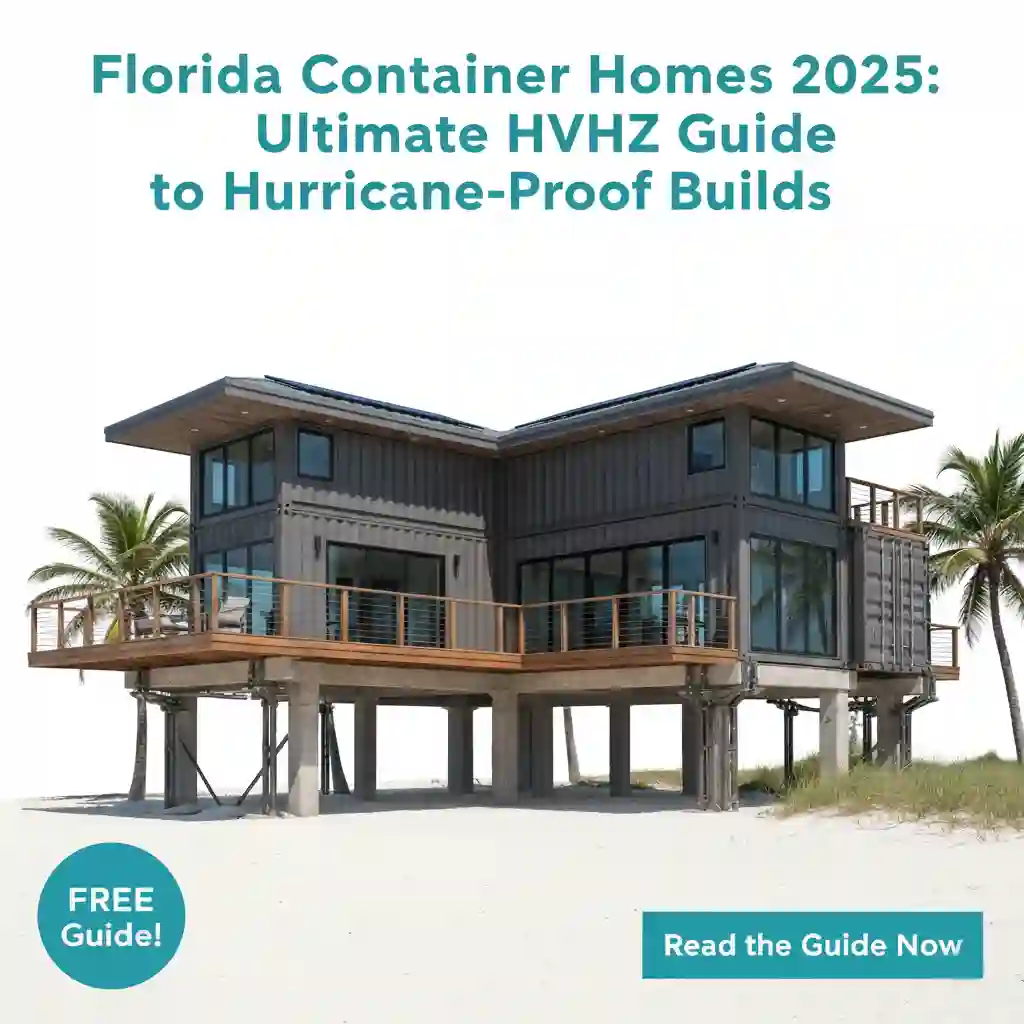
Florida Container Homes 2025: Ultimate HVHZ Guide To Hurricane-Proof Builds
We welcome you to the most comprehensive guide for building hurricane-resistant Florida container homes. We provide the essential strategies for navigating the state’s strictest codes, including HVHZ certification, mandatory impact protection, and proper flood elevation across all 67 counties.
Florida container homes require engineering that meets the nation’s most stringent building codes to withstand extreme hurricane conditions. Building success in Florida means engineering for Category 5 winds up to 180 MPH in High Velocity Hurricane Zones (HVHZ), protecting every opening against large-missile impacts, and elevating your structure above the Base Flood Elevation (BFE) to survive storm surge. This applies to projects across all 67 Florida counties, from the Panhandle to the Keys.
This comprehensive 2025 guide is designed to empower you to successfully permit and construct your code-compliant Florida container home. Whether you are building in Miami-Dade’s strict HVHZ, Broward County’s coastal areas, or inland regions, this guide translates complex hurricane engineering into practical strategies for wind resistance, impact protection, flood elevation, and smooth permit approval.
🌀 Understanding Florida’s Hurricane Reality
Florida container homes are built to handle conditions that demand robust engineering: winds over 140 MPH, 9-pound 2×4 lumber projectiles traveling at 50 feet per second, and storm surge flooding up to 25 feet above ground level. Miami-Dade and Broward counties enforce the nation’s only HVHZ jurisdictions, demanding 180 MPH design wind speeds and mandatory impact testing. We highly recommend consulting the Florida Building Commission.
📖 Comprehensive Table of Contents
- Florida Building Codes & HVHZ Requirements
- Wind Resistance Engineering (140-180 MPH)
- Impact Protection & NOAA Approvals
- Flood Elevation & BFE Compliance
- Structural Modifications & Load Paths
- Hurricane-Resistant Foundation Systems
- Regional Requirements by County
- Complete Permit Process
- Detailed Cost Analysis
- Inspection Schedule & Milestones
- Hurricane Readiness & Maintenance
- Expert Success Strategies
🏛️ Florida Building Codes & HVHZ Requirements for Container Homes
Understanding the Florida Building Code (FBC)
Florida container homes must comply with the Florida Building Code (FBC), which includes state amendments to the IRC and IBC focused heavily on hurricane resistance. Florida mandates statewide FBC compliance, meaning consistent, high standards. Residential container homes fall under the Florida Residential Code (based on IRC).
📋 Key FBC/IRC Sections for Florida Container Homes
- FBC Section 1609: Wind load calculations including 180 MPH HVHZ provisions.
- FBC Section 1623: Mandates impact-resistant coverings for openings in wind-borne debris regions.
- IRC R301.2.1.1: Defines wind design speeds (140-180 MPH Florida).
- IRC R322: Specifies flood-resistant construction including BFE elevation.
- IRC R403: Details foundation anchoring and uplift resistance for hurricanes.
- IRC R802: Ensures continuous load path from roof to foundation.
For permit submission, you must secure sealed engineering documents from a Florida-licensed Professional Engineer (PE), confirming full FBC compliance with local amendments. We recommend verifying PE licensing through the Florida Board of Professional Engineers.
High Velocity Hurricane Zone (HVHZ) Designation
Miami-Dade and Broward counties are designated as HVHZ jurisdictions, setting the national benchmark for residential construction safety. Homes here must meet enhanced standards, including:
⚠️ HVHZ Enhanced Requirements
- 180 MPH Wind Design: All structural components must be engineered for these speeds.
- NOAA Product Approvals: Exterior products (windows, doors, roofing) must have valid Miami-Dade or Broward NOAA documentation.
- Large Missile Impact: All glass openings must be tested to withstand a 9-pound 2×4 lumber projectile at 50 fps.
- Enhanced Inspections: Mandatory special inspections are required at critical structural milestones.
Wind-Borne Debris Regions
Beyond HVHZ, most Florida coastal counties designate wind-borne debris regions requiring impact protection for all exterior openings. Florida container homes within one mile of the coast where design wind speed exceeds 130 MPH, or in areas where wind speed exceeds 140 MPH regardless of distance from coast, must protect all glazed openings with impact-rated products or approved shutters.
💨 Wind Resistance Engineering for Florida Container Homes
Design Wind Speeds Across Florida
Florida container homes face varying wind design requirements based on geographic location and exposure categories. The FBC specifies design wind speeds ranging from 140 MPH in North Florida inland areas to 180 MPH in Miami-Dade and Broward HVHZ zones.
| Florida Region | Design Wind Speed | Impact Protection | Special Requirements |
|---|---|---|---|
| Miami-Dade County (HVHZ) | 180 MPH | Large-missile required | NOAA approvals mandatory |
| Broward County (HVHZ) | 180 MPH | Large-missile required | NOAA approvals mandatory |
| Palm Beach, Monroe (Keys) | 170-175 MPH | Large-missile required | Enhanced wind provisions |
| Coastal Counties (within 1 mi) | 150-170 MPH | Required per FBC 1623 | State-approved products |
| Central Florida | 140-160 MPH | Required >140 MPH | Standard FBC provisions |
| North Florida Inland | 140-150 MPH | Limited requirements | Standard IRC/FBC |
Container-Specific Wind Vulnerabilities
Standard shipping containers are designed for static stacking loads and horizontal shipping forces, not dynamic wind loads with cyclic pressure reversals. Florida container homes require specific engineered reinforcement:
⚠️ Critical Container Wind Weaknesses
- Cut Openings: Every door, window, or skylight opening removes corrugated steel strength requiring portal frame reinforcement.
- Roof Structures: Added roofing systems create uplift and require load path from roof through container to foundation.
- Corner Post Loading: Container strength concentrates at corner posts; modifications affecting corners dramatically reduce capacity.
- Connection Seams: Multi-container assemblies need engineered welded or bolted connections transferring wind forces.
🛡️ Impact Protection & NOAA Approval Requirements
Understanding Impact Testing Standards
Florida container homes in wind-borne debris regions must protect all glazed openings against airborne projectiles generated by hurricane winds. The FBC references two impact test protocols:
📋 Florida Impact Test Standards
Large Missile Impact Test (ASTM E1996)
- Simulates a 9-pound 2×4 lumber projectile at 50 feet per second.
- Required in HVHZ and coastal wind-borne debris regions.
- Involves 9,000 cycles of positive/negative pressure after impact.
Small Missile Impact Test (ASTM E1996)
- Involves 10 steel ball bearings impacting at 80 feet per second.
- Applicable in limited inland wind-borne debris zones.
NOAA Product Approvals
Miami-Dade and Broward counties require product-specific NOAA (Notice of Acceptance) documentation demonstrating test compliance and installation specifications. Florida container homes in HVHZ areas must use only products with valid NOAAs covering:
| Product Category | NOAA Requirement | Typical Cost Premium | Key Specifications |
|---|---|---|---|
| Impact Windows | Required in HVHZ | +$250-400/sq ft | Laminated glass, tested frame systems |
| Impact Doors | Required in HVHZ | +$3,000-8,000 each | Reinforced cores, impact-rated glass |
| Hurricane Shutters | Alternative to impact | +$20-50/sq ft | Aluminum, steel, or polycarbonate panels |
| Skylights | Impact-rated required | +$1,500-4,000 each | Laminated dome, tested curb |
| Garage Doors | Wind-rated required | +$2,000-5,000 | Reinforced sections, bracing |
🌊 Flood Elevation & BFE Compliance
Understanding Florida Flood Zones
Most Florida coastal and low-lying areas fall within Special Flood Hazard Areas (SFHAs) requiring flood-resistant construction. Florida container homes must comply with local floodplain ordinances implementing FEMA minimum standards plus additional freeboard requirements.
Common Florida Flood Zone Designations
- VE Zone (Coastal High Hazard): Requires elevated pile/column foundations minimum 1 foot above BFE.
- AE Zone (Riverine/Coastal Flooding): Requires elevation to or above BFE plus local freeboard.
- X Zone (Moderate/Minimal Risk): Outside 100-year floodplain; limited or no flood requirements.
Check current flood zone status at FEMA Flood Map Service Center (.gov).
BFE Elevation Requirements
Florida container homes in SFHAs must elevate the lowest floor (including basement or enclosed areas below) to the Base Flood Elevation (BFE) shown on FEMA Flood Insurance Rate Maps (FIRMs) plus local freeboard requirements. Many Florida jurisdictions require additional freeboard of 1-2 feet above BFE for residential structures.
| Flood Zone | Minimum Elevation | Typical Freeboard | Foundation Type |
|---|---|---|---|
| VE (High Velocity) | BFE + 1 ft minimum | 1-2 ft above BFE | Elevated piles/columns only |
| AE (Coastal/Riverine) | At or above BFE | 1-2 ft above BFE | Piles, piers, or fill + slab |
| AO (Shallow Flooding) | Elevation depth shown | Per local ordinance | Fill, piers, or crawlspace |
| X (Minimal Risk) | No requirement | None | Any approved system |
🏗️ Structural Modifications & Continuous Load Paths
Engineering Container Modifications
Every structural modification to shipping containers weakens the original design and requires engineered analysis. Florida container homes with wind loads up to 180 MPH demand rigorous structural engineering addressing:
📋 Required Structural Engineering Analysis
- Opening Reinforcement: Portal frames using steel channels, angles, or tubes to restore load paths around door/window openings.
- Roof Load Transfer: Engineered connections transferring roof uplift and lateral loads through container structure to foundation.
- Multi-Container Connections: Welded or bolted assembly connections allowing containers to act as unified structure under wind loads.
- Foundation Anchoring: Anchor bolt or weld plate systems resisting overturning, sliding, and uplift per calculated wind forces.
- Continuous Load Path: Documented load transfer from roof through walls, floor, and foundation to resist uplift and lateral wind forces.
⚓ Hurricane-Resistant Foundation Systems
Foundation Design Criteria for Florida
Florida container home foundations must resist simultaneous wind uplift, lateral wind forces, and flood loads (where applicable). Foundation selection depends on site-specific conditions including flood zone, soil bearing capacity, groundwater level, and seismic risk (minimal in most of Florida except northwest Panhandle).
| Foundation Type | Best Applications | Cost Range | Hurricane Performance |
|---|---|---|---|
| Driven Concrete Piles | V-zones, high BFE, poor soils | $25,000–$45,000 | Excellent: Deep embedment, scour-resistant |
| Helical Piles (Steel) | V-zones, quick install, limited access | $22,000–$42,000 | Excellent: Instant capacity, corrosion requires treatment |
| Elevated Pier & Beam | AE zones, moderate elevation | $18,000–$35,000 | Good: Flow-through design, anchor properly |
🗺️ Regional Requirements by Florida County
Florida’s 67 counties present a diverse range of coastal and inland regulatory environments. Understanding these regional variations is key to a smooth permit process:
Regional Compliance Profiles
- South Florida (Miami-Dade, Broward): Requires highest level of engineering due to HVHZ 180 MPH wind loads, demanding NOAA-approved products and mandatory special inspections.
- Southwest Florida (Collier, Lee): Typically faces 160–170 MPH winds and significant storm surge, necessitating elevated foundations and impact protection near the Gulf Coast.
- Central Florida (Orange, Osceola): Generally deals with 140–150 MPH winds and lower flood risks, allowing for less complex foundations like slab-on-grade in X zones.
- Northeast Florida (Duval, St. Johns): Coastal areas require **140–160 MPH wind** design and flood elevation due to Atlantic coastal flooding.
- Panhandle (Escambia, Bay): Subject to **150–170 MPH winds** and high storm surge, with local enforcement driven by lessons from Hurricane Michael.
💰 Detailed Cost Analysis for Florida Container Homes
Due to the complexity of hurricane engineering, impact protection, and flood elevation, Florida container home costs are generally higher than the national average. Here are realistic 2025 cost ranges for a typical 1,280 sq ft (two 40-foot containers) project:
Hard Construction Costs
| Category | HVHZ (Miami/Broward) | Coastal Counties | Inland Florida |
|---|---|---|---|
| Containers (2x40ft used) | $7,000–$11,000 | $6,500–$10,000 | $6,000–$9,500 |
| Site Prep & Utilities | $18,000–$38,000 | $15,000–$32,000 | $12,000–$28,000 |
| Hurricane Foundation System | $28,000–$50,000 | $22,000–$42,000 | $15,000–$30,000 |
| Structural Reinforcement | $12,000–$22,000 | $10,000–$18,000 | $8,000–$15,000 |
| Hurricane Windows & Doors | $25,000–$40,000 | $18,000–$32,000 | $10,000–$20,000 |
| Hurricane Roof System | $14,000–$24,000 | $12,000–$20,000 | $9,000–$16,000 |
| Exterior Insulation & Cladding | $20,000–$35,000 | $18,000–$30,000 | $15,000–$26,000 |
| Interior Build-Out | $35,000–$60,000 | $30,000–$50,000 | $25,000–$42,000 |
| HVAC System | $14,000–$24,000 | $12,000–$20,000 | $10,000–$18,000 |
| Electrical System | $12,000–$20,000 | $10,000–$18,000 | $9,000–$15,000 |
| Plumbing System | $14,000–$24,000 | $12,000–$20,000 | $10,000–$18,000 |
| Corrosion Protection | $6,000–$10,000 | $4,000–$8,000 | $2,000–$5,000 |
💰 Total Project Cost Ranges (1,280 sq ft / 2 containers)
Please use these figures for your budget planning:
- HVHZ (Miami-Dade/Broward): $280,000–$420,000 (or $220–$330/sq ft)
- Coastal Counties (High Wind): $220,000–$340,000 (or $170–$265/sq ft)
- Inland Florida (Moderate): $160,000–$260,000 (or $125–$200/sq ft)
🏗️ Structural Modifications & Continuous Load Paths
Required Structural Engineering Analysis
To safely manage wind loads up to 180 MPH, your structural engineering plans must include:
📋 Required Structural Engineering Analysis
- Opening Reinforcement: Portal frames to restore strength around all door/window openings.
- Roof Load Transfer: Engineered connections to transfer roof uplift and lateral loads safely through the container structure.
- Multi-Container Connections: Welded or bolted assemblies allowing containers to act as unified structure under wind loads.
- Foundation Anchoring: Anchor bolt systems resisting overturning and uplift per calculated wind forces.
- Continuous Load Path: Documented load transfer from roof through walls, floor, and foundation to resist uplift and lateral wind forces.
⚓ Hurricane-Resistant Foundation Systems
Foundation Design Criteria for Florida
Florida container home foundations must resist simultaneous wind uplift, lateral wind forces, and flood loads (where applicable). Foundation selection depends on site-specific conditions including flood zone, soil bearing capacity, groundwater level, and seismic risk (minimal in most of Florida except northwest Panhandle).
| Foundation Type | Best Applications | Cost Range | Hurricane Performance |
|---|---|---|---|
| Driven Concrete Piles | V-zones, high BFE, poor soils | $25,000–$45,000 | Excellent: Deep embedment, scour-resistant |
| Helical Piles (Steel) | V-zones, quick install, limited access | $22,000–$42,000 | Excellent: Instant capacity, corrosion requires treatment |
| Elevated Pier & Beam | AE zones, moderate elevation | $18,000–$35,000 | Good: Flow-through design, anchor properly |
🗺️ Regional Requirements by Florida County
Florida’s 67 counties present a diverse range of coastal and inland regulatory environments. Understanding these regional variations is key to a smooth permit process:
Regional Compliance Profiles
- South Florida (Miami-Dade, Broward): Requires highest level of engineering due to HVHZ 180 MPH wind loads, demanding NOAA-approved products and mandatory special inspections.
- Southwest Florida (Collier, Lee): Typically faces 160–170 MPH winds and significant storm surge, necessitating elevated foundations and impact protection near the Gulf Coast.
- Central Florida (Orange, Lee, Charlotte): Generally deals with 140–150 MPH winds and lower flood risks (X zones are common), making slab-on-grade foundations often suitable.
- Northeast Florida (Duval, St. Johns): Coastal areas require 140–160 MPH wind design and flood elevation due to Atlantic coastal flooding.
- Panhandle (Escambia, Bay): Subject to 150–170 MPH winds, with local enforcement driven by lessons from Hurricane Michael. High elevation and impact protection are often required in coastal zones.
Ready to Engineer Your Florida Container Home?
We are dedicated to helping you achieve a safe, code-compliant, hurricane-resistant home. Our plans provide the comprehensive architectural and structural documentation necessary to approach the permit process with assurance.
Plan Quality and Local PE Approval
Our plans are permit-ready and rigorously designed for FBC and HVHZ compliance, specifically addressing Florida’s severe climate. To ensure compliance with highly localized regulations (site-specific wind/flood loads), we kindly remind you that all buyers are required to obtain final structural approval from a local Florida-licensed Professional Engineer (PE). Our documentation is tailored to make this process as smooth as possible for your PE.
Need Customization? We’re Here to Help!
Should your local building department or site conditions require changes to the layout, window placement, or foundation, we are pleased to offer plan editing and customization services after your purchase at an additional cost. This service ensures your investment perfectly fits your vision and your local code requirements.
**Important Notice:** Due to the nature of digital plans and variations in local jurisdictions, we are unable to offer a money-back guarantee or refund in any case. We provide quality assurance that our plans are designed for PE review and code compliance, but the final responsibility for local PE approval and permitting rests with the buyer.



[…] State-specific guidance is available for California container homes, Texas building requirements, Florida hurricane codes, Colorado climate considerations, and New York zoning […]
[…] design strategies proven in thousands of container homes across America—from Texas to California, Florida to New […]