Shipping Container Footing Dimensions & Foundation Requirements
The definitive guide to sizing footings, calculating loads, and meeting IRC standards for your container build
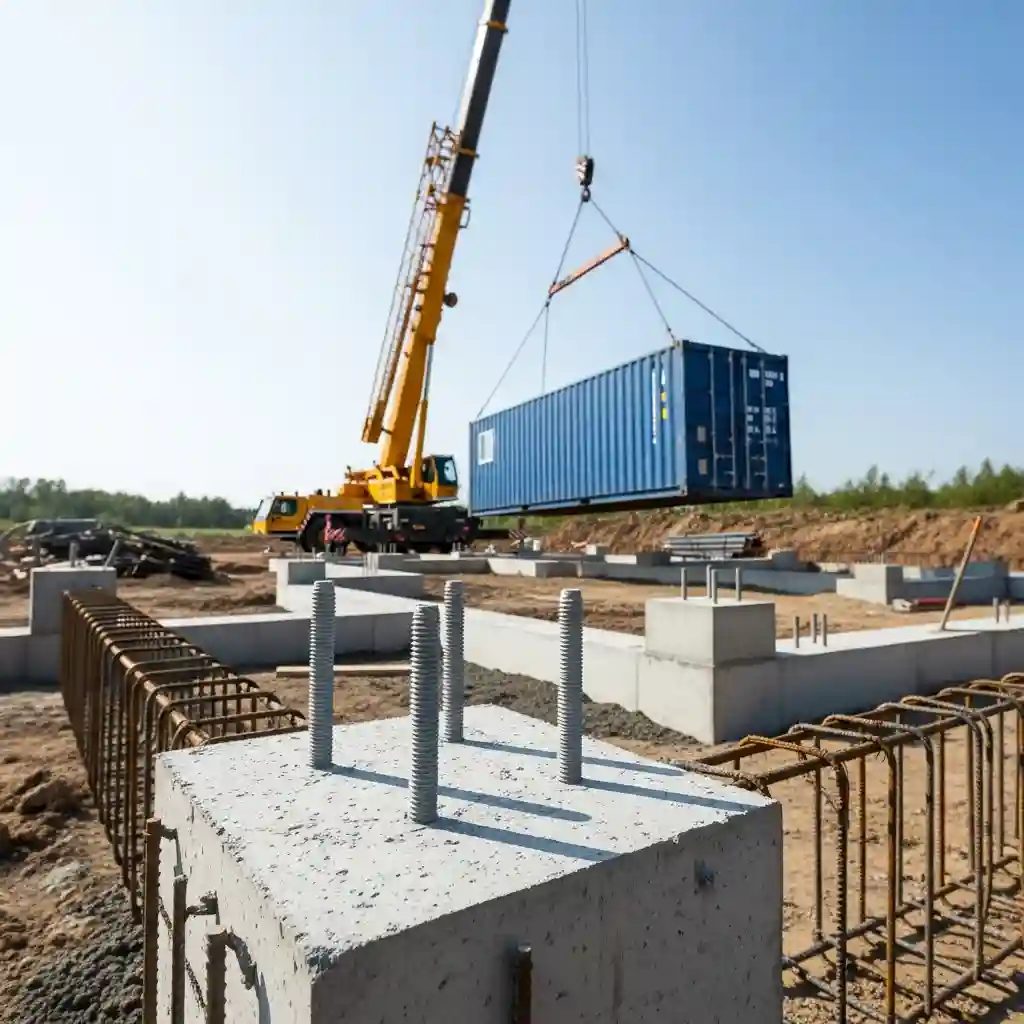
One of the most frequent questions we receive from owner-builders concerns shipping container footing dimensions and how to properly transfer the immense weight of a steel box into the ground. Unlike traditional stick-built homes that distribute load evenly along perimeter walls, shipping containers carry their entire structural load at four corner castings. This point-load characteristic fundamentally changes how you must approach footing design and foundation requirements compared to conventional residential construction.
Failure to properly size your footings can lead to catastrophic settling, structural racking, and the inability to open or close your container doors. Navigating the International Residential Code (IRC) requirements for foundations ensures your home remains level, stable, and safe for decades to come.
Our goal is to demystify the technical code sections governing foundation design, helping you understand exactly what your local building department—and your Professional Engineer—will be looking for. By starting with the correct dimensions and load calculations, you avoid costly retrofits and ensure a smooth path to permit approval.
Understanding Foundation Loads & Design Criteria
Before digging a single hole, you must understand the forces your foundation needs to resist. The IRC requires all buildings to be constructed to safely support all loads, including dead loads (the weight of the container and materials) and live loads (occupants, furniture, snow, etc.).
Design Criteria Overview
The 2021 IRC, Section R301, establishes the general design criteria for residential structures. It mandates that the construction must result in a complete load path that transfers loads from their point of origin (your roof, floor, and container walls) through the load-resisting elements to the foundation.
The International Code Council publishes the IRC, which establishes these baseline performance requirements to protect public safety.
📖 Click to Read Full IRC Section R301.1
IRC Section R301.1 – Application:
Buildings and structures, and parts thereof, shall be constructed to safely support all loads, including dead loads, live loads, roof loads, flood loads, snow loads, wind loads and seismic loads as prescribed by this code. The construction of buildings and structures in accordance with the provisions of this code shall result in a system that provides a complete load path that meets the requirements for the transfer of loads from their point of origin through the load-resisting elements to the foundation. Buildings and structures constructed as prescribed by this code are deemed to comply with the requirements of this section.
Source: 2021 International Residential Code
For detailed guidance on preparing your site for these loads, review our site preparation guide, which covers clearing, grading, and soil compaction essential for a stable foundation.
IRC Footing Size Requirements
The dimensions of your footings are not arbitrary; they are calculated based on the weight of the building and the load-bearing capacity of your soil. The IRC provides prescriptive tables for minimum widths, but these generally assume uniform loads for light-frame construction, so careful adaptation for containers is necessary.
General Footing Standards
Section R403.1 of the IRC dictates that all exterior walls must be supported by continuous solid or fully grouted masonry or concrete footings, or other approved structural systems. This section specifically requires that footings be designed to accommodate all loads and transmit them to the soil without exceeding the soil’s bearing capacity.
📖 Click to Read Full IRC Section R403.1.1
IRC Section R403.1.1 – Minimum size:
The minimum width, W, and thickness, T, for concrete footings shall be in accordance with Tables R403.1(1) through R403.1(3) and Figure R403.1(1) or R403.1.3, as applicable, but not less than 12 inches (305 mm) in width and 6 inches (152 mm) in depth. The footing width shall be based on the load-bearing value of the soil in accordance with Table R401.4.1. Footing projections, P, shall be not less than 2 inches (51 mm) and shall not exceed the thickness of the footing. Footing thickness and projection for fireplaces shall be in accordance with Section R1001.2. The size of footings supporting piers and columns shall be based on the tributary load and allowable soil pressure in accordance with Table R401.4.1.
Source: 2021 International Residential Code
When selecting a foundation type, consider checking our guide on foundation options to compare pier, strip, and slab foundations suitable for container homes.
Frost Protection & Depth Regulations
One of the most critical aspects of foundation design, particularly for lightweight structures like shipping containers, is protection against frost heave. When water in the soil freezes, it expands, exerting tremendous upward force that can lift (heave) your footings, causing structural damage, unlevel floors, and jammed doors.
Code-Mandated Frost Protection Methods
The IRC provides specific methods for preventing frost damage. For most owner-builders, the most common approach is extending the footing depth below the local frost line. This ensures the soil supporting your home never freezes and moves.
Section R403.1.4.1 of the 2021 IRC outlines the acceptable methods for frost protection. While extending below the frost line is standard, the code also allows for frost-protected shallow foundations (FPSF) which use insulation to prevent the soil beneath the footing from freezing, potentially saving on excavation costs.
📖 View IRC Section R403.1.4.1 Text
IRC Section R403.1.4.1 – Frost protection:
Except where otherwise protected from frost, foundation walls, piers and other permanent supports of buildings and structures shall be protected from frost by one or more of the following methods:
- Extended below the frost line specified in Table R301.2.
- Constructed in accordance with Section R403.3.
- Constructed in accordance with ASCE 32.
- Erected on solid rock.
Footings shall not bear on frozen soil unless the frozen condition is permanent.
Source: 2021 International Residential Code
If you choose a Frost-Protected Shallow Foundation (Method 2), you must carefully follow insulation detailing. The U.S. Department of Energy provides excellent resources on managing moisture and thermal performance in foundation systems, which is critical when using insulation-based frost protection.
Soil Bearing Capacity & Site Testing
Your shipping container footing dimensions are directly dependent on the “load-bearing pressure” of your soil. Simply put, soft clay requires a much larger footing to spread the weight than hard bedrock. Building on soil that is too weak can lead to sinking, differential settlement, and structural failure.
Determining Your Soil Type
The IRC classifies soils and assigns them a “presumptive load-bearing value.” This value tells you how many pounds per square foot (PSF) the soil can safely support. A Professional Engineer (PE) will typically require a Geotechnical Report (soil test) to confirm these values for your specific site, especially if the soil conditions are questionable.
IRC Table R401.4.1 establishes these baseline values used by engineers and building officials:
| Class of Material | Load-Bearing Pressure (psf) | Suitability for Containers |
|---|---|---|
| Crystalline Bedrock | 12,000 | Excellent (Requires pinning) |
| Sedimentary/Foliated Rock | 4,000 | Excellent |
| Sandy Gravel / Gravel | 3,000 | Very Good |
| Sand, Silty Sand, Clayey Sand | 2,000 | Good (Common) |
| Clay, Sandy Clay, Clayey Silt | 1,500 | Fair (Requires larger footings) |
Note: Values derived from 2021 IRC Table R401.4.1. Always confirm with a local soil test.
The Engineering Process & Costs
Since PermitContainerhomes.com plans provide the structural loads of the building itself, your local PE will use that data combined with your local soil conditions to finalize the foundation design. This “site-adaptation” is a standard part of the building process.
| Service Item | Estimated Cost Range | Necessity |
|---|---|---|
| Geotechnical Soil Test | $800 – $2,500 | Required by most PEs/Cities |
| Foundation Engineering (PE) | $1,500 – $3,000 | Mandatory for Permits |
| Site Survey | $600 – $1,500 | Required for Site Plan |
Note: These costs are estimates and vary significantly by region and site complexity. They are separate from the plan purchase.
📖 View IRC Section R401.4.1 Text
IRC Section R401.4.1 – Geotechnical evaluation:
In lieu of a complete geotechnical evaluation, the load-bearing values in Table R401.4.1 shall be assumed.
Source: 2021 International Residential Code
Common Footing Types for Containers
While the IRC outlines various foundation systems, not all are ideal for shipping containers. The “point-load” nature of a container (where weight is concentrated at the four corners) makes pier foundations the most popular and often the most economical choice, though other options exist depending on your site conditions.
1. Concrete Pier Footings
Piers are isolated columns of concrete that extend from the ground up to the container’s corner castings. They are efficient because they place concrete only where the load is concentrated.
IRC Section R403.1.6 mandates that sill plates and walls be anchored to the foundation. For containers, this typically means embedding J-bolts or threaded rods into the wet concrete, which are later bolted to a steel plate welded to the container’s ISO corner casting.
📖 View IRC Section R403.1.6 Requirements
IRC Section R403.1.6 – Foundation anchorage:
Wood sill plates and wood walls supported directly on continuous foundations shall be anchored to the foundation in accordance with this section. Cold-formed steel framing shall be anchored directly to the foundation or fastened to wood sill plates in accordance with Section R505.3.1 or R603.3.1. Anchorage of other materials shall be in accordance with the manufacturer’s instructions or the engineered design.
Source: 2021 International Residential Code
2. Strip Footings (Continuous)
A strip footing supports a continuous foundation wall. While excellent for distributing loads, they can be overkill for a container unless you are building a basement or have soil with very low bearing capacity.
3. Slab-on-Grade
A full concrete slab provides a finished floor and foundation in one. However, since containers have timber floors, a slab is often redundant unless used for a garage or specific thermal mass design.
Expert Tips & Key Takeaways
Designing the correct footing dimensions for your shipping container home is a balance of understanding code requirements, soil mechanics, and structural engineering. Here are the essential points to guide your project.
Essential Points Summary
- Point Loads Matter: unlike stick-built homes, containers transfer weight primarily through their corners. Ensure your footings are concentrated at these load points.
- Know Your Frost Line: You must dig below the frost line (or use approved FPSF methods) to prevent frost heave from damaging your structure.
- Test Your Soil: “Presumptive” load values are a guess. A $1,500 soil test can save you thousands in unnecessary concrete or future repairs.
- Connection is Key: The “uplift” force from wind can flip a container. Your connection detail (anchorage) to the footing is just as important as the footing size itself.
- PE Review is Mandatory: Foundation plans almost always require a Professional Engineer’s stamp to verify they suit your specific local soil conditions.
With comprehensive planning documentation, Professional Engineer support, and understanding of your local requirements, you’re well-positioned to successfully navigate the permitting process and build your dream container home.
Ready to Start Your Container Home Project?
Explore our collection of comprehensive container home plans designed to align with 2021 IRC and IBC building code standards. Each plan includes complete architectural drawings, structural details, electrical layouts, plumbing systems, and beautiful 3D visualizations—everything your Professional Engineer needs for efficient review.
Browse Complete Plan Collection →Need Plan Modification? If you find a plan you love but need to adjust it for your local climate or personal needs—such as moving a window or adding a door—our team can help. We offer a professional plan modification service after purchase. Simply contact us with your modification needs, and we’ll provide a personalized quote.
⚖️ Professional Engineering & Plan Documentation Disclaimer
Important: Our plans are permit-ready but require review and stamping by a local licensed Professional Engineer (PE) in your jurisdiction. Final approval is subject to local building codes and regulations. We recommend consulting your local building department to verify all requirements.
Refund Policy: Due to the digital nature of our plans, all sales are final. Please review our Refund Policy for details.