Pier Foundation for Shipping Container Home: 5 Critical Design Factors
Expert cost comparison and code-compliant foundation recommendations for shipping container construction
A properly designed pier foundation for shipping container home construction provides the structural stability, drainage, and code compliance required for long-term residential occupancy. The pier foundation for shipping container home projects offers significant advantages over slab foundations in specific site conditions, particularly on sloped terrain, areas with high water tables, or locations requiring future utility access.
Selecting between pier foundation for shipping container home installation versus traditional slab foundations centers on three critical factors: initial construction costs ($3,000-$6,000 for pier systems versus $5,000-$12,000 for slabs), site-specific soil conditions, and permanence requirements. Understanding how pier foundation for shipping container home systems distribute loads and comply with IRC requirements helps you make informed decisions aligned with your budget and building department expectations.
This guide examines pier foundation for shipping container home design through the lens of 2021 IRC/IBC code requirements, Professional Engineer review processes, and practical installation considerations. You’ll discover exact specifications for footing depth, concrete strength, reinforcement placement, and cost comparisons that inform your foundation selection.
Pier Foundation for Shipping Container Home Basics
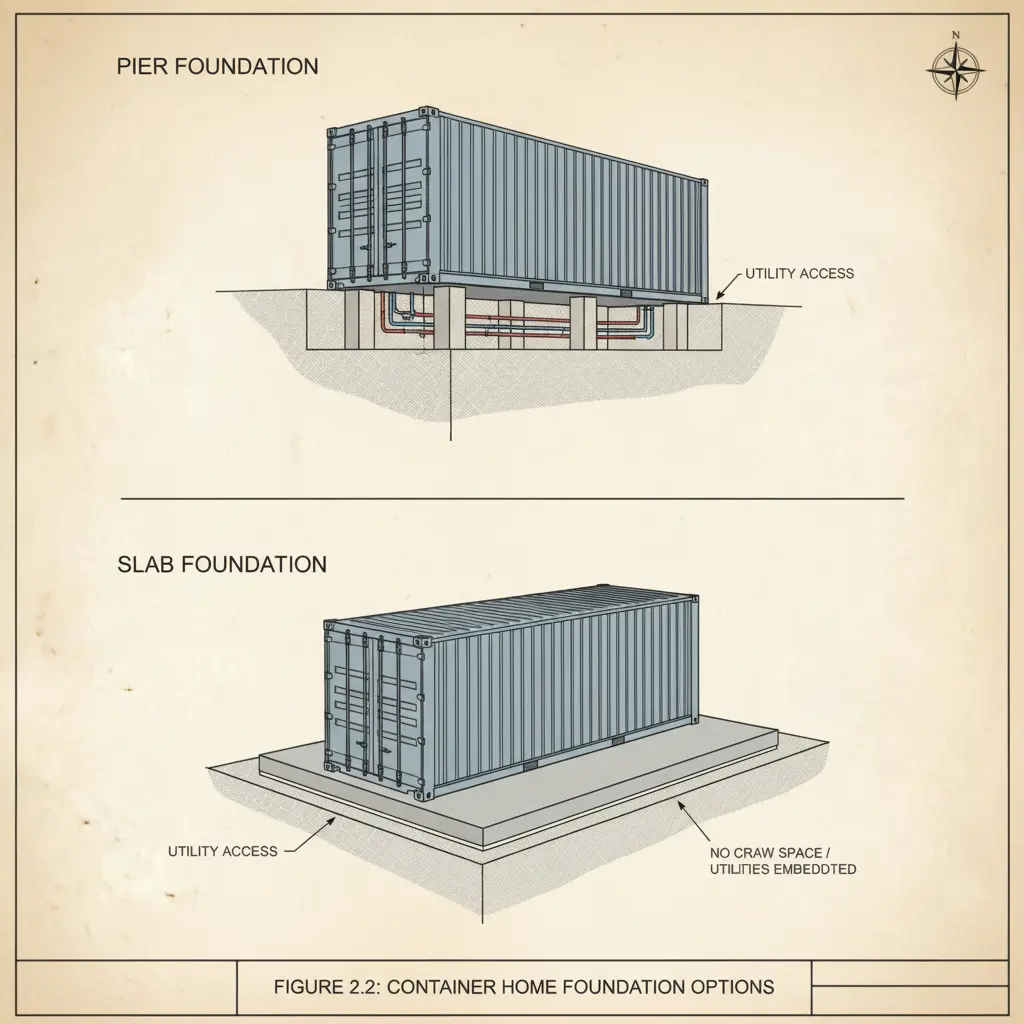
The pier foundation for shipping container home construction utilizes individual concrete supports positioned at strategic load-bearing points beneath the container corners and center sections. A standard 40-foot shipping container requires six piers minimum: four corner piers plus two center supports to prevent mid-span deflection and floor sagging.
Each pier foundation for shipping container home installation creates an elevated platform with accessible crawl space underneath. This elevation provides multiple benefits including improved site drainage, natural termite protection, and unobstructed access for plumbing lines, electrical conduits, and future maintenance work.
Components of Pier Foundation Systems
Every pier foundation for shipping container home system consists of three essential components: a below-grade footing that extends past frost line, a vertical reinforced concrete pier shaft, and a leveled cap that provides bearing surface for container corner castings. The International Code Council publishes the IRC, which establishes minimum footing dimensions based on soil bearing capacity and anticipated structural loads.
Typical pier foundation for shipping container home installations use 12-inch square piers minimum, with footings measuring 24 inches square and 12 inches thick as prescriptive minimums. Actual dimensions increase based on soil bearing capacity, seismic design category, and total structural loads calculated by your Professional Engineer.
📖 View Full IRC Section R403.1.4 Text
IRC Section R403.1.4 – Minimum Depth:
All exterior footings shall be placed not less than 12 inches (305 mm) below the undisturbed ground surface. Where applicable, the depth of footings shall also conform to Sections R403.1.4.1 through R403.1.4.2.
Source: 2021 International Residential Code
Why Choose Pier Foundations
The pier foundation for shipping container home construction method excels in multiple scenarios that make slab foundations impractical or cost-prohibitive. Installation speed ranks among the top advantages, with typical pier foundation for shipping container home completion in 2-3 working days compared to 5-7 days for equivalent slab installations.
Material costs for pier foundation for shipping container home projects remain substantially lower due to reduced concrete volume requirements—typically 3-4 cubic yards for piers versus 8-12 cubic yards for full slab foundations. The accessible crawl space created by pier elevation permits straightforward plumbing, electrical, and HVAC modifications without concrete demolition.
Pier Foundation Load Distribution
Understanding how pier foundation for shipping container home systems distribute weight prevents common structural failures. Each 40-foot container weighs 8,000-10,000 pounds when outfitted for residential use, with loads concentrated at reinforced corner castings designed for vertical stacking during transport.
Proper pier foundation for shipping container home design accounts for this concentrated load distribution pattern, which differs significantly from traditional residential construction with continuous wall bearing. Your Professional Engineer calculates pier spacing, reinforcement, and footing dimensions specific to your container configuration and local soil conditions.
Multi-container configurations require additional interior piers where containers join or where second-story units bear on lower containers. These load transfer points demand precise engineering analysis to prevent differential settlement and structural damage over time.
IRC Foundation Requirements and Code Compliance
The 2021 International Residential Code establishes prescriptive foundation requirements directly applicable to pier foundation for shipping container home construction. IRC Section R403 governs footing design, specifying minimum dimensions, frost depth requirements, and reinforcement standards based on soil classification and structural loading patterns.
Pier foundation for shipping container home installations must satisfy the same code requirements as conventional residential foundations. This includes adequate soil bearing capacity verification, proper footing depth below frost line, specified concrete strengths, and appropriate reinforcement to resist uplift and lateral forces.
Frost Depth and Footing Requirements
IRC Section R403.1.4.1 mandates that pier foundation for shipping container home footings extend below established frost line depths unless protected through approved alternative methods. Frost depth requirements vary dramatically by geographic location, ranging from zero inches in southern coastal zones to 60 inches or deeper in northern tier states.
| Climate Zone | Typical Frost Depth | Minimum Footing Depth | Pier Foundation Impact |
|---|---|---|---|
| Southern (Zone 1-2) | 0-12 inches | 12 inches minimum | Standard shallow footings |
| Moderate (Zone 3-4) | 12-30 inches | 30-36 inches | Increased excavation costs |
| Northern (Zone 5-7) | 30-60+ inches | 48-72 inches | Significant depth requirements |
Note: Actual frost depths and footing requirements vary by jurisdiction. Consult IRC Figure R301.2(1) and verify with your local building department for site-specific requirements affecting pier foundation for shipping container home projects.
📖 View IRC Section R403.1.6 Anchorage Requirements
IRC Section R403.1.6 – Foundation Anchorage:
Sill plates and walls supported directly on continuous foundations shall be anchored to the foundation in accordance with this section. For pier foundation applications, containers shall be anchored with approved connectors capable of resisting uplift and lateral forces. Anchor bolts shall be not less than 1/2-inch-diameter (12.7 mm) embedded minimum 7 inches into concrete.
Source: 2021 International Residential Code
Concrete Strength Requirements
IRC Table R402.2 specifies minimum concrete compressive strength of 2,500 psi at 28 days for pier foundation for shipping container home applications in standard climate zones. Projects in Seismic Design Categories D, E, and F require 3,000 psi minimum to provide enhanced seismic resistance and structural integrity.
Your pier foundation for shipping container home concrete mix design must account for local environmental exposure conditions including freeze-thaw cycles, soil chemistry, and groundwater presence. These factors may necessitate air entrainment additives, reduced water-cement ratios, or specialized admixtures specified by your Professional Engineer.
Soil Bearing Capacity Considerations
IRC Table R401.4.1 provides presumptive soil bearing values that influence pier foundation for shipping container home footing sizing. Values range from 1,500 psf for soft clay soils to 12,000 psf for competent bedrock, directly determining minimum footing surface area requirements.
Site-specific geotechnical investigation establishes actual bearing capacity for your pier foundation for shipping container home project. Professional Engineers use these test results to calculate exact footing dimensions that distribute container loads safely below established bearing capacity with appropriate safety factors.
Our comprehensive container home foundation documentation provides detailed pier specifications and load calculations that streamline your Professional Engineer’s review process and support efficient permit approval.
Professional Engineer’s Role in Pier Foundation for Shipping Container Home Design
Professional Engineer review represents a mandatory step for pier foundation for shipping container home projects in most US jurisdictions. Your PE analyzes site-specific soil conditions, calculates exact structural loads, and adapts foundation plans to meet local building code amendments and environmental factors unique to your property.
The PE’s pier foundation for shipping container home review process begins with geotechnical investigation results that establish actual soil bearing capacity. These findings determine whether standard prescriptive pier designs suffice or whether engineered solutions with deeper footings, increased reinforcement, or alternative foundation systems become necessary.
What Your Professional Engineer Reviews
For pier foundation for shipping container home applications, the PE evaluates multiple critical factors. Load calculations verify that proposed pier spacing and footing dimensions adequately support dead loads (container weight, fixtures, roofing) plus live loads (occupants, furniture, snow accumulation) with appropriate safety factors.
Lateral stability analysis ensures pier foundation for shipping container home systems resist wind loads per ASCE 7 wind speed maps and seismic forces based on your site’s Seismic Design Category. The PE calculates required anchorage strength to prevent container uplift during extreme weather events—a critical consideration for elevated pier installations.
PE Costs and Budget Planning
Professional Engineer review costs for pier foundation for shipping container home projects range from $2,000-$5,000 depending on project scope, site complexity, and regional market rates. Single-container installations at the lower end, while multi-container configurations with complex load transfers command higher engineering fees.
After purchasing comprehensive plans from PermitContainerhomes.com, you’ll work with a licensed PE who reviews the detailed documentation, adapts specifications for your site conditions, and provides stamped drawings required for permit submission. This collaborative process ensures your pier foundation for shipping container home meets both IRC requirements and local jurisdiction expectations.
Site-Specific Engineering Considerations
Your PE’s pier foundation for shipping container home analysis addresses site conditions that prescriptive code tables cannot anticipate. Sloped sites require calculations for downhill soil pressure and potential pier overturning. High water table locations demand evaluation of buoyancy forces and soil bearing capacity reduction.
Expansive clay soils present unique challenges for pier foundation for shipping container home installations. The PE may specify deeper footings below active soil zones, increased pier reinforcement, or moisture barriers that minimize soil volume changes affecting foundation stability over the structure’s service life.
Cost Analysis: Pier Foundation for Shipping Container Home vs. Slab
Understanding complete cost implications helps you select the most economical pier foundation for shipping container home solution for your specific circumstances. While pier foundations typically cost less initially, total project economics depend on site conditions, utility installation requirements, and long-term maintenance considerations.
For additional guidance on residential building requirements and energy-efficient foundation design, the U.S. Department of Energy provides resources on meeting thermal performance standards that affect both pier foundation for shipping container home and slab installations, particularly regarding crawl space insulation and moisture control strategies.
Detailed Cost Breakdown Comparison
The following table compares typical costs for pier foundation for shipping container home installation versus concrete slab alternatives for a standard 40-foot single container project. Actual costs vary significantly based on geographic location, site accessibility, and local material and labor rates.
| Foundation Component | Pier Foundation Cost | Concrete Slab Cost | Cost Difference |
|---|---|---|---|
| Site preparation & excavation | $500-$800 | $1,500-$3,000 | Pier saves $1,000-$2,200 |
| Concrete materials (3-4 vs 8-12 yards) | $600-$900 | $1,600-$2,400 | Pier saves $1,000-$1,500 |
| Reinforcement (rebar, wire mesh) | $200-$400 | $400-$800 | Pier saves $200-$400 |
| Formwork & labor | $800-$1,200 | $1,500-$2,500 | Pier saves $700-$1,300 |
| Gravel base & vapor barrier | $300-$500 | $800-$1,500 | Pier saves $500-$1,000 |
| Insulation (crawl vs. slab edge) | $400-$800 | $300-$600 | Slab saves $100-$200 |
| Total Foundation Cost | $2,800-$4,600 | $6,100-$10,800 | Pier saves $3,300-$6,200 |
| PE Review & Stamping | $2,000-$5,000 | $2,000-$5,000 | Equivalent |
| Permit Fees | $500-$2,000 | $500-$2,000 | Varies by jurisdiction |
Note: Costs shown represent typical ranges for standard site conditions. Difficult access, sloped terrain, poor soil conditions, or extreme frost depth requirements can increase foundation costs 25-100% above these estimates. Always obtain multiple contractor quotes specific to your site and local market conditions.
Hidden Cost Considerations
Beyond initial installation, pier foundation for shipping container home projects involve ongoing maintenance costs that differ from slab foundations. Crawl space encapsulation, vapor barrier replacement, and periodic pier inspection add $200-$500 annually to long-term ownership costs.
However, pier foundation for shipping container home systems provide cost advantages for utility modifications and repairs. Accessing plumbing or electrical systems beneath slab foundations requires concrete cutting at $500-$2,000 per penetration, while pier foundations permit straightforward crawl space access at minimal cost.
📖 View IRC Section R408 Crawl Space Requirements
IRC Section R408.1 – Ventilation:
The under-floor space between the bottom of the floor joists and the earth under any building (except space occupied by a basement) shall have ventilation openings through foundation walls or exterior walls. The minimum net area of ventilation openings shall be not less than 1 square foot for each 150 square feet of under-floor space area. One such ventilating opening shall be within 3 feet of each corner of the building.
Source: 2021 International Residential Code
Site Conditions That Favor Each Foundation Type
Pier foundation for shipping container home installations excel on sloped sites where slab foundations would require extensive cut-and-fill operations costing $5,000-$20,000 additional. Sites with high seasonal water tables also favor elevated pier systems that maintain crawl space drainage and prevent moisture intrusion.
Conversely, flat sites with excellent soil conditions and no drainage concerns may benefit from slab foundations. The thermal mass advantage of concrete slabs can reduce heating and cooling costs by 10-15% in moderate climates, offsetting higher initial construction costs over 15-20 year periods.
Multi-Container Cost Scaling
For multi-container configurations, pier foundation for shipping container home systems scale more economically than slab foundations. Each additional container requires 4-6 additional piers at $400-$800 each, while expanding slab foundations involves proportionally higher concrete volumes and forming costs.
A two-container (80 linear feet) pier foundation for shipping container home typically costs $4,500-$7,000 total, compared to $10,000-$18,000 for equivalent slab coverage. This cost advantage increases with project size, making pier foundations particularly attractive for larger container home designs.
Detailed specifications and cost estimation tools are available in our container home site preparation guide, which helps you develop accurate budget projections for your specific project configuration and location.
Site-Specific Considerations and Installation
Successful pier foundation for shipping container home installation depends on thorough site evaluation and proper construction sequencing. Site conditions including slope, drainage patterns, soil composition, and accessibility directly impact pier placement, excavation requirements, and overall project timeline.
Before beginning pier foundation for shipping container home construction, obtain complete site surveys showing existing grades, utility locations, and property boundaries. This documentation prevents costly errors and ensures pier placement complies with setback requirements and easement restrictions established by local zoning ordinances.
Sloped Site Challenges
Pier foundation for shipping container home projects on sloped terrain require careful attention to pier height variations and lateral bracing requirements. Downhill piers may extend 6-10 feet above grade while uphill piers remain near ground level, creating significant height differentials that demand adequate lateral stability measures.
Your Professional Engineer calculates lateral earth pressure on downhill piers and specifies appropriate reinforcement to resist soil forces. Some pier foundation for shipping container home installations on steep slopes require diagonal bracing between piers or grade beams connecting pier caps to create a unified foundation system resistant to sliding and overturning.
Drainage and Moisture Management
Proper drainage protects pier foundation for shipping container home installations from moisture damage and soil erosion. Site grading should direct water away from pier locations with minimum 5% slope extending at least 10 feet from the foundation perimeter per IRC Section R401.3.
The crawl space created by pier foundation for shipping container home elevation requires adequate ventilation per IRC Section R408. Provide minimum one square foot of vent area per 150 square feet of crawl space, with vents positioned within three feet of each corner to promote cross-ventilation and moisture control.
Utility Integration Planning
One significant advantage of pier foundation for shipping container home systems involves simplified utility installation. Electrical conduits, plumbing supply lines, and drainage pipes route through the crawl space without requiring trenching beneath concrete slabs or core drilling through foundation elements.
Plan utility penetration points during pier foundation for shipping container home design to ensure adequate clearance and access. Water supply lines require insulation in cold climates to prevent freezing, while sewer lines need proper slope (minimum 1/4 inch per foot) for gravity drainage to septic or municipal systems.
Common Installation Mistakes
Several errors plague pier foundation for shipping container home projects and result in failed inspections or structural problems. Inadequate pier spacing tops the list—attempting to support 40-foot containers with only four corner piers creates excessive mid-span deflection and floor sagging over time.
Another frequent mistake involves insufficient footing depth in cold climates. Frost heave destroys pier foundation for shipping container home systems when footings sit above frost line. Always verify local frost depth requirements and excavate accordingly, even when this increases initial costs substantially.
Inspection and Quality Control
Building departments typically require multiple inspections during pier foundation for shipping container home construction. The first inspection occurs after excavation but before concrete placement, allowing inspectors to verify footing depth, dimensions, and reinforcement placement meet approved plans.
After concrete curing, a final pier foundation for shipping container home inspection confirms pier height uniformity, proper cap leveling, and adequate anchorage provisions. Expect 7-14 day lead times for inspection scheduling in most jurisdictions, requiring careful construction timeline coordination.
Documentation from our comprehensive plan packages provides detailed installation sequences and inspection checklists that help contractors and owner-builders navigate the approval process efficiently.
Expert Recommendations and Key Takeaways
Selecting the optimal pier foundation for shipping container home solution requires balancing multiple factors including site conditions, budget constraints, climate considerations, and long-term occupancy intentions. This final section distills critical decision points and best practices from industry experience and building code requirements.
Essential Points Summary
- Foundation Selection Criteria: Choose pier foundation for shipping container home systems when dealing with sloped terrain, high water tables, or situations requiring future container relocation. The $3,000-$6,000 cost advantage over slab foundations makes piers economically attractive for budget-conscious projects, particularly single-container installations.
- Code Compliance Requirements: All pier foundation for shipping container home projects must satisfy IRC Section R403 footing requirements including minimum 12-inch depth below undisturbed soil, frost line protection per local climate zone, and adequate soil bearing capacity verified through geotechnical investigation. Professional Engineer review remains mandatory in most jurisdictions.
- Professional Engineer Partnership: Budget $2,000-$5,000 for PE review and stamping of your pier foundation for shipping container home plans. The PE adapts generic specifications to your site-specific soil conditions, seismic requirements, and local code amendments, then provides stamped drawings required for permit submission.
- Installation Timeline Planning: Typical pier foundation for shipping container home construction requires 2-3 days for excavation and concrete placement, plus 7-14 days curing time before container installation. Add 2-4 weeks for PE review and 4-12 weeks for building department permit processing when developing project schedules.
- Long-term Considerations: While pier foundation for shipping container home systems cost less initially, factor ongoing crawl space maintenance including vapor barrier inspection, ventilation system upkeep, and periodic pier condition assessment. These requirements add $200-500 annually but provide access advantages worth thousands during utility modifications.
When Slab Foundations Make More Sense
Despite numerous advantages, pier foundation for shipping container home installations aren’t optimal for every situation. Flat sites with excellent soil conditions, permanent installations without relocation possibility, and projects requiring wheelchair accessibility or barrier-free entries may benefit from slab foundations despite higher initial costs.
The thermal mass of concrete slabs provides passive heating and cooling benefits worth 10-15% energy savings in moderate climates. For owner-occupied permanent residences in stable locations, these long-term operational savings can justify $3,000-$6,000 additional foundation investment over 20-30 year ownership periods.
Final Recommendations
For most owner-builders and first-time container home constructors, pier foundation for shipping container home systems offer the ideal combination of affordability, constructability, and code compliance. The reduced concrete volumes, simplified installation procedures, and flexibility for site variations make piers particularly well-suited to DIY-friendly projects.
Start with professionally prepared plans that align with IRC/IBC standards and provide complete specifications for Professional Engineer review. This foundation accelerates permit approval, reduces engineering revision cycles, and gives building officials confidence in your project’s structural integrity and code compliance.
With comprehensive planning documentation, experienced Professional Engineer support, and thorough understanding of local requirements, you’re well-positioned to successfully navigate the permitting process and build your dream container home on a solid, code-compliant pier foundation for shipping container home system.
Ready to Start Your Container Home Project?
Explore our collection of comprehensive container home plans designed to align with 2021 IRC and IBC building code standards. Each plan includes complete architectural drawings, detailed pier foundation for shipping container home specifications, structural details, electrical layouts, plumbing systems, and beautiful 3D visualizations—everything your Professional Engineer needs for efficient review.
Browse Complete Plan Collection →Need Plan Modification? If you find a plan you love but need to adjust it for your local climate or personal needs—such as modifying pier foundation for shipping container home specifications, moving a window, or adding a door—our team can help. We offer a professional plan modification service after purchase. Simply contact us with your modification needs, and we’ll provide a personalized quote.
⚖️ Professional Engineering & Plan Documentation Disclaimer
Important: Our plans are permit-ready but require review and stamping by a local licensed Professional Engineer (PE) in your jurisdiction. Final approval is subject to local building codes and regulations. We recommend consulting your local building department to verify all requirements.
Refund Policy: Due to the digital nature of our plans, all sales are final. Please review our Refund Policy for details.