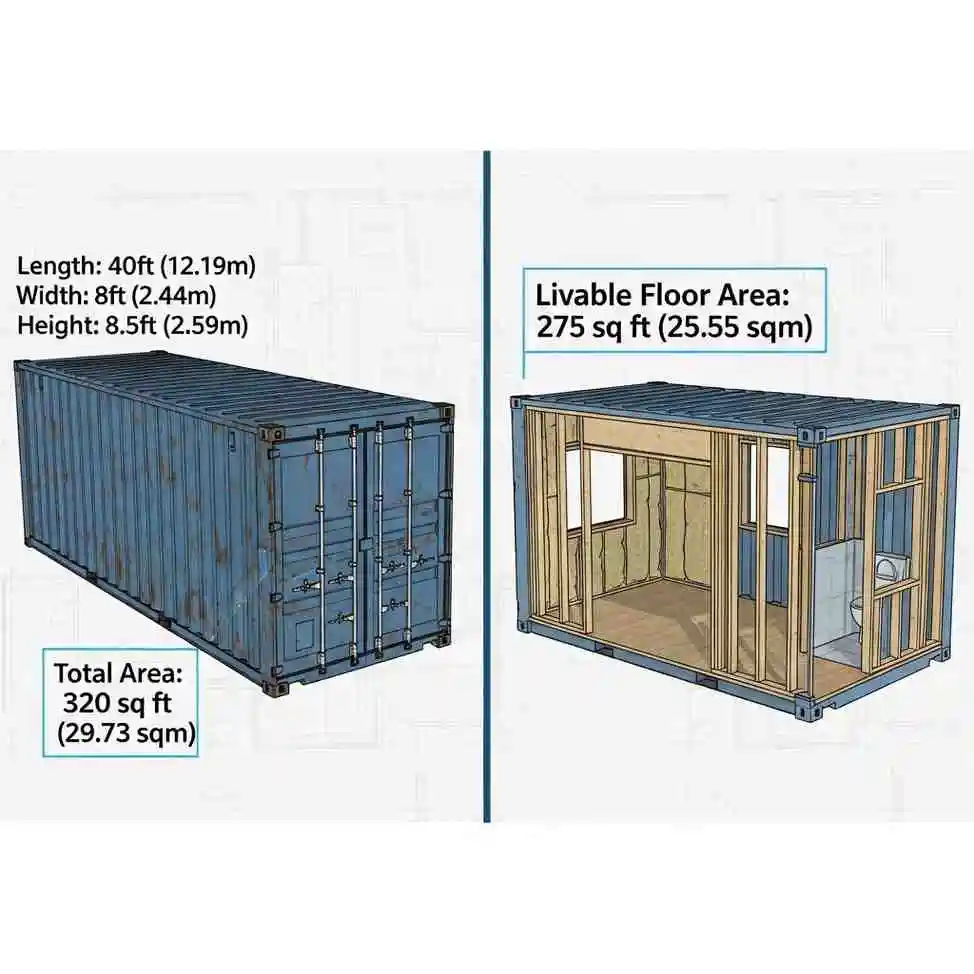
How Big is a Container Home? Realistic Living Space Calculator
Beyond the Box: Calculating Usable Square Footage After Insulation and Framing
One of the first questions aspiring builders ask is, “how big is a container home really?” The answer seems simple on the surface—multiply length by width—but the reality of construction tells a different story. Once you account for mandatory insulation, interior framing, and drywall, that 320-square-foot box shrinks significantly, often catching DIYers off guard during the design phase.
Understanding the true livable dimensions is critical not just for furniture placement, but for meeting International Residential Code (IRC) requirements for minimum room sizes. A design that looks spacious on a napkin sketch can easily violate code once the walls are built, leading to costly revisions or permitting rejections.
In this guide, we will break down the actual interior dimensions you can expect, how to calculate your “loss factor,” and why multi-container plans are often the smartest route for comfortable living. We will also cover the specific code requirements that dictate how small a room can legally be.
ISO Dimensions vs. Reality: What You Lose
When you look up how big is a container home, you usually find the external ISO (International Organization for Standardization) dimensions. For a standard 40-foot container, this is 8 feet wide by 40 feet long, totaling 320 square feet. However, you cannot live on the exterior metal skin.
The “Real” Width Problem
The internal width of a raw shipping container is approximately 7 feet 8 inches (2.35 meters). To make it habitable and code-compliant, you must add framing (usually 2×4 wood or steel studs) and insulation (spray foam or batting). This assembly typically consumes about 4-5 inches per wall.
If you lose 5 inches on both side walls, your interior finished width drops to roughly 6 feet 10 inches. This narrow corridor effect is the primary challenge in single-container designs. It restricts hallway widths, bathroom layouts, and the ability to place standard furniture without blocking traffic flow.
The International Code Council (ICC) sets standards for minimum room dimensions that can be difficult to meet in single-container configurations without careful planning. Failing to account for wall thickness is the number one reason DIY floor plans fail PE review.
IRC Minimum Room Requirements
Calculating how big is a container home isn’t just about physical space; it’s about legal space. The 2021 International Residential Code (IRC) mandates specific minimum areas for habitable rooms. If your container modification results in a room smaller than these standards, it cannot legally be classified as a bedroom or living space.
The 70-Square-Foot Rule
Per the IRC, every dwelling unit must have at least one habitable room that is not less than 120 square feet. Other habitable rooms (like bedrooms) must generally be at least 70 square feet. This prevents builders from creating “micro-rooms” that are unsafe or unusable.
📖 Click to Read Full IRC Section R304.1
IRC Section R304.1 Minimum area:
Habitable rooms shall have a floor area of not less than 70 square feet (6.5 m2).
Exception: Kitchens.
Source: 2021 International Residential Code
Furthermore, the code restricts the horizontal dimension of these rooms. You cannot satisfy the 70-square-foot requirement with a room that is 3 feet wide and 24 feet long. The room must be at least 7 feet wide in any horizontal dimension.
📖 Click to Read Full IRC Section R304.2
IRC Section R304.2 Minimum dimensions:
Habitable rooms shall be not less than 7 feet (2134 mm) in any horizontal dimension.
Exception: Kitchens.
Source: 2021 International Residential Code
The Professional Engineer’s Role in Space
Many builders assume a Professional Engineer (PE) only looks at “safety” items like snow loads or wind bracing. However, your PE plays a critical role in determining how big is a container home allowed to be functionally. When you want to expand beyond the 320 square feet of a single container, you typically need to join multiple units together.
Creating a “double-wide” container home requires cutting out the entire sidewalls of two adjacent containers to create a large, open living area. This removal significantly compromises the structural integrity of the box. A PE must calculate the size of the header beams and reinforcement columns required to support the roof once the metal skin is removed. These support beams often protrude into the interior space, further impacting your ceiling height and usable floor area.
Structural Reinforcement vs. Usable Space
A common surprise for builders is the intrusion of structural elements into their design. If your PE determines that a steel wide-flange beam must run the length of the opening to support the roof load, that beam might drop 8-12 inches below the existing ceiling. In a standard height container (8’6″ tall), this can reduce your clearance to below legal habitable limits.
After purchasing comprehensive plans from PermitContainerhomes.com, you’ll work with a licensed PE who will review the detailed documentation, adapt the structural reinforcement details for your specific site loads, and ensure that the finished interior dimensions meet local code requirements for habitable space.
Step-by-Step Space Calculation
To realistically answer how big is a container home, you must perform a “Net Usable Area” calculation. This process subtracts the necessary construction layers from the raw steel shell. The thickness of your insulation is the biggest variable, which is heavily dictated by your local climate zone’s energy code.
For additional guidance on residential building requirements and R-value recommendations by zip code, the U.S. Department of Energy provides resources on meeting energy standards. In colder climates, meeting these standards may require thicker walls, further reducing your interior space.
The “Shrinkage” Calculator
Use the following table to estimate your actual finished width. Note how quickly a 7’8″ wide space becomes a narrow corridor.
| Component | Thickness (One Wall) | Total Width Loss (Two Walls) | Remaining Width (Approx.) |
|---|---|---|---|
| ISO External Width | – | – | 8′ 0″ |
| Corrugated Steel Skin | ~2.0″ | 4.0″ | 7′ 8″ (Internal Raw) |
| Stud Framing (2×4) | 3.5″ | 7.0″ | 7′ 1″ |
| Spray Foam (Closed Cell) | (Inside Studs) | 0″ | 7′ 1″ |
| Drywall (1/2 inch) | 0.5″ | 1.0″ | 7′ 0″ (Finished) |
| Alternative: 2×6 Framing | 5.5″ | 11.0″ | 6′ 8″ (Finished) |
Note: Timelines and costs vary significantly by location, project complexity, and jurisdiction workload. Using 2×6 framing for higher R-values in cold climates can reduce an interior width to less than 7 feet, potentially violating bedroom dimension codes.
Hallways and Circulation
The IRC requires hallways to be a minimum of 3 feet wide. In a finished container that is only 7 feet wide, a hallway consumes nearly 43% of the total width. This makes “side-by-side” room layouts (like a bedroom next to a bathroom) physically impossible in a single 40-foot container. Designs must be linear (shotgun style), which impacts flow and privacy.
📖 View IRC Section R311.6 Hallways
IRC Section R311.6 Hallways:
The width of a hallway shall be not less than 3 feet (914 mm).
Source: 2021 International Residential Code
📖 View IRC Section R305.1 Ceiling Height
IRC Section R305.1 Minimum height:
Habitable space, hallways and portions of basements containing these spaces shall have a ceiling height of not less than 7 feet (2134 mm). Bathrooms, toilet rooms and laundry rooms shall have a ceiling height of not less than 6 feet 8 inches (2032 mm).
Source: 2021 International Residential Code
The Multi-Container Solution
Given the constraints of how big is a container home when using a single unit, the most effective solution for family living is a multi-container design. By joining two 40-foot containers side-by-side, you essentially double your footprint to 640 square feet, but more importantly, you solve the width problem.
However, this isn’t as simple as parking them next to each other. You must remove the interior walls to create a unified space. This removal compromises the structural integrity of the containers, as the corrugated metal walls carry the roof load. A Professional Engineer must design a beam-and-column system to support the roof where the walls used to be.
The “Open Plan” Benefit
With a 16-foot wide footprint (before insulation), you can comfortably fit standard hallways, queen-sized beds, and full bathrooms without feeling cramped. Even after losing 5 inches on the exterior walls for insulation, you are left with over 15 feet of usable width. This allows for a much more conventional home layout.
Cost vs. Space Trade-off
While multi-container homes offer superior livability, they significantly increase the complexity of the build. You are now dealing with foundation alignment for multiple units, heavy steel fabrication for headers, and complex weatherproofing at the seam between containers. This is why having a comprehensive plan set that details these connections is vital for your contractor and PE.
Expert Tips & Key Takeaways
Building a container home requires careful navigation of building codes, permit processes, and professional engineering requirements. Here are the essential points to remember as you move forward with your project to ensure you have enough space to live comfortably.
Essential Points Summary
- The Insulation Tax: Always subtract at least 8-10 inches from the total width of your container to calculate true livable space. A 8-foot wide container is effectively 7-foot wide inside.
- IRC Room Minimums: Ensure every habitable room is at least 70 square feet and 7 feet wide. Closets and bathrooms do not count toward this habitable minimum.
- Hallway Constraints: A 3-foot wide hallway in a single container takes up nearly half your available width, forcing linear floor plans.
- High Cube Advantage: Always prioritize High Cube containers (9’6″ tall) to allow for insulation and ductwork without dropping below the 7-foot ceiling height minimum.
- PE Necessity: Any modification to the container walls (doors, windows, joining units) requires a Professional Engineer to calculate reinforcement and stamp your plans.
With comprehensive planning documentation, Professional Engineer support, and understanding of your local requirements, you’re well-positioned to successfully navigate the permitting process and build your dream container home.
Ready to Start Your Container Home Project?
Explore our collection of comprehensive container home plans designed to align with 2021 IRC and IBC building code standards. Each plan includes complete architectural drawings, structural details, electrical layouts, plumbing systems, and beautiful 3D visualizations—everything your Professional Engineer needs for efficient review.
Browse Complete Plan Collection →Need Plan Modification? If you find a plan you love but need to adjust it for your local climate or personal needs—such as moving a window or adding a door—our team can help. We offer a professional plan modification service after purchase. Simply contact us with your modification needs, and we’ll provide a personalized quote.
⚖️ Professional Engineering & Plan Documentation Disclaimer
Important: Our plans are permit-ready but require review and stamping by a local licensed Professional Engineer (PE) in your jurisdiction. Final approval is subject to local building codes and regulations. We recommend consulting your local building department to verify all requirements.
Refund Policy: Due to the digital nature of our plans, all sales are final. Please review our Refund Policy for details.