
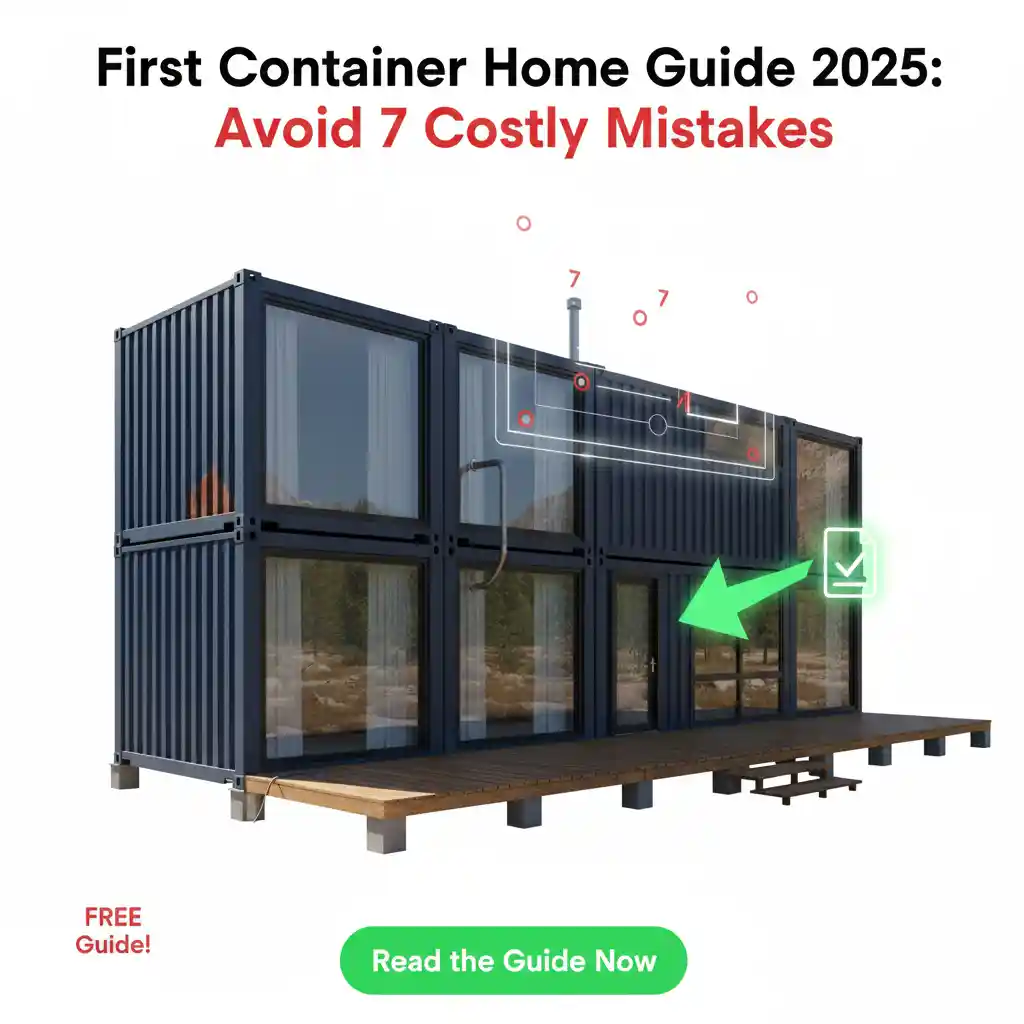
First Container Home Guide 2026: Avoid 7 Costly Mistakes & Build Successfully in the USA
Building your first container home in the USA is an exciting journey that requires careful planning and the right guidance. This comprehensive guide walks you through every step—from initial planning to move-in—helping you avoid the 7 biggest mistakes that cost first-time builders $10,000-$50,000+. We’re here to support you with honest, practical advice based on real-world container home projects across America.
First Container Home By The Numbers
- Average Timeline: 4-8 months from planning to move-in (vs. 8-16 months traditional)
- Average Cost: $125-$350 per sq ft all-in ($50,000-$175,000 for typical homes)
- Permit Success Rate: 87% with professional plans; 31% without engineering
- Most Common Mistake: Using standard 8’6″ containers (fails IRC codes)
- ROI Potential: 15-25% appreciation in first 5 years in progressive US markets
Step 1: First Container Home Reality Check
Before falling in love with Pinterest-perfect container home photos, we’d like to share the complete reality of building your first container home in the USA. Container homes offer wonderful advantages, and they also come with unique challenges that are important to understand. According to the U.S. Department of Energy, alternative homes like shipping container houses are gaining popularity for their energy efficiency potential when properly constructed.
The Truth About Your First Container Home: Pros & Cons
✅ Is a First Container Home Right for You?
Your first container home works exceptionally well if you:
- Live in progressive USA areas with container-friendly zoning (Portland OR, Austin TX, Denver CO, San Diego CA, Seattle WA)
- Value unique design and modern aesthetics over traditional appearance
- Have a realistic budget: $125-$250/sq ft including all costs
- Can invest in professional engineering ($5,000-$15,000 for plans with PE approval)
- Appreciate compact, efficient living (640-1,280 sq ft is ideal for first container homes)
- Want a faster construction timeline (4-8 months vs. 12-16 for traditional builds)
⚠️ Challenges to Consider Honestly
We believe in being transparent about the challenges you may face:
- Some USA jurisdictions still have restrictions on container homes—zoning research is essential
- Professional engineering approval is required by IRC and IBC codes in all USA jurisdictions
- Traditional mortgage financing can be more complex—alternative financing may be needed
- Insulation and climate control require specialized knowledge to prevent condensation
- Finding contractors with container experience may take extra effort in some areas
- Resale values can vary significantly depending on local market acceptance
Step 2: 7 Biggest First Container Home Mistakes (And How to Avoid Them)
Learning from others’ experiences is one of the wisest approaches to your container home project. These seven errors account for over 80% of first container home project challenges in the USA. Each one could potentially cost $10,000-$50,000, which is why we’re sharing this information to help you plan more effectively. The National Association of Home Builders reports that proper planning is the single most important factor in construction project success.
❌ Mistake #1: Buying Standard 8’6″ Containers
The Challenge: This is the most common first container home mistake. Standard containers are 8’6″ tall, providing only 7’0″-7’2″ interior ceiling height after insulation. IRC Section R305.1 requires 7’6″ (90 inches) minimum ceiling height in all habitable spaces.
What May Happen: Building departments typically identify this issue during plan review. At that point, you may have already purchased containers ($2,500-$4,000 each), paid for delivery ($500-$1,500), and possibly started site work.
The Better Approach: We recommend specifying High Cube (9’6″) containers for all habitable spaces. They cost approximately $800-$1,500 more per container but provide 8’0″-8’2″ finished ceiling height, comfortably meeting IRC requirements. This investment typically pays for itself by avoiding costly modifications later.
❌ Mistake #2: Skipping Professional Engineering
The Challenge: Some first-time builders hope to reduce costs by using generic plans from the internet or DIY drawings to avoid $5,000-$15,000 engineering costs. However, IRC Section R301.1.3 and IBC Section 3115 require Professional Engineer (PE) approval for all structural modifications—this is a mandatory requirement for container homes in all USA jurisdictions.
What May Happen: Building departments require PE-stamped plans for permit approval. Without them, applications are typically returned, which may result in lost permit fees ($500-$2,000) and project delays of weeks or months.
The Better Approach: We encourage budgeting $2,500-$5,000 for single container engineering, or $5,000-$10,000 for 2-4 containers. Our permit-ready container home plans are professionally designed to facilitate PE review and approval. Please note that buyers are responsible for obtaining local PE approval to comply with building codes in their specific USA jurisdiction, as requirements vary by location.
❌ Mistake #3: Buying Land Without Checking Zoning
The Challenge: Some builders purchase property for their container home, then discover their county or city has restrictions on container homes or HOA regulations against “non-traditional structures.” Many USA municipalities have specific regulations for alternative housing.
What May Happen: You may own land where container homes face restrictions. Options might include selling at a potential loss, applying for a variance (which can cost $5,000-$15,000 with uncertain outcomes), or reconsidering the container home approach.
The Better Approach: Before making offers on land, we strongly recommend calling your local planning department to ask “Are shipping container homes permitted as primary residences?” Request written confirmation, review any HOA covenants, and check minimum square footage requirements. Investing $500-$1,000 for a zoning attorney’s review is typically far more cost-effective than discovering issues after purchase. The American Planning Association provides helpful zoning resources.
❌ Mistake #4: Underestimating Total Costs
The Challenge: First-time builders sometimes see “$3,000 container + $15,000 materials = $20,000 home!” In reality, containers are just the shell. You’ll also need foundation ($8,000-$25,000), insulation ($5,000-$12,000), HVAC ($6,000-$15,000), plumbing ($8,000-$18,000), electrical ($6,000-$12,000), windows/doors ($4,000-$12,000), engineering ($5,000-$15,000), permits ($3,000-$12,000), and labor ($30,000-$80,000).
What May Happen: Projects can run out of funding partway through construction. Incomplete structures are difficult to finance or sell, which can create significant challenges.
The Better Approach: We recommend budgeting $125-$200/sq ft minimum for a complete first container home ($50,000-$80,000 for a single 40′ container; $80,000-$160,000 for 640-1,280 sq ft). Adding a 20% contingency for unexpected costs is wise. Getting detailed written quotes from every trade before starting helps ensure accurate budgeting. See our complete cost estimator with real USA pricing.
❌ Mistake #5: Buying Damaged Containers
The Challenge: Some builders purchase inexpensive damaged “cargo-worthy” or “wind & water tight” containers ($1,500-$2,500) to save $2,000-$3,000 per box, rather than buying one-trip condition containers ($4,500-$7,000) from reputable USA suppliers.
What May Happen: Structural repairs can cost $3,000-$8,000 per container (steel replacement, rust remediation, floor replacement). Some containers may have chemical floor treatments requiring expensive removal. Building inspectors may have concerns about heavily damaged containers.
The Better Approach: We suggest purchasing only “One-Trip” or certified “Cargo-Worthy” containers. Personal inspection or professional inspection services ($200-$400) are worthwhile investments. Look for containers with no toxic floor treatments, good structural integrity at corners, minimal rust, straight frames, and intact ISO certification plates.
❌ Mistake #6: Ignoring Egress Window Requirements
The Challenge: IRC Section R310 requires every bedroom to have an emergency escape window with specific dimensions: 5.7 sq ft minimum net clear opening, 24″ minimum height, 20″ minimum width, maximum 44″ sill height. Container wall thickness (6″-8″) reduces net clear opening by 30-40%.
What May Happen: This issue may be identified during plan review or final inspection. Cutting larger openings through steel walls after construction can cost $800-$2,000 per opening, plus structural reinforcement ($1,500-$3,000 per window).
The Better Approach: We recommend planning 36″×30″ or 38″×32″ rough openings minimum for bedroom egress windows. Your PE must provide structural reinforcement details for each opening. Don’t assume standard residential windows will meet requirements in container construction. See our building codes section for complete requirements.
❌ Mistake #7: Hiring Inexperienced Contractors
The Challenge: Container homes require specialized skills: steel welding, metal cutting, understanding load paths through corrugated steel, and proper insulation techniques to prevent condensation. Traditional carpenters may not have container-specific experience.
What May Happen: Inexperienced contractors may cut openings without proper reinforcement, install incorrect insulation causing condensation and potential mold issues ($8,000-$15,000 remediation), take longer than anticipated, or require additional change orders ($10,000-$40,000 extra).
The Better Approach: We encourage interviewing at least 3 contractors with proven container home experience. Request references from previous container projects in your USA region, verify licensed welders on staff, confirm metal fabrication experience, and ensure proper insurance coverage. The 10-20% premium for specialized skills is typically a worthwhile investment. Learn more in our blog and guides.
Step 3: First Container Home Building Codes & Permits Explained
Understanding first container home building codes is essential—they’re legal requirements throughout the USA that protect your safety and investment. Here’s what every first container home builder should know about IRC 2021 codes and permits. Most USA jurisdictions have adopted the International Residential Code (IRC) or similar standards.
Key Building Code Requirements
According to IRC 2021 and IBC 2021, container homes must meet:
- Minimum Ceiling Heights: 7’6″ (90″) in habitable rooms per IRC R305.1
- Structural Engineering: PE approval required for all structural modifications per IRC R301.1.3 and IBC 3115
- Egress Requirements: Emergency escape windows in bedrooms per IRC R310
- Foundation Standards: Permanent foundation meeting local frost depth and seismic requirements
- Energy Efficiency: Insulation R-values appropriate for your climate zone
- Electrical Systems: Full compliance with National Electrical Code (NEC)
- Plumbing Systems: Compliance with International Plumbing Code (IPC)
- Fire Safety: Smoke detectors, CO detectors, proper egress per IRC requirements
📋 USA Permit Application Process for First Container Home
- Pre-Application: Verify zoning allows container homes; consider requesting a pre-application meeting with your building department
- Design Phase: Work with an architect or engineer to create plans compliant with IRC 2021 and local amendments
- Engineering Review: Obtain local PE approval for all structural modifications (this is the buyer’s responsibility)
- Submit Application: Submit complete permit package including site plans, architectural drawings, PE-stamped structural calculations, and energy calculations
- Plan Review: Building department reviews (typically 2-8 weeks in most USA jurisdictions); respond to any correction requests
- Permit Issuance: Pay permit fees ($1,500-$8,000); receive building permit to begin construction
- Inspections: Schedule mandatory inspections: foundation, framing, electrical, plumbing, mechanical, insulation, and final
- Certificate of Occupancy: After final inspection approval, receive CO to legally occupy your container home
Step 4: Choosing Containers for Your First Container Home
The containers you select for your first container home fundamentally affect livability, code compliance, and long-term satisfaction. Here’s your complete container buying guide for USA buyers. Quality containers are available from suppliers nationwide and regional distributors across the United States.
First Container Home Sizes & Configurations
Standard Container Dimensions
| Container Type | External Dimensions | Internal Height | Finished Ceiling | IRC Compliant? |
|---|---|---|---|---|
| Standard 20′ | 20′ × 8′ × 8’6″ | 7’10” | 7’0″-7’2″ | ❌ No |
| Standard 40′ | 40′ × 8′ × 8’6″ | 7’10” | 7’0″-7’2″ | ❌ No |
| High Cube 20′ | 20′ × 8′ × 9’6″ | 8’10” | 8’0″-8’2″ | ✅ Yes |
| High Cube 40′ | 40′ × 8′ × 9’6″ | 8’10” | 8’0″-8’2″ | ✅ Yes |
Step 5: Complete First Container Home Cost Breakdown
Let’s discuss realistic first container home costs. This comprehensive breakdown is based on actual completed container home projects across the USA in 2024-2026. Prices vary by region—costs are typically 20-30% higher in California, New York, and other high-cost areas.
Single 40′ High Cube First Container Home (320 sq ft)
| Cost Category | Low Range | High Range | Notes |
|---|---|---|---|
| Container Purchase (1x 40′ HC) | $4,500 | $7,000 | One-trip condition recommended |
| Delivery & Placement | $800 | $2,500 | Varies by distance and access |
| Foundation (Pier & Beam) | $3,500 | $8,000 | Most economical option |
| Engineering & Plans | $2,500 | $5,000 | PE approval required |
| Permits & Fees | $1,500 | $4,000 | Varies by jurisdiction |
| Steel Cutting & Welding | $3,000 | $6,000 | Openings and reinforcement |
| Windows & Doors | $2,500 | $5,000 | Energy-efficient recommended |
| Insulation (Spray Foam) | $2,500 | $4,500 | Closed-cell spray foam ideal |
| Electrical System | $3,000 | $5,000 | Licensed electrician required |
| Plumbing System | $4,000 | $7,000 | Licensed plumber required |
| HVAC System | $3,000 | $6,000 | Mini-split systems popular |
| Interior Finishes | $5,000 | $10,000 | Flooring, drywall, paint |
| Kitchen & Bath Fixtures | $3,000 | $8,000 | Budget to luxury options |
| Misc & Contingency (20%) | $7,000 | $14,000 | Unexpected costs buffer |
| TOTAL ESTIMATED COST | $46,300 | $92,000 | $145-$290 per sq ft |
💰 Cost Management Tips for Your First Container Home
- Buy containers locally: Can save $500-$2,000 per container on delivery from regional USA suppliers
- DIY finish work: Handle painting, flooring, and basic carpentry yourself (potential savings: $8,000-$15,000)
- Use permit-ready plans: Professional plans can save months of design time and revision costs
- Simple foundation: Pier & beam typically costs 40-60% less than slab or basement options
- Energy-efficient systems: Invest in good insulation upfront to reduce $100-$300/month in ongoing utility costs
- Shop building material sales: Purchase windows and appliances during USA holiday sales (Memorial Day, Labor Day, Black Friday)
Step 6: First Container Home Foundation Options
Foundation choice for your first container home significantly affects cost, timeline, and long-term performance. Here’s what you need to know for your container home foundation. The American Concrete Institute provides technical resources for foundation design throughout the USA. Learn more about foundation options on our website.
Pier & Beam Foundation
Cost Range: $3,500-$8,000 for single 40′ container
Best For: Most climates; cost-conscious builders; sloped lots
Advantages: Most economical option, excellent drainage, easy utility access, works on slopes
Considerations: Requires proper frost depth in cold climates, needs skirting for finished appearance
Concrete Slab Foundation
Cost Range: $6,000-$12,000 for single 40′ container
Best For: Warm climates; permanent, solid feel; wheelchair accessibility
Advantages: Very stable, pest-resistant, wheelchair accessible, polished concrete finish options
Considerations: More expensive, utility modifications difficult, requires level site
Strip/Grade Beam Foundation
Cost Range: $5,000-$10,000 for single 40′ container
Best For: Cold climates; areas with frost concerns; seismic zones
Advantages: Extends below frost line, very strong, good for seismic areas
Considerations: Moderate cost, requires excavation, professional installation needed
Basement Foundation
Cost Range: $15,000-$30,000+ for single 40′ container
Best For: Cold climates; maximizing total square footage; storage needs
Advantages: Doubles living/storage space, excellent insulation, maximum resale value
Considerations: Highest cost option, longer construction timeline, requires proper waterproofing
🏗️ Foundation Requirements by USA Region
- Northeast & Midwest: Frost line depth 36″-60″; pier footings must extend below frost line; basement foundations common
- Southeast & Gulf Coast: Hurricane anchoring required; elevated foundations for flood zones; moisture barriers critical
- Southwest & West: Seismic anchoring required in CA, WA, OR; expansive soil considerations; slab-on-grade popular
- Mountain States: Deep frost lines (48″-72″); pier & beam with proper drainage; snow load considerations
Step 7: First Container Home Construction Timeline
Understanding your first container home timeline helps you plan, budget, and coordinate trades effectively. Here’s the typical schedule from permits to move-in across USA markets.
📆 First Container Home Month-by-Month Schedule
Months 1-2: Planning & Permits
- Finalize your container home design with architect or engineer
- Order containers from USA suppliers (lead time: 2-6 weeks)
- Submit permit application to local building department
- Interview contractors with container experience and obtain written bids
- Consider using our permit-ready plans to help streamline approval
Month 3: Foundation & Delivery
- Building permit approval received from USA jurisdiction
- Pour foundation (piers or slab) per PE-approved plans
- Containers delivered to site by regional USA supplier
- Crane places containers on foundation (requires proper equipment and clearances)
- First building inspection: foundation approval
Month 4: Structural Modifications
- Cut door and window openings per PE-approved engineering calculations
- Install structural reinforcement around all openings (critical step)
- Weld containers together if multi-container design
- Install roof modifications, overhangs, extensions per plans
- Second building inspection: structural framing approval
Months 5-7: MEP & Finishes
- Electrical, plumbing, HVAC rough-in (inspections required at each stage)
- Spray foam insulation installation (recommended for USA climates) – see our insulation guide
- Drywall, interior finishes, flooring, paint
- Install cabinets, countertops, appliances, fixtures
- Final inspections: electrical, plumbing, mechanical, energy compliance
- Certificate of Occupancy issued – move-in ready!
⏰ Timeline Tips for USA Container Home Builders
- Permit review times vary significantly (2-8 weeks typical; can be longer in busy jurisdictions)
- Winter weather may extend timelines by 1-2 months in northern USA states
- Pre-ordering materials helps prevent delays (windows often have 4-8 week lead times)
- Schedule crane service 2-4 weeks in advance (high demand in construction season)
- Build buffer time into your schedule—most projects take 10-20% longer than initial estimates
Step 8: First Container Home Insulation & Climate Control
Proper first container home insulation is essential for USA climates. Steel containers conduct heat and cold rapidly—uncomfortably hot in summer and very cold in winter without proper insulation. Getting insulation right significantly affects long-term comfort in your container home. The U.S. Department of Energy recommends specific R-values for different climate zones. Visit our detailed insulation guide and use our insulation calculator for your specific needs.
❄️🔥 Recommended R-Values by USA Climate Zone
- Zone 1-2 (South Florida, South Texas, Hawaii): Minimum R-13 walls, R-30 roof
- Zone 3-4 (Southeast, Southwest, Pacific Coast): Minimum R-19 walls, R-38 roof
- Zone 5-6 (Midwest, Mid-Atlantic, Mountain States): Minimum R-21 walls, R-49 roof
- Zone 7-8 (Northern states, Alaska): Minimum R-25 walls, R-60 roof
Learn more about energy-efficient weatherization from the Department of Energy.
Insulation Options for Container Homes
Closed-Cell Spray Foam (Most Recommended)
Cost: $2,500-$4,500 for single 40′ container
R-Value: R-6 to R-7 per inch
Advantages: Excellent vapor barrier, prevents condensation, air sealing, high R-value per inch
Best For: All USA climates, especially humid regions
Rigid Foam Panels
Cost: $1,800-$3,500 for single 40′ container
R-Value: R-4 to R-6 per inch
Advantages: Lower cost, DIY-friendly, good vapor barrier with proper sealing
Best For: Dry climates, budget-conscious builders with DIY skills
Mineral Wool (Rockwool)
Cost: $2,000-$3,800 for single 40′ container
R-Value: R-4 per inch
Advantages: Fire-resistant, sound dampening, mold-resistant
Considerations: Requires separate vapor barrier; condensation management critical
HVAC System Recommendations
Container homes require properly sized climate control systems:
- Mini-Split Heat Pumps: Most popular choice ($3,000-$6,000); efficient, quiet, no ductwork needed
- Traditional HVAC: More expensive ($5,000-$8,000); requires ductwork; works if space allows
- Portable/Window Units: Budget option ($800-$2,000); less efficient; acceptable for small spaces
- Radiant Floor Heating: Luxury option ($4,000-$8,000); excellent comfort; works best with slab foundation
Step 9: Finding Professionals for Your First Container Home
Your first container home professional team significantly influences your project success. Here’s who you need for your container home in the USA and guidance for finding qualified people.
1. Professional Engineer (PE) – MANDATORY FOR USA JURISDICTIONS
What They Do: Structural engineering calculations for all container home modifications; PE approval required for permits in all USA jurisdictions
Cost for First Container Home: $2,500-$15,000 depending on complexity and USA region
How to Find: Search “structural engineer container homes [your city/state]”; verify PE license active in your USA state via state engineering board; request container-specific experience references
Important Note: Our permit-ready plans are professionally designed to facilitate PE review and approval, but buyers are responsible for obtaining local Professional Engineer (PE) approval to comply with building codes in their USA jurisdiction.
2. General Contractor (with container experience)
What They Do: Coordinate all trades; manage container home construction timeline; help ensure code compliance
Cost: Typically 10-20% of total project budget ($8,000-$30,000+ for most container homes)
How to Find: Request at least 3 references from completed container projects in your USA state; verify active contractor’s license, insurance, and bonding; check with Better Business Bureau
3. Specialized Trades
- Steel Fabricator/Welder: Cuts openings, installs reinforcement ($3,000-$8,000)
- Insulation Specialist: Spray foam installation ($2,500-$5,000)
- Licensed Electrician: All electrical work per USA National Electrical Code ($3,000-$6,000) – use our electrical calculator
- Licensed Plumber: All plumbing per USA Uniform Plumbing Code ($4,000-$8,000)
- HVAC Technician: Climate control systems sized for container construction ($3,500-$7,000)
Tips for Hiring Container Home Professionals
- Always interview at least 3 candidates for major roles
- Request and actually contact previous client references
- Verify all licenses are current and in good standing
- Confirm adequate insurance coverage (general liability minimum $1M)
- Get detailed written quotes before starting work
- Review contracts carefully; consider having an attorney review major contracts
- Establish clear payment schedules tied to completed milestones
Step 10: First Container Home Financing Options
Traditional mortgages may not work for container homes under construction. Here are realistic first container home financing options available in the USA market. Many lenders are becoming more container-friendly as the alternative housing market grows.
💡 Financing Tips for USA Buyers
- Shop multiple lenders: Interest rates can vary 2-3% between USA banks, credit unions, and online lenders
- Emphasize permanence: Show permanent foundation, utilities, compliance with USA building codes
- Get pre-approval: Before buying land or containers for your container home
- Consider construction-to-permanent loans: Single closing can save $3,000-$8,000 in USA closing costs
- Credit unions often more flexible: Local USA credit unions may approve projects where big banks won’t
- Have complete documentation ready: PE-approved plans, detailed budget, contractor quotes, and project timeline
Check HUD and FHA for alternative housing financing programs that may apply to your situation.
🎯 Ready to Start Your First Container Home in the USA?
You’ve learned how to avoid the costly first container home mistakes that create challenges for many USA projects. Now it’s time to take the next step with professional, permit-ready plans designed to work with USA building codes.
✅ What Our First Container Home Plans Include
- ✓ Professional architectural drawings designed for USA jurisdictions
- ✓ IRC 2021 & IBC 2021 compliance documentation to facilitate permit applications
- ✓ High Cube (9’6″) specifications for code compliance
- ✓ Egress window details with reinforcement specifications
- ✓ Foundation engineering options for various USA climates
- ✓ Complete MEP (Mechanical, Electrical, Plumbing) drawings
- ✓ Energy code compliance guidance for USA climate zones
- ✓ Designed to facilitate local PE approval process (buyer responsible for obtaining PE approval)
🛠️ Plan Customization Services Available
We understand that every project has unique requirements. After purchasing your plans, we’re happy to offer plan editing and customization services at an additional cost to accommodate your specific needs. This service allows you to modify:
- Room layouts and configurations
- Window and door placements
- Specific local code requirements
- Foundation options for your site conditions
- Climate-specific insulation specifications
Contact our team after your purchase to discuss customization options and pricing based on the scope of modifications needed.
Our plans have been used as the foundation for successful container home projects across the USA. We’re committed to supporting your container home journey with honest guidance and quality documentation.
First Container Home Pre-Build Checklist
✅ Complete Before Starting Your First Container Home in USA
📚 Additional Resources for Your First Container Home
Final Thoughts: Your First Container Home Success Path in the USA
Building your first container home in the USA is an exciting challenge that requires careful planning, professional guidance, and realistic expectations. Thousands of Americans have successfully built beautiful, code-compliant, permitted container homes from California to Maine, Texas to Washington. The common thread among successful projects? They invested in professional engineering approval, used high cube specifications, understood USA building codes before starting, and maintained realistic budgets.
Your container home journey starts with education—and you’ve just completed a comprehensive container home guide for USA buyers. Now it’s time to take the next step: securing professional plans designed to work with USA building departments and IRC 2021 / IBC 2021 compliance requirements. Remember, while our plans are permit-ready and designed to facilitate professional engineer review, buyers are responsible for obtaining local Professional Engineer (PE) approval to comply with building codes in their USA jurisdiction.
The container home market in the USA continues to grow as more jurisdictions recognize shipping containers as legitimate building materials. Progressive states like Oregon, Texas, Colorado, and California have led the way, and container homes are now being permitted in most USA markets with proper engineering and code compliance. Whether you’re building in urban Portland, suburban Austin, rural Montana, or coastal Florida, this guide provides foundational knowledge for your success.
We invite you to start your container home project today with confidence. Browse our permit-ready container home plans designed specifically to work with USA building codes, connect with local professionals in your state, and join the growing community of successful container home owners across America. We’re here to support your journey with honest guidance, quality documentation, and optional customization services to meet your specific needs.
⚠️ Important Information for USA Buyers
This first container home guide provides educational information for USA residents interested in container home construction. It is not professional engineering advice, legal advice, or construction advice. Container home construction requires professional engineering approval by a licensed Professional Engineer (PE) per IRC §R301.1.3, IBC §3115, and applicable state/local codes.
Buyer Responsibility: When purchasing our permit-ready container house plans, buyers are responsible for obtaining local Professional Engineer (PE) approval to comply with building codes in their USA jurisdiction. Our plans are professionally designed to facilitate PE review and approval, but do not constitute PE-stamped plans ready for immediate permit submission. Local PE approval requirements vary by state and municipality throughout the USA, and obtaining this approval is the purchaser’s responsibility.
Always verify specific requirements with your local USA building department for your container home project. Building codes, zoning regulations, and permit requirements vary significantly across USA jurisdictions. What’s permitted in Austin, TX may not be allowed in New York, NY, or your specific location. Conducting proper due diligence is your responsibility as a property owner and builder.
No Guarantees or Warranties: We do not provide money-back guarantees, refunds, or warranties of any kind. While our plans are professionally designed with USA building code compliance in mind and structured to facilitate PE review, permit approval depends on multiple factors including local jurisdictions, PE approval, site-specific conditions, proper construction execution, and compliance with all applicable USA regulations. Success requires proper planning, qualified professionals, adequate funding, and compliance with all applicable regulations in your area.
Container home construction is a significant undertaking. We encourage all prospective builders to conduct thorough research, consult with local professionals, verify all local requirements, and ensure adequate resources before beginning any construction project.


