Container House Colorado: Designing for Cold Climates
Master thermal efficiency and code compliance for Colorado’s challenging mountain climate
Building a container house in Colorado presents unique challenges that require careful attention to thermal efficiency and cold climate design. From Denver’s urban corridors at 5,280 feet to mountain communities exceeding 10,000 feet elevation, Colorado’s diverse climate zones demand specialized construction approaches that address extreme temperature fluctuations, significant snow loads, and deep frost penetration.
Colorado spans Climate Zones 4B through 7, with winter design temperatures ranging from 20°F in lower elevations to -30°F in high mountain areas. Container homes, constructed from steel shipping containers, face particular thermal challenges due to steel’s high thermal conductivity, making proper insulation and vapor barrier installation absolutely critical for year-round comfort and energy efficiency.
This comprehensive guide walks you through the specific IRC requirements, thermal envelope strategies, and Professional Engineer considerations necessary for successful container house construction in Colorado. You’ll learn how to achieve superior R-values, manage condensation risks, address frost depth requirements, and navigate the permitting process with confidence.
Understanding Colorado’s Climate Challenges for Container Homes
Colorado’s container house projects must address three primary environmental factors that directly impact structural design and thermal performance. The state’s high-altitude locations create unique conditions where intense solar radiation during the day combines with rapid nighttime temperature drops, sometimes exceeding 40°F differentials. This dramatic diurnal temperature swing places extraordinary stress on building envelopes, particularly steel structures like shipping containers.
The International Code Council publishes the IRC, which establishes baseline requirements that Colorado jurisdictions adopt and often modify to address local conditions. Most Colorado communities fall within Climate Zones 4B, 5B, 6B, and 7, each carrying specific insulation requirements, air sealing standards, and mechanical system specifications designed to maintain indoor comfort while minimizing energy consumption.
Colorado Climate Zone Distribution
Understanding which climate zone applies to your Colorado container house project is fundamental to determining code requirements. Zone 4B covers lower-elevation eastern plains communities with winter design temperatures of 5°F to 20°F. Zone 5B encompasses most Front Range cities including Denver, Colorado Springs, Boulder, and Fort Collins, where winter design temperatures range from -5°F to 15°F.
Mountain communities above 7,500 feet typically fall into Zones 6B or 7, experiencing winter design temperatures as low as -30°F. These extreme conditions require enhanced insulation strategies, advanced air sealing techniques, and mechanical systems capable of maintaining safe interior temperatures during extended cold periods.
| Climate Zone | Colorado Locations | Winter Design Temp | Heating Degree Days |
|---|---|---|---|
| 4B | Eastern Plains (below 5,000 ft) | 5°F to 20°F | 5,000-6,000 HDD |
| 5B | Denver, Boulder, Fort Collins | -5°F to 15°F | 6,000-7,000 HDD |
| 6B | Mountain towns (7,500-9,000 ft) | -15°F to 5°F | 7,000-9,000 HDD |
| 7 | High elevation (above 9,000 ft) | -30°F to -10°F | 9,000+ HDD |
Unique Thermal Challenges of Steel Container Construction
Shipping containers are constructed from corrugated steel approximately 3/16 inch thick, creating a continuous thermal bridge that conducts heat rapidly in both directions. Without proper insulation, interior surfaces reach exterior temperatures within minutes, causing severe condensation problems during heating seasons and creating uncomfortable living conditions year-round.
Steel’s thermal conductivity (approximately R-0.001 per inch) means the container shell provides essentially zero insulation value. A container house in Colorado’s cold climate without adequate insulation can experience interior surface temperatures below freezing even when heated, leading to moisture accumulation, mold growth, and structural deterioration through rust formation.
IRC Energy Code Requirements for Cold Climate Zones
The 2021 International Residential Code Chapter 11 establishes minimum energy efficiency standards that govern thermal envelope performance, mechanical system specifications, and air sealing requirements for residential construction. Colorado jurisdictions adopt these provisions with amendments reflecting local climate conditions, altitude effects, and regional construction practices.
For additional guidance on residential building requirements, the U.S. Department of Energy provides resources on meeting energy code standards for container home projects. These federal resources complement IRC requirements with practical strategies for achieving superior energy performance in challenging climates.
Building Thermal Envelope Requirements
IRC Section N1102 defines the building thermal envelope as the boundary between conditioned and unconditioned space, establishing performance criteria for all components including walls, ceilings, floors, windows, and doors. For container house construction in Colorado, this envelope must achieve prescribed U-factors or R-values based on your specific climate zone designation.
📖 View Full IRC Section N1102.1.2 Text
IRC Section N1102.1.2 – Insulation and Fenestration Criteria:
The building thermal envelope shall meet the requirements of Table N1102.1.2 based on the climate zone specified in Section N1101.7. Assemblies shall have a U-factor equal to or less than that specified in Table N1102.1.2. Fenestration shall have a U-factor and glazed fenestration SHGC equal to or less than that specified in Table N1102.1.2.
Source: 2021 International Residential Code
Table N1102.1.3 prescribes minimum insulation R-values by component and climate zone. For Climate Zone 5B (typical of Front Range Colorado), wood frame walls require R-20 or R-13 cavity insulation plus R-5 continuous insulation. Ceiling assemblies require R-60, floor assemblies R-30, and basement walls R-15 continuous insulation or R-19 cavity insulation.
Container house construction presents unique challenges in meeting these requirements because the steel structure interrupts traditional cavity insulation approaches. Most successful designs utilize spray foam insulation applied directly to interior steel surfaces, rigid foam board systems with furring strips, or exterior insulation finishing systems that maintain thermal continuity across the entire envelope.
| Building Component | Zone 5B Requirement | Zone 6B Requirement | Zone 7 Requirement |
|---|---|---|---|
| Ceiling (Attic) | R-60 | R-60 | R-60 |
| Wood Frame Wall | R-20+5 or R-13+10 | R-20+5 or R-13+10 | R-20+5 or R-13+10 |
| Floor (Over Unconditioned) | R-30 | R-30 | R-38 |
| Basement Wall | R-15ci or R-19 | R-15ci or R-19 | R-15ci or R-19 |
| Slab Edge (Heated) | R-10, 4 ft depth | R-10, 4 ft depth | R-10, 4 ft depth |
Note: “ci” indicates continuous insulation. Values shown are minimum requirements; actual designs often exceed these specifications for improved comfort and energy efficiency.
Air Sealing and Infiltration Standards
Beyond insulation R-values, IRC Section N1102.4.1.2 requires whole-building air leakage testing to verify envelope tightness. Colorado jurisdictions in Climate Zones 5 through 8 must achieve air leakage rates not exceeding 3.0 air changes per hour at 50 Pascals pressure differential (3.0 ACH50) when tested in accordance with ANSI/RESNET/ICC 380 or ASTM E779.
Container construction offers potential advantages for air sealing because the steel shell forms an inherently airtight barrier. However, penetrations for windows, doors, utilities, and ventilation systems require meticulous sealing to maintain performance. Professional testing after construction completion verifies compliance and identifies any deficiencies requiring correction before occupancy approval.
📖 View IRC Section N1102.4.1.2 Air Leakage Testing Requirements
IRC Section N1102.4.1.2 – Testing:
The building or dwelling unit shall be tested for air leakage. The maximum air leakage rate for any building or dwelling unit under any compliance path shall not exceed 5.0 air changes per hour or 0.28 cubic feet per minute (CFM) per square foot of dwelling unit enclosure area. Testing shall be conducted in accordance with ANSI/RESNET/ICC 380, ASTM E779 or ASTM E1827 and reported at a pressure of 0.2 inch w.g. (50 Pascals). Where required by the code official, testing shall be conducted by an approved third party.
Source: 2021 International Residential Code
Thermal Envelope Design and R-Value Specifications
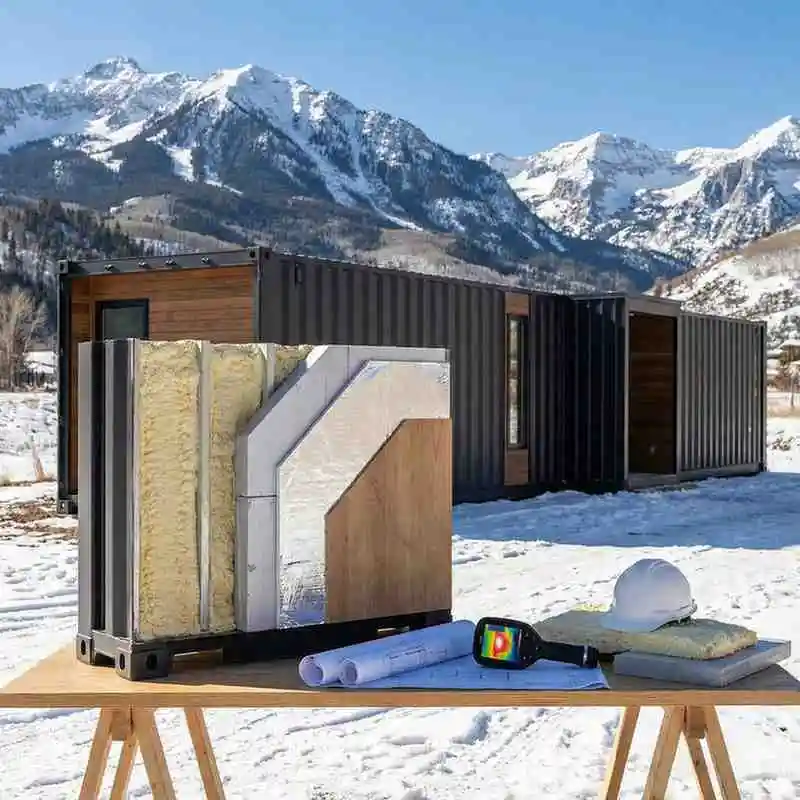
Achieving superior thermal performance in a container house in Colorado requires strategic insulation placement that addresses the steel structure’s thermal bridging characteristics while meeting or exceeding IRC minimum R-value requirements. Three primary insulation strategies dominate successful Colorado container home construction: interior spray foam application, exterior insulated cladding systems, and hybrid approaches combining multiple insulation types.
Interior spray foam insulation, typically closed-cell polyurethane applied at 3 to 6 inches thickness, provides both insulation and air sealing in a single application. Closed-cell foam delivers approximately R-6 to R-7 per inch, meaning 5 inches achieves R-30 to R-35 while creating a vapor barrier that prevents condensation on cold steel surfaces. This approach maintains maximum interior space within the container’s 7’10” interior width while completely isolating the steel envelope from conditioned air.
Insulation System Options for Colorado Climates
Exterior insulation systems wrap the container shell with continuous rigid foam boards, typically extruded polystyrene (XPS) at R-5 per inch or polyisocyanurate at R-6 per inch, followed by weather-resistant cladding. This approach preserves full interior dimensions, eliminates all interior thermal bridging, and allows the container’s thermal mass to moderate indoor temperature fluctuations. However, exterior systems require robust cladding attachment details and careful moisture management to prevent water intrusion.
Hybrid systems combine spray foam in critical areas (corners, ceiling-to-wall transitions, window and door perimeters) with rigid foam board on flat wall surfaces. This balanced approach optimizes material costs while ensuring superior performance at thermal weak points. Many Colorado container homes use 3 inches of interior spray foam (R-18 to R-21) supplemented with R-13 batt insulation in furred-out wall cavities, achieving total R-values of R-31 to R-34.
| Insulation Strategy | Typical R-Value | Advantages | Considerations |
|---|---|---|---|
| Closed-Cell Spray Foam (5″) | R-30 to R-35 | Air sealing, vapor barrier, fast application | Higher material cost, reduces interior width by 5″ |
| Exterior Rigid Foam (4″ XPS) | R-20 base + interior finish | Preserves interior space, thermal mass benefit | Requires cladding, attachment complexity |
| Hybrid: Spray Foam + Batts | R-31 to R-34 combined | Cost-effective, optimized performance | More labor intensive, requires furring |
| Structural Insulated Panels (Interior) | R-25 to R-40 | Fast installation, continuous insulation | Attachment details critical, higher cost |
Vapor Barrier and Condensation Management
Colorado’s cold climate creates significant vapor drive from warm, humid interior air toward cold exterior surfaces during heating seasons. IRC Section R702.7 requires vapor retarders in wall assemblies, with Class I or Class II vapor retarders specified for Climate Zones 5 and higher. Container construction must prevent interior moisture from reaching cold steel surfaces where it would condense, freeze, and cause long-term durability problems.
📖 View IRC Section N1102.1.1 Vapor Retarder Requirements
IRC Section N1102.1.1 – Vapor Retarder:
Wall assemblies in the building thermal envelope shall comply with the vapor retarder requirements of Section R702.7.
Source: 2021 International Residential Code
Closed-cell spray foam serves as a Class II vapor retarder when applied at 2 inches or greater thickness, satisfying IRC requirements while providing insulation. When using batt insulation or exterior foam systems, install a separate 6-mil polyethylene vapor barrier on the warm (interior) side of the insulation assembly, with all seams overlapped and sealed. Never install vapor barriers on both sides of an assembly, as this can trap moisture within the wall system.
Professional Engineer’s Role in Colorado Container Projects
Colorado building departments require Professional Engineer review and stamping for most container home projects because shipping containers are not conventional building materials addressed in prescriptive IRC provisions. Your PE verifies that the modified container structure, foundation connections, lateral force resistance, and snow load capacity meet adopted building codes for your specific site conditions including elevation, exposure category, soil bearing capacity, and seismic design category.
After purchasing comprehensive plans from PermitContainerhomes.com, you’ll work with a Colorado-licensed PE who will review the detailed documentation, adapt it for your specific location’s climate zone, frost depth, snow load, and wind exposure, then provide stamped structural drawings required for permit submission. The PE’s calculations address container modifications including window and door openings that affect structural integrity, connections between multiple containers, and foundation attachment details.
What Your Professional Engineer Reviews and Stamps
The PE analyzes your container home design against Colorado-specific requirements including ground snow loads ranging from 30 to 300 pounds per square foot depending on elevation and local microclimate, wind speeds from 90 to 160 mph in exposed mountain locations, frost depth requirements from 30 to 60 inches, and seismic design categories A through D based on proximity to known fault zones. Each variable significantly impacts foundation design, structural connections, and overall construction approach.
For container modifications, the PE calculates remaining load capacity after cutting openings for windows, doors, and multi-container connections. Steel shipping containers derive structural strength from their corner posts and corrugated walls working as a unified system. Large openings compromise this structural action, requiring reinforcement through steel framing, headers, and supplementary bracing that the PE designs and specifies. The PE also verifies that insulation weight, interior finishes, and roofing materials don’t exceed the container’s original load rating.
Project Timeline and Cost Considerations
Understanding the complete timeline and budget for your Colorado container house project enables realistic planning and adequate financial preparation. The following table outlines typical phases, timeframes, and costs based on representative projects in Front Range and mountain communities. Individual project costs vary significantly based on site accessibility, complexity, local jurisdiction requirements, and seasonal construction timing.
| Project Phase | Timeline | Cost Range | Key Variables |
|---|---|---|---|
| Plan Purchase | Immediate download | Varies by size/complexity | Number of containers, custom features |
| PE Review & Stamp | 2-4 weeks | $2,000-$5,000 | Project complexity, site conditions, modifications |
| Building Permit Review | 4-12 weeks | $500-$2,500 | Jurisdiction size, review backlog, completeness |
| Foundation Construction | 2-4 weeks | $15,000-$35,000 | Frost depth, soil conditions, accessibility |
| Container Modification | 4-8 weeks | $25,000-$65,000 | Openings, insulation strategy, finish level |
| Site Utility Connections | 1-3 weeks | $8,000-$25,000 | Distance to utilities, terrain, well/septic needs |
Note: Costs shown reflect 2025 Colorado market conditions and vary significantly by location, with mountain communities typically 25-40% higher than Front Range cities due to material transportation, weather delays, and shorter construction seasons. These estimates do not include land costs, site preparation, or architectural design fees. Always obtain multiple quotes from licensed contractors familiar with container home construction.
Colorado-Specific Code Amendments
Many Colorado jurisdictions amend the IRC to address local conditions beyond base code requirements. Mountain counties often increase snow load factors above published ground snow load maps based on observed historical accumulations. Some communities require enhanced wind resistance for exposed ridgeline locations. Several Front Range jurisdictions mandate wildfire-resistant construction materials and defensible space requirements for properties in Wildland-Urban Interface zones.
Your Professional Engineer stays current with jurisdiction-specific amendments and incorporates them into stamped plans. During the pre-application meeting with your building department, ask specifically about local amendments affecting insulation requirements, foundation depths, snow load multipliers, and any special provisions for alternative building systems like shipping containers. Document these requirements and share them with your PE to ensure complete compliance from the project’s beginning.
📖 View IRC Section R301.2 Climate and Geographic Design Criteria
IRC Section R301.2 – Design Criteria:
Buildings shall be constructed in accordance with the provisions of this code as limited by the provisions of this section. Additional criteria shall be established by the local jurisdiction and set forth in Table R301.2(1).
Source: 2021 International Residential Code
Foundation Systems and Frost Depth Requirements
Colorado’s frost depth requirements range from 30 inches in lower-elevation eastern plains communities to 60 inches or more in mountain regions, directly impacting foundation design and construction costs for container house projects. IRC Figure R301.2(1) provides minimum frost depth by location, but local building officials often specify greater depths based on site-specific conditions including elevation, northern exposure, soil moisture content, and historical freeze events.
Container homes typically utilize three foundation approaches suitable for Colorado’s challenging soil and climate conditions: continuous perimeter concrete footings with frost walls, helical pier systems with grade beams, and insulated slab-on-grade designs. Each system must extend below frost depth to prevent heaving caused by soil expansion during freeze-thaw cycles that could damage the container structure and compromise the building envelope’s integrity.
Frost-Protected Foundation Systems
Continuous perimeter footings provide robust support for multi-container configurations and accommodate sloped sites common in Colorado mountain locations. The footing bottom must reach specified frost depth, with minimum width of 12 inches and thickness of 6 inches as prescribed by IRC Section R403.1. Footings support 8-inch or wider concrete or insulated concrete form (ICF) foundation walls that extend to finished grade and provide attachment points for container corner posts.
Helical pier systems offer advantages for difficult access sites, seasonal construction limitations, and locations with high water tables or expansive clay soils prevalent along Colorado’s Front Range. Each pier consists of a central steel shaft with helical bearing plates that are rotated into the soil to prescribed depths and torque values verified by your PE. Steel grade beams connect pier tops and provide level mounting surfaces for container corners, with spacing calculated to support concentrated loads.
📖 View IRC Section R403.1.4 Minimum Footing Requirements
IRC Section R403.1.4 – Minimum Depth:
All exterior footings and foundation systems shall extend 42 inches (1067 mm) below undisturbed ground surface. Where applicable, the depth of footings shall also conform to Sections R403.1.4.1 through R403.1.4.2.
IRC Section R403.1.4.1 – Frost Protection:
Except where otherwise protected from frost, foundation walls, piers and other permanent supports of buildings and structures shall be protected from frost by one or more of the following methods: 1. Extending below the frost line specified in Table R301.2(1); 2. Constructing in accordance with Section R403.3; 3. Constructing in accordance with ASCE 32.
Source: 2021 International Residential Code
Insulated slab-on-grade foundations incorporate frost-protected shallow foundation (FPSF) principles where vertical insulation along slab perimeters and horizontal insulation extending outward reduce heat loss and prevent frost penetration. IRC Section R403.3 permits FPSF designs in all climate zones when constructed per ASCE 32 standards, offering cost savings of 30-50% compared to deep footings while providing excellent thermal performance for container homes in Colorado.
| Foundation Type | Best Applications | Colorado Frost Depth | Typical Cost Range |
|---|---|---|---|
| Continuous Perimeter Footing | Multi-container, sloped sites, traditional approach | 30″-60″ below grade | $18,000-$35,000 |
| Helical Pier System | Difficult access, expansive soils, fast installation | Engineered depth, typically 8-15 ft | $15,000-$28,000 |
| Insulated Slab (FPSF) | Level sites, heated floors, energy efficiency | 12″-24″ (with insulation) | $12,000-$22,000 |
| Basement Foundation | Maximum space, sloped lots, storage needs | Full frost depth walls | $35,000-$65,000 |
Note: Costs vary significantly based on site accessibility, soil conditions, depth requirements, and regional labor rates. Mountain locations typically add 25-40% to base costs due to transportation and weather factors.
Snow Load Considerations for Colorado
Colorado ground snow loads range from 20 pounds per square foot (psf) on eastern plains to over 300 psf in high-mountain communities. IRC Table R301.2(1) requires building officials to specify design snow loads based on local conditions, with many mountain counties maintaining detailed snow load maps that account for elevation, slope orientation, and wind exposure. Your container house roof system must support these loads plus additional factors for drift, unbalanced loading, and rain-on-snow events.
Standard shipping containers are engineered to support approximately 75,000 pounds uniformly distributed across their roof surface, equating to roughly 300 psf when loaded. However, container modifications including roof openings for skylights, structural cuts, and aged condition reduce this capacity. Your PE verifies that modified containers retain adequate strength for site-specific snow loads, specifying reinforcement where necessary through supplementary steel framing or structural roof panel systems.
Utility Connections and Freeze Protection
Water supply lines entering container homes in Colorado must be buried below frost depth or installed within heated spaces to prevent freezing. IRC Section P2603.5.1 requires protection for water service piping in freezing climates, with burial depths matching frost protection requirements. Many Colorado jurisdictions specify 48 to 60 inches minimum depth for supply lines, with some mountain communities requiring 72 inches based on documented freeze events.
Sewer lines require minimum slope for drainage while maintaining frost protection, creating challenges on sloped mountain lots. Heat trace cable with thermostat control provides freeze protection for difficult runs, particularly for water meter installations in unheated vaults. Alternative approaches include installing water service within insulated chases entering through the container floor, maintaining continuous insulation and air sealing to prevent cold air infiltration around utility penetrations.
Construction Best Practices and Expert Tips
Successfully building a container house in Colorado requires attention to details that go beyond minimum code requirements to ensure long-term durability, energy efficiency, and occupant comfort. The following expert recommendations come from experienced builders, engineers, and homeowners who have navigated Colorado’s unique construction challenges and learned valuable lessons applicable to container home projects throughout the state.
Essential Design and Construction Strategies
- Prioritize Continuous Insulation: Eliminate thermal bridging completely by ensuring insulation systems cover all steel surfaces without gaps or compressed areas. Pay special attention to container corrugations where spray foam must completely fill valleys, corners where walls meet ceiling and floor, and perimeters around window and door rough openings. Even small uninsulated areas create cold spots that collect condensation and reduce overall thermal performance.
- Oversize Mechanical Systems for High Altitude: Colorado’s high elevation reduces air density, decreasing HVAC efficiency by approximately 3% per 1,000 feet of elevation. A heating system rated for 60,000 BTU at sea level delivers only 51,000 BTU at 9,000 feet elevation. Work with licensed HVAC contractors to properly size equipment accounting for altitude effects, increased heating loads from extreme winter conditions, and enhanced ventilation requirements for tighter building envelopes.
- Install Whole-House Mechanical Ventilation: IRC Section M1505 requires mechanical ventilation for tight homes achieving low air leakage rates. Container homes with spray foam insulation and careful air sealing typically test at 1.5 to 2.5 ACH50, well below the 3.0 ACH50 maximum for Climate Zones 5-7. Install energy recovery ventilators (ERV) or heat recovery ventilators (HRV) that provide fresh air while capturing heat from exhaust air, maintaining indoor air quality without sacrificing energy efficiency.
- Plan for Seasonal Construction Constraints: Colorado mountain construction seasons run approximately May through October, with winter weather making foundation work and container delivery extremely difficult. Schedule foundation installation for late spring when frost depths have thawed but before summer thunderstorm season. Plan container delivery and setting after foundation completion, allowing time for modifications before snow flies. Interior finish work can continue through winter once the envelope is sealed.
- Select High-Performance Windows: Fenestration U-factors in IRC Table N1102.1.3 specify maximum values, but superior performance pays dividends in Colorado’s climate. Specify triple-pane windows with U-0.20 or better, low-E coatings optimized for heating climates (low solar heat gain isn’t necessary in cooling-minimal Colorado), and argon or krypton gas fills. Consider operable windows with tight weatherstripping rather than fixed units to allow natural ventilation during Colorado’s pleasant shoulder seasons.
Common Challenges and Solutions
Container home builders in Colorado frequently encounter specific challenges that require creative problem-solving and collaboration between owners, engineers, and building officials. Understanding these issues beforehand allows you to plan appropriate solutions and budget accordingly. Condensation management remains the single most critical concern, as even small failures in vapor barrier continuity or insulation coverage create cold spots where moisture accumulates, potentially causing rust, mold growth, and insulation degradation.
Transportation logistics for container delivery become complex in mountain locations with narrow roads, weight-restricted bridges, and tight turning radii. A 40-foot container requires specialized equipment and experienced operators for placement, with mountain deliveries often costing $3,000 to $8,000 compared to $800 to $2,000 for Front Range locations. Schedule delivery after foundation completion but verify equipment access before finalizing your site plan. Some properties require temporary road improvements or crane placement from adjacent parcels, necessitating easement agreements.
Building department familiarity with container construction varies widely across Colorado jurisdictions. Urban areas along the Front Range have processed numerous container home permits and understand the approval process. Many rural mountain counties have limited experience, requiring additional documentation, extended review periods, and sometimes requesting precedent examples from other jurisdictions. Patience, thorough documentation, and professional engineer involvement help navigate these situations successfully.
Ready to Start Your Colorado Container Home Project?
Explore our collection of comprehensive container home plans designed to align with 2021 IRC and IBC building code standards. Each plan includes complete architectural drawings, structural details, electrical layouts, plumbing systems, and beautiful 3D visualizations—everything your Professional Engineer needs for efficient review and adaptation to Colorado’s specific climate zones, frost depths, and snow load requirements.
Browse Complete Plan Collection →Need Plan Modification? If you find a plan you love but need to adjust it for your Colorado location’s specific requirements—such as enhanced insulation for mountain climates, modified window placement for solar gain, or additional structural reinforcement for high snow loads—our team can help. We offer a professional plan modification service after purchase. Simply contact us with your modification needs, and we’ll provide a personalized quote.
⚖️ Professional Engineering & Plan Documentation Disclaimer
Important: Our plans are permit-ready but require review and stamping by a local licensed Professional Engineer (PE) in your jurisdiction. Final approval is subject to local building codes and regulations. We recommend consulting your local building department to verify all requirements.
Refund Policy: Due to the digital nature of our plans, all sales are final. Please review our Refund Policy for details.