
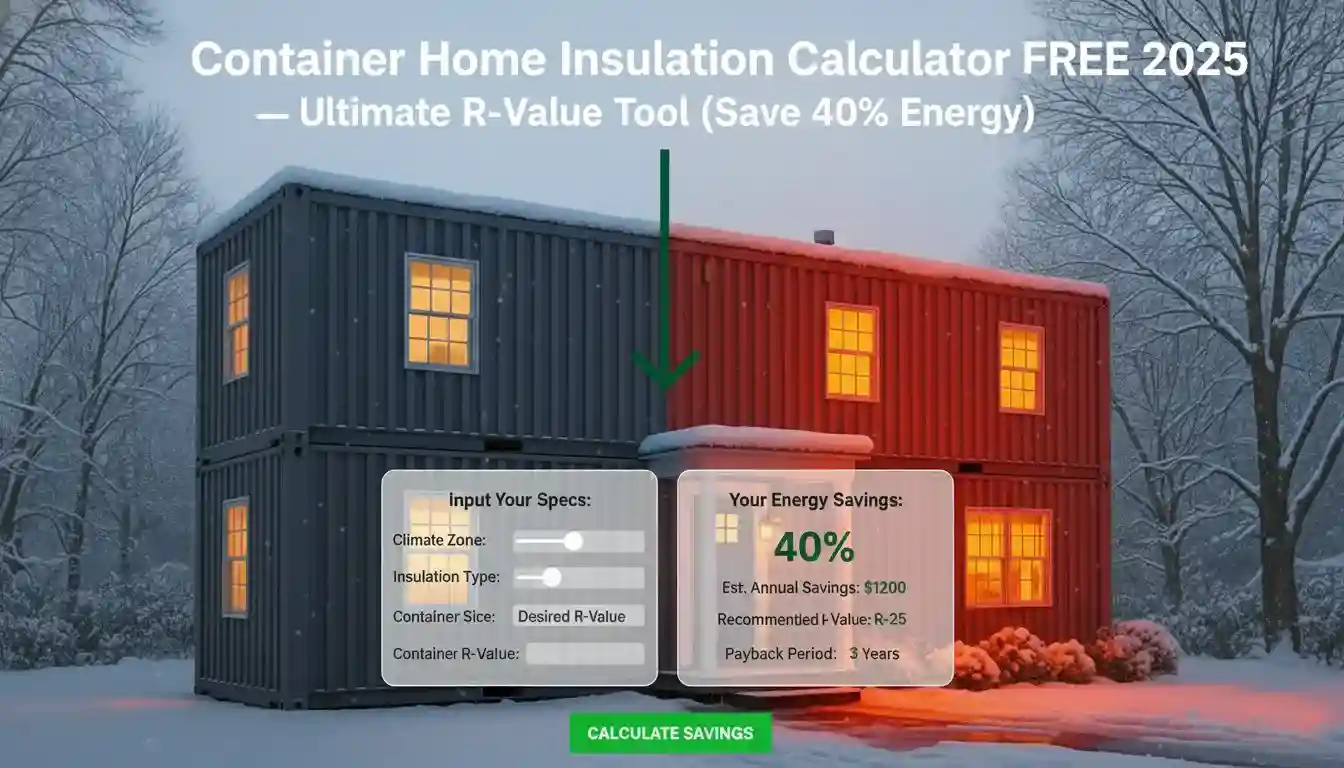
FREE Container Home Insulation Calculator 2025 — Save 40% on Energy Bills
Use our powerful free tool to determine R-values, insulation thickness, and costs by state and climate zone based on IECC 2021 standards for shipping container homes.
Why Use a Container Home Insulation Calculator?
Container home insulation is critical for energy efficiency, comfort, and code compliance. Our free container home insulation calculator helps you determine exact R-value requirements, insulation thickness, and material costs for shipping container homes based on your specific climate zone and state.
Shipping containers are made of steel, which conducts heat and cold rapidly. Without proper container home insulation, your home will be uncomfortably hot in summer and freezing in winter. Quality insulation reduces heating and cooling costs by 30-40%, prevents condensation and mold, eliminates thermal bridging, and ensures year-round comfort in your container home.
This powerful insulation calculator uses IECC 2021 building code standards to provide accurate R-value requirements for floors, ceilings, and walls. Whether you’re building a shipping container home in Florida, Texas, Alaska, or anywhere in the USA, this free insulation calculator delivers code-compliant results instantly. The calculator accounts for all climate zones, insulation materials, and installation methods to ensure your shipping container home meets building codes.
The container insulation calculator is designed specifically for shipping container construction, accounting for steel thermal bridging, corrugated wall surfaces, and unique container home challenges. Unlike generic insulation calculators, our container home insulation calculator understands the specific needs of converted shipping containers and provides recommendations tailored to container home architecture.
🗺️ Container Home Climate Zone Guide
Find your state’s climate zones below to use the insulation calculator effectively. Most states have multiple zones depending on location. Select your state in the insulation calculator to see available zones and R-value requirements for shipping container homes.
| State | Climate Zones for Container Home Insulation |
|---|---|
| Alabama | 2A, 3A |
| Alaska | 6A, 7, 8 |
| Arizona | 2B, 3B, 4B, 5B |
| Arkansas | 3A, 4A |
| California | 3B, 3C, 4B, 4C, 5B, 6B |
| Colorado | 3B, 4B, 5B, 6B, 7 |
| Connecticut | 5A |
| Delaware | 4A |
| Florida | 1A, 2A |
| Georgia | 2A, 3A |
| Hawaii | 1A |
| Idaho | 5B, 6B |
| Illinois | 4A, 5A |
| Indiana | 4A, 5A |
| Iowa | 5A, 6A |
| Kansas | 4A, 5A |
| Kentucky | 4A |
| Louisiana | 2A, 3A |
| Maine | 6A, 7 |
| Maryland | 4A |
| Massachusetts | 5A |
| Michigan | 5A, 6A, 7 |
| Minnesota | 6A, 7 |
| Mississippi | 2A, 3A |
| Missouri | 4A, 5A |
| Montana | 6B, 7 |
| Nebraska | 5A, 6A |
| Nevada | 3B, 5B |
| New Hampshire | 6A |
| New Jersey | 4A, 5A |
| New Mexico | 3B, 4B, 5B |
| New York | 4A, 5A, 6A |
| North Carolina | 3A, 4A |
| North Dakota | 6A, 7 |
| Ohio | 4A, 5A |
| Oklahoma | 3A, 4A |
| Oregon | 4C, 5B, 6B |
| Pennsylvania | 4A, 5A, 6A |
| Rhode Island | 5A |
| South Carolina | 2A, 3A |
| South Dakota | 5A, 6A |
| Tennessee | 3A, 4A |
| Texas | 2A, 2B, 3A, 3B |
| Utah | 3B, 5B, 6B |
| Vermont | 6A |
| Virginia | 4A |
| Washington | 4C, 5B, 6B |
| West Virginia | 4A, 5A |
| Wisconsin | 6A, 7 |
| Wyoming | 6B, 7 |
Use the Container Home Insulation Calculator (100% FREE)
Start using our free calculator below to get instant R-value requirements, insulation thickness recommendations, and cost estimates for your shipping container home project. This tool provides results tailored to your specific climate zone and container home design.
Ready to Build Your Container Home with Proper Insulation?
Get permit-ready container home plan sets engineered to meet IECC 2021 standards. All plans include detailed insulation specifications for your climate zone based on the insulation calculator results. Our shipping container home plans incorporate proper insulation design verified by the calculator methodology.
Container Home Insulation Calculator FAQ
What is a container home insulation calculator and how does it work?
A container home insulation calculator is a free online tool that determines R-value requirements, insulation thickness, and costs for shipping container homes based on IECC 2021 building codes. Our calculator uses your state and climate zone to provide accurate, code-compliant insulation specifications for floors, walls, and ceilings. Simply select your location, choose insulation materials, and adjust thickness sliders to see real-time compliance status and visual representations. The container home insulation calculator accounts for steel thermal bridging unique to shipping containers.
What R-value does the calculator recommend?
R-value requirements from our insulation calculator depend on your climate zone per IECC 2021 standards. Cold climates (zones 6-8) require R-49 to R-60 for ceilings and R-20+5 to R-30 for walls. Moderate climates (zones 3-5) need R-38 to R-49 for ceilings and R-13+5 to R-20 for walls. Hot climates (zones 1-2) require R-30 to R-38 for ceilings and R-13 for walls. Use the calculator above to get exact requirements for your state and shipping container home design.
What is the best insulation for shipping container homes according to the calculator?
The container home insulation calculator includes three popular options: closed-cell spray foam (R-6 to R-7 per inch) is most popular for shipping container insulation because it provides excellent insulation, acts as both insulation and vapor barrier, prevents condensation on steel walls, adds structural strength, and fills all gaps completely. The calculator also includes rigid foam boards (R-5 per inch), fiberglass batts (R-3.5 per inch), and continuous exterior insulation systems for different container home applications.
How much does container home insulation cost using the calculator estimates?
The calculator helps estimate costs accurately. Container home insulation typically costs $1.50 to $4.50 per square foot for materials, plus $2 to $4 per square foot for professional installation. For example, a 40-foot shipping container (320 sq ft) might cost $1,120 to $2,720 for complete insulation based on calculator results. Spray foam is more expensive upfront but provides superior performance. The container home insulation calculator can help you compare costs across different insulation materials.
Does the calculator work for warm climates?
Yes! The container home insulation calculator is essential for ALL climates, including hot regions. In warm areas, steel shipping containers become extremely hot without insulation—interior temperatures can exceed 120°F on sunny days. The calculator shows how proper insulation prevents heat gain, reduces cooling costs by 30-40%, prevents condensation when air conditioning cools the interior, protects against rust and mold, and maintains comfortable indoor temperatures. Even in Florida, Texas, and Arizona, the container home insulation calculator confirms that code-compliant insulation is mandatory for shipping container homes.
Can the calculator help with exterior insulation?
Yes, our container home insulation calculator includes both interior and exterior insulation options for shipping container homes. Exterior insulation preserves interior living space and reduces thermal bridging through the steel frame. The calculator helps you plan exterior insulation methods including rigid foam boards with furring strips, continuous insulation systems, and rainscreen assemblies. Exterior insulation requires weather-resistant cladding like wood siding, metal panels, or stucco, which the container home insulation calculator accounts for in its recommendations for shipping container homes.
How thick should container home insulation be according to the calculator?
The container home insulation calculator determines exact thickness based on R-value requirements and material type. For spray foam (R-6/inch) in the calculator: 2-3 inches for walls in warm climates, 3-5 inches for walls in cold climates, and 5-10 inches for ceilings depending on zone. For fiberglass batts (R-3.5/inch): 4-6 inches for walls and 10-15 inches for ceilings. For rigid foam (R-5/inch): 3-4 inches for walls and 8-12 inches for ceilings. Use the calculator sliders above for exact thickness recommendations for your shipping container home.
Does the container home insulation calculator prevent condensation?
Yes! The container home insulation calculator helps prevent condensation, which is critical for shipping container homes. Steel conducts temperature rapidly, so uninsulated containers experience severe condensation when warm, humid air contacts cold steel walls, leading to mold, rust, and structural damage. The calculator recommends closed-cell spray foam because it acts as both insulation and vapor barrier. If using other insulation types shown in the calculator, install a continuous vapor barrier on the warm side to prevent moisture infiltration in your shipping container home.
Is the container home insulation calculator accurate for building permits?
Our container home insulation calculator uses official IECC 2021 standards, making results reliable for permit planning. However, shipping container home insulation must meet local building codes and requires permits in most jurisdictions. The calculator provides code-compliant baselines that local PE engineers can adapt for your specific jurisdiction. Building inspectors verify that container home insulation meets energy code requirements for your climate zone, includes proper vapor barriers, and has correct installation depth. Your permit-ready plans from Permit Container Homes include detailed insulation specifications based on calculator methodology for shipping container homes.
How long does container home insulation last according to calculator recommendations?
Insulation recommended by our container home insulation calculator lasts 20-50+ years depending on material type. Closed-cell spray foam featured in the calculator lasts 50+ years without degradation. Rigid foam boards last 25-50 years if protected from UV exposure. Fiberglass batts last 20-30 years if kept dry, and rock wool lasts 50+ years with excellent fire resistance. Shipping container homes with professionally installed spray foam insulation planned using the calculator typically never need insulation replacement, making the calculator valuable for long-term planning.
How to Use the Container Home Insulation Calculator in 5 Easy Steps
Step 1: Select Your Location in the Calculator
Choose your state from the dropdown menu in the calculator. The calculator automatically loads available climate zones for your state. Most states have multiple zones—urban areas may differ from mountain regions. If unsure of your specific zone, consult the IECC climate zone map or contact your local building department. The calculator uses this information to determine accurate R-value requirements for your shipping container home.
Step 2: Choose Your Climate Zone in the Container Home Insulation Calculator
After selecting your state, pick the appropriate climate zone in the calculator. The calculator displays IECC 2021 prescriptive R-values for ceilings, walls, and floors specific to your zone. These are minimum requirements—the calculator allows you to exceed them for better energy performance and comfort in your shipping container home. The calculator adapts recommendations based on your specific climate zone.
Step 3: Plan Each Assembly with the Container Home Insulation Calculator
For floors, ceilings, and walls, select your shipping container insulation material and adjust thickness using the slider in the calculator. The calculator shows real-time R-value calculations and compliance status. Visual diagrams display how insulation layers will appear in your container cross-section, making it easy to understand your container home insulation design. The calculator provides instant feedback on code compliance.
Step 4: Review Requirements in the Calculator
Green “Meets requirement” status in the container home insulation calculator indicates code compliance. Red “Does not meet requirement” means additional thickness is needed. For wall assemblies, the calculator allows you to combine cavity insulation (between studs) with continuous insulation (exterior or interior layers) to achieve required R-values while minimizing thermal bridging in your shipping container home. The calculator helps optimize your insulation strategy.
Step 5: Order Your Container Home Plans
Once you’ve determined your insulation strategy using the calculator, order permit-ready container home plans from Permit Container Homes. All plan sets include detailed insulation specifications based on container home insulation calculator methodology, installation details, and material lists for shipping container homes. Local PE review and stamping are required before permit submission—this is the buyer’s responsibility. The calculator provides the foundation for your permit-ready plans.
Building Codes & Calculator Resources
Authoritative resources for residential energy codes and shipping container home construction standards used in our calculator:
- International Code Council — IECC and IRC Standards for Container Home Insulation (opens in new window)
- U.S. DOE — Building Energy Codes Program (Container Home Insulation Calculator Standards) (opens in new window)
- Building America Solution Center — Climate Zones for Container Home Insulation Calculator (opens in new window)
⚠️ Container Home Insulation Calculator Disclaimer
This container home insulation calculator provides estimates based on IECC 2021 prescriptive R-values for shipping container homes. Actual requirements may vary by local jurisdiction, building department interpretation, and site-specific conditions. Always consult your local building codes and engage a licensed Professional Engineer (PE) to review and stamp your container home plans before permit submission. Permit Container Homes provides permit-ready plan sets as a basis for local PE review—final approval and stamping are the buyer’s responsibility. Results from this container home insulation calculator are for planning purposes only.


