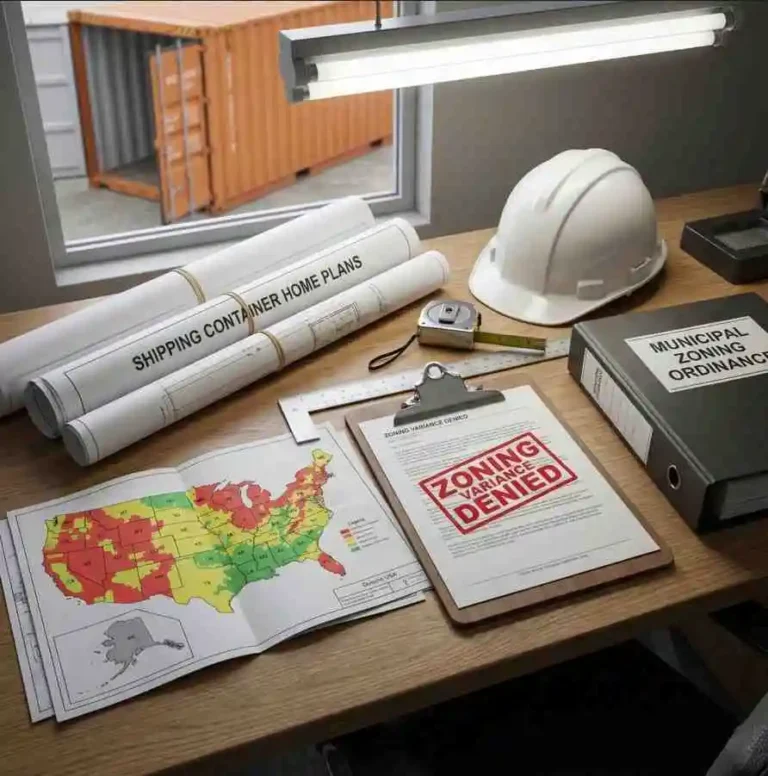
Shipping Container Building Codes: A 50-State Overview
How IBC Section 3115, local amendments, and PE review shape container home approvals nationwide
Shipping container building codes define how jurisdictions evaluate structural safety, fire and life safety, and permitting for container homes and container-based buildings across the United States. The practical baseline for most US jurisdictions is the International Codes framework, with shipping containers addressed directly in IBC Section 3115, and one- and two-family dwellings guided by the IRC where adopted and applicable.
This overview shows how the model codes translate into real requirements, when a Professional Engineer (PE) steps in, and how to move from concept to permits while aligning with IBC/IRC expectations across different states and localities.
How codes apply to containers
Intermodal shipping containers repurposed as buildings are covered by IBC Section 3115, which requires design per Chapter 16, documented container identification and ratings, and appropriate foundations, among other protections and fire-lifecycle details. If your project is a one- or two-family dwelling, your local jurisdiction may reference the IRC for residential provisions and the IBC’s Section 3115 for container-specific requirements, subject to local adoption and amendments.
IBC and the national framework
The International Code Council publishes the IBC and IRC, which many jurisdictions adopt statewide or locally with modifications. The International Code Council provides public access to official adoptions and digital code references, so checking your state’s adoption context and local amendments early in planning is essential.
📖 View Full IBC Section 3115 Text (Key Excerpts)
IBC Section 3115 – Intermodal Shipping Containers (Excerpts):
3115.1 General. The provisions of Section 3115 and other applicable sections of this code shall apply to intermodal shipping containers that are repurposed for use as buildings or structures, or as a part of buildings or structures.
3115.2 Construction documents. The construction documents shall contain information to verify the dimensions and establish the physical properties of the steel components and wood floor components of the intermodal shipping container, in addition to the information required by Sections 107 and 1603.
3115.3 Intermodal shipping container information. Intermodal shipping containers shall bear an existing data plate containing the following information as required by ISO 6346 and verified by an approved agency. A report of the verification process and findings shall be provided to the building owner.
3115.8 Structural. Intermodal shipping containers that conform to ISO 1496-1 and are repurposed for use as buildings or structures, or as a part of buildings or structures, shall be designed in accordance with Chapter 16 and this section.
3115.8.1 Foundations. Intermodal shipping containers repurposed for use as a permanent building or structure shall be supported on foundations or other supporting structures designed and constructed in accordance with Chapters 16 through 23.
Source: 2021 International Building Code
For a quick next step, review the building department basics and what documents you’ll prepare on our Building Codes & Permits hub, then check your local zoning parameters with our zoning guide.
Core requirements in every state
Structural design follows IBC Chapter 16 to establish load path, risk category, wind, snow, seismic, anchorage, and lateral systems. Your PE will design to these criteria and local amendments to ensure your project meets the jurisdiction’s adopted code provisions.
What you’ll see on most plans
Expect documentation that shows a complete load path, lateral force distribution, assigned risk category, and anchorage across roof–wall–foundation connections per IBC 1604 and related provisions.
| Requirement | Code Basis | Application |
|---|---|---|
| Complete load path & rational analysis | IBC 1604.4 | PE shows forces transfer from origin to load-resisting elements, including lateral distribution and diaphragm behavior |
| Risk category assignment | IBC 1604.5 | Sets reliability targets for design; dwellings are Category II unless otherwise specified |
| Wind, snow, seismic, flood checks | IBC Ch. 16 | Local parameters drive member sizing, connections, and detailing; flood hazard documentation where applicable |
| Container identification & data plate | IBC 3115.3 | Verify manufacturer, stacking loads, and racking test data per ISO 6346 during repurposing |
| Foundations for permanent use | IBC 3115.8.1 | Design and build per Chapters 16–23; do not rely on temporary blocks for permanent occupancy |
To prepare your application, start a permit-friendly documentation set and review our Building Codes & Permits hub. For land-use fit, confirm your local zoning rules before purchasing or placing containers using our zoning guide, then browse complete plan sets to streamline PE review.
Your Professional Engineer’s role
A licensed Professional Engineer adapts your plan documentation to site-specific conditions, verifies structural compliance with local amendments, performs calculations, and stamps drawings for permit submission in your jurisdiction. Container homes involve modified structural elements—cuts for windows and doors, stacking loads, lateral bracing—that require engineering analysis beyond the original ISO shipping certification, which applies only to cargo transport conditions.
What your Professional Engineer reviews
Your PE will verify the container data plate and ISO 6346 identification, calculate modified section properties after openings are cut, design anchorage and lateral systems per IBC Chapter 16, specify foundation details per Chapters 18–20, and ensure all assemblies meet fire, life safety, and energy code provisions.
After purchasing comprehensive plans from PermitContainerhomes.com, you’ll work with a licensed PE who will review the detailed documentation, adapt it for your site conditions, perform jurisdiction-specific calculations, and provide stamped drawings required for permit submission.
PE scope across different project types
Single-unit container ADUs, multi-container residential dwellings, and commercial or mixed-use projects all require PE involvement, but the scope varies. Residential typically uses IRC/IBC residential provisions, while commercial occupancies trigger full IBC Chapter 3 occupancy classification and Chapter 10 means of egress requirements. For additional guidance on residential building requirements and energy-efficient design strategies that support code compliance, the U.S. Department of Energy provides resources on meeting energy code standards for container home projects and optimizing thermal envelope performance.
For state-specific nuances—climate zones, wind exposure categories, seismic design categories—explore our state guides to understand local adoption patterns and common amendments before your PE begins detailed design.
Step-by-step permitting workflow
Permitting for shipping container homes follows the same general sequence as conventional construction: pre-application consultation, plan preparation, PE review and stamping, formal submission, plan review cycles, approval, and inspections during construction.
Phase 1: Pre-application and site evaluation
Contact your building department to confirm zoning allowances, setback requirements, and any local container-specific ordinances. Request a pre-application meeting to discuss the project scope, IBC Section 3115 applicability, and required documentation. Verify that your site allows the intended use (residential or commercial), meets minimum lot size and coverage ratios, and satisfies utility connection requirements for water, sewer, and electric service.
Phase 2: Plan preparation and PE engagement
Start with complete architectural plans that show container layout, openings, finishes, and mechanical, electrical, and plumbing systems. Your PE uses these as the basis for structural calculations, foundation design, and stamped drawings. The PE will reference local climatic and geographic design criteria—wind speed, snow load, seismic parameters, frost depth—to size members and connections per IBC 1604 and Chapter 16 load combinations.
📖 View IRC Table R301.2 Application (Climatic Criteria Example)
IRC Table R301.2(1) – Climatic and Geographic Design Criteria:
The IRC requires that jurisdictions fill in Table R301.2(1) with locally applicable values for wind design, seismic design category, weathering probability, frost line depth, termite infestation probability, winter design temperature, ice barrier underlayment requirement, flood hazards, air freezing index, and mean annual temperature. These parameters drive every structural, thermal, and foundation decision. Your PE obtains the jurisdiction’s adopted table and designs accordingly.
Common entries include wind speed (mph), ground snow load (psf), seismic design category (A through E), and frost depth (inches). For example, a jurisdiction in coastal South Carolina might specify: Wind speed 150 mph (coastal exposure), SDC B, frost depth 6 inches, termite infestation “very heavy,” flood hazard zone AE with BFE specified. That same table in Colorado might show: Wind speed 115 mph, SDC C, ground snow load 50 psf, frost depth 36 inches.
Source: 2021 International Residential Code, Table R301.2(1)
Phase 3: Permit submission and review cycles
Submit PE-stamped drawings, completed permit application, container ISO data plate verification report, energy compliance documentation (per IECC or local energy code), and applicable fees. Plan reviewers check for IBC/IRC compliance, zoning conformance, and completeness.
Phase 4: Approval and construction inspections
Once approved, you’ll receive a building permit authorizing construction. Schedule inspections at key milestones—foundation, framing and structural, rough-in (MEP), insulation and energy, and final. Each inspection verifies compliance with approved plans and applicable codes.
| Phase | Timeline | Cost Range |
|---|---|---|
| Pre-application consultation | 1–2 weeks | No fee or nominal fee |
| Plan preparation (architectural) | 2–4 weeks | Varies by plan complexity |
| PE review and stamping | 2–4 weeks | $2,000–$5,000 |
| Permit application and review | 4–12 weeks | Varies by jurisdiction and valuation |
| Construction and inspections | 8–20 weeks | Material, labor, and contractor fees |
Note: Timelines and costs vary significantly by location, project complexity, and jurisdiction workload. These are general estimates. PE costs are separate from plan purchases and permit fees.
To see how different states approach adoption and amendments, explore our state-specific guides covering climate considerations, hurricane and seismic provisions, and local permitting processes.
Costs, timelines, common pitfalls
Container home permitting costs include plan purchases, PE review and stamping, permit application fees (often calculated as a percentage of construction valuation), and inspection fees during construction. The largest variable expense is PE engineering, which ranges from $2,000 to $5,000 for single-family residential projects but can increase for multi-unit, commercial, or high-seismic and high-wind jurisdictions requiring extensive lateral design and foundation calculations.
Budget breakdown and planning
Beyond PE fees, expect permit application fees (typically 1–2% of construction valuation in many jurisdictions), plan review fees, and potential re-review fees if corrections are required. Some jurisdictions charge flat fees; others use sliding scales based on square footage or valuation.
| Cost Category | Typical Range | Notes |
|---|---|---|
| Complete plan set purchase | Varies by size and complexity | One-time cost; provides PE-ready documentation |
| PE review and stamping | $2,000–$5,000 | Depends on project complexity, jurisdiction requirements, and site conditions |
| Permit application fees | $500–$3,000+ | Based on construction valuation or square footage; varies widely by jurisdiction |
| Plan review fees | $300–$1,500 | Often included in permit fee; some jurisdictions separate |
| Inspection fees | $200–$800 | Per inspection or bundled; foundation, framing, rough-in, final |
Note: All costs are estimates and vary by jurisdiction, project scope, and local fee schedules. Contact your building department for exact fee structures.
Common challenges and how to avoid them
Many builders underestimate the documentation requirements for container verification—ISO data plate, manufacturer identification, stacking load ratings—leading to plan review delays when these details are missing or incomplete. Another frequent issue is assuming that containers can be placed on temporary blocks or grade without engineered foundations. IBC Section 3115.8.1 explicitly requires foundations designed per Chapters 16–23 for permanent occupancy, and plan reviewers will reject drawings that lack foundation design.
Inadequate lateral bracing design after cutting large openings for windows or doors also triggers corrections. The original container’s lateral capacity assumes intact corrugated walls; once you remove sections, your PE must redesign the lateral system with supplemental framing, shear panels, or moment connections.
Timeline realities
From initial concept to permit issuance, expect 8–16 weeks if everything moves smoothly: 2–4 weeks for plan prep, 2–4 weeks for PE review, 4–12 weeks for jurisdiction plan review. Construction and inspections add another 8–20 weeks depending on project size and contractor schedule. For detailed breakdowns of common mistakes and how to streamline your approval process, review our guide on Container Home Permit Mistakes and explore state-specific timelines on our State Building Guides hub.
Expert tips & key takeaways
Navigating shipping container building codes requires understanding the interplay between IBC Section 3115, local code adoption patterns, PE responsibilities, and jurisdiction-specific amendments. Here are the essential points to remember as you move forward with your project.
Essential points summary
- IBC Section 3115 is your starting point: Repurposed containers must comply with Section 3115 and Chapter 16 structural design requirements. The code requires container verification (ISO 6346 data plate), engineered foundations per Chapters 18–23, and proper fire and life safety detailing.
- Local adoption drives the details: States and jurisdictions adopt the IBC/IRC with amendments. Verify your local adoption, check for container-specific ordinances, and obtain the jurisdiction’s filled-in climatic design criteria (IRC Table R301.2 or equivalent) early in planning.
- PE involvement is mandatory in most jurisdictions: A licensed Professional Engineer adapts plans to site conditions, performs structural calculations for modified containers, designs foundations and lateral systems, and stamps drawings for permit submission. Budget $2,000–$5,000 for residential PE services.
- Documentation is non-negotiable: Plan reviewers expect container data plate verification, ISO 6346 compliance reports, PE-stamped structural drawings, and complete architectural and MEP plans. Missing documentation causes delays and correction cycles.
- Timeline planning prevents surprises: Allocate 8–16 weeks for permitting (plan prep, PE review, jurisdiction review) and 8–20 weeks for construction and inspections. Start PE engagement before container purchase to confirm compatibility and code pathways.
- Foundations matter: Do not rely on temporary supports for permanent buildings. IBC 3115.8.1 requires engineered foundations designed per Chapters 16–23, with proper anchorage, frost protection, and load path continuity from container to soil.
- State-by-state nuances exist: Coastal states emphasize wind and flood provisions; seismic zones require ductile connections and lateral analysis; cold climates focus on snow loads and frost depth. Your PE tailors design to local parameters.
With comprehensive planning documentation, Professional Engineer support, and clear understanding of IBC Section 3115 and local requirements, you’re well-positioned to successfully navigate the permitting process and build your container home with confidence.
Ready to Start Your Container Home Project?
Explore our collection of comprehensive container home plans designed to align with 2021 IRC and IBC building code standards. Each plan includes complete architectural drawings, structural details, electrical layouts, plumbing systems, and beautiful 3D visualizations—everything your Professional Engineer needs for efficient review.
Browse Complete Plan Collection →Need Plan Modification? If you find a plan you love but need to adjust it for your local climate or personal needs—such as moving a window or adding a door—our team can help. We offer a professional plan modification service after purchase. Simply contact us with your modification needs, and we’ll provide a personalized quote.
⚖️ Professional Engineering & Plan Documentation Disclaimer
Important: Our plans are permit-ready but require review and stamping by a local licensed Professional Engineer (PE) in your jurisdiction. Final approval is subject to local building codes and regulations. We recommend consulting your local building department to verify all requirements.
Refund Policy: Due to the digital nature of our plans, all sales are final. Please review our Refund Policy for details.