Container Home Cost Estimate: 2025 Materials, Labor & Permits
Complete transparency on where your money goes—and how comprehensive plans prevent costly rework
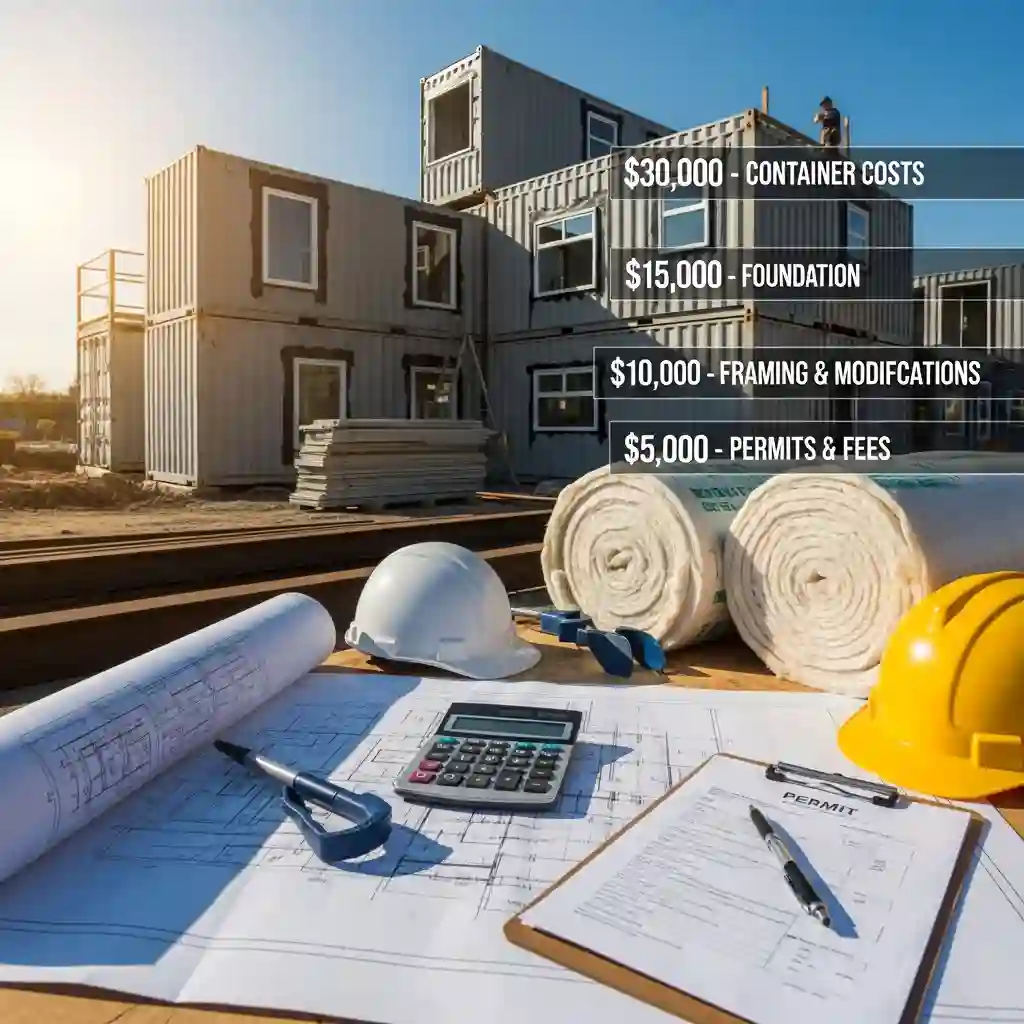
A realistic container home cost estimate starts with understanding the three major expense categories: materials (typically 40-50% of total budget), labor (25-35%), and permits with professional engineering fees (15-25%). Your container home cost estimate for a typical 40-foot container conversion ranges from $55,000 to $180,000 depending on finishes, while multi-container homes can reach $250,000 or more.
Most builders create inaccurate container home cost estimates by underestimating hidden costs by 20-30%, leading to budget overruns and project delays. Permit fees vary from $500 to $3,000 depending on jurisdiction, but Professional Engineer review—required in most U.S. jurisdictions—adds $2,000 to $5,000 to your container home cost estimate. Site preparation, foundation work, utility connections, and code-compliant modifications often surprise first-time builders who used incomplete cost planning.
This comprehensive guide reveals exact 2025 cost breakdowns across all construction phases, shows you where comprehensive planning documentation saves thousands in rework, and explains how proper budgeting from the start prevents the costly mistakes that derail 40% of DIY container projects. Use our online cost estimator alongside this guide for personalized budget projections.
Understanding Your Container Home Cost Estimate Components
A detailed container home cost estimate divides expenses into three primary categories that together determine your total project budget. Materials account for 40-50% of costs including the container purchase, insulation, framing, windows, doors, roofing modifications, and interior finishes. Labor typically represents 25-35% of your container home cost estimate covering skilled trades like welding, electrical, plumbing, HVAC installation, and general construction work at rates from $50 to $200 per hour depending on location and specialization.
Base Container Acquisition Costs
Your container home cost estimate foundation starts with container selection where costs vary significantly based on size, condition, and modifications needed. A standard 20-foot container (160 square feet) in used condition costs $1,200 to $3,500, while 40-foot containers (320 square feet) range from $3,500 to $7,500. New “one-trip” containers command premium prices but offer better structural integrity and fewer rust issues—critical factors that affect long-term durability and code compliance.
Raw materials for converting a single 40-foot container into livable space add approximately $55,000 to your container home cost estimate for materials alone, not including labor, according to industry data from alternative living space builders. For 20-foot containers, material costs average $35,000 for basic conversions. These figures include insulation, interior framing, electrical systems, plumbing, HVAC, windows, doors, and basic finishes necessary to meet residential building standards established in the 2021 IRC.
Code-Compliant Material Requirements
Building codes established by the International Code Council set minimum standards for materials used in residential construction, including container homes. The 2021 International Residential Code (IRC) specifies requirements for structural materials, insulation values, fire-resistant construction, and moisture protection that directly impact your container home cost estimate. Understanding these code requirements early helps you create accurate budgets and avoid expensive rework discovered during permit review.
Container homes must meet the same building standards as traditional residential construction. This means your material selections in your container home cost estimate cannot simply focus on aesthetics or initial cost—they must satisfy code requirements for structural integrity, fire safety, energy efficiency, and durability as detailed in our building codes guide. These requirements often surprise builders who initially underestimate the complexity of code-compliant container conversion.
📖 View IRC Section R105 Permit Requirements
IRC Section R105.1 Required:
Any owner or owner’s authorized agent who intends to construct, enlarge, alter, repair, move, demolish or change the occupancy of a building or structure, or to erect, install, enlarge, alter, repair, remove, convert or replace any electrical, gas, mechanical or plumbing system, the installation of which is regulated by this code, or to cause any such work to be performed, shall first make application to the building official and obtain the required permit.
Source: 2021 International Residential Code
Materials Cost Breakdown and Code Requirements
Breaking down material costs into specific construction phases helps create accurate container home cost estimates and identifies where code requirements drive expense increases. Foundation work typically costs $3,000 to $15,000 depending on whether you choose concrete slab ($5,000-$15,000), pier systems ($3,000-$10,000), or full basement foundations ($25,000-$50,000). Your foundation choice significantly impacts both initial costs and long-term structural performance, making it a critical component of your container home cost estimate. Review our foundation planning guide for detailed analysis of each option.
Structural Modification Costs
Creating openings for windows and doors requires precise cutting and structural reinforcement of container walls, adding substantial costs to your container home cost estimate. Window installations start at $400 per window depending on size and type, while door installations range from $500 to $2,000 per unit. These modifications must maintain structural integrity while meeting egress requirements specified in IRC Section R310 for emergency escape and rescue openings.
Roof modifications for additional headroom, skylights, or aesthetic improvements cost $3 to $6 per square foot in your container home cost estimate. Standard shipping containers provide only 7’10” interior height, which falls short of IRC minimum ceiling height requirements in most cases. Adding roofing structure, insulation, and weatherproofing materials to achieve compliant ceiling heights adds substantial material costs but remains necessary for permit approval.
Insulation and Climate Control Systems
Insulation represents a critical cost category in your container home cost estimate where code requirements and climate zone specifications determine minimum R-values. Framing materials cost $18 to $24 per linear foot, while insulation ranges from $0.80 to $4.50 per square foot depending on material type and R-value achieved. Container homes face unique insulation challenges due to thermal bridging through metal walls, requiring specialized approaches detailed in our insulation guide to meet energy code requirements.
HVAC system installation costs $2,000 to $10,000 in a typical container home cost estimate based on system size, efficiency ratings, and complexity. Electrical installations average $2 to $4 per square foot, while plumbing systems cost $4 to $6 per square foot. These systems must comply with IRC mechanical, electrical, and plumbing chapters, with specific requirements for load calculations, ventilation rates, and safety devices that impact material and labor costs.
| Material Category | Cost Range | Code Reference |
|---|---|---|
| Foundation (concrete slab) | $5,000-$15,000 | IRC Chapter 4 |
| Foundation (pier system) | $3,000-$10,000 | IRC R403 |
| Windows (per unit) | $400-$1,500 | IRC R310, R613 |
| Doors (per unit) | $500-$2,000 | IRC R311 |
| Insulation | $0.80-$4.50/sq ft | IRC N1102 |
| HVAC System | $2,000-$10,000 | IRC Chapter 14 |
| Electrical System | $2-$4/sq ft | IRC Chapter 34-43 |
| Plumbing System | $4-$6/sq ft | IRC Chapter 25-33 |
Note: Container home cost estimate ranges vary significantly by location, material quality, and project complexity. These ranges reflect 2025 national averages and may be 20-40% higher in high-cost metropolitan areas.
Interior Finish Materials
Interior finishes transform raw container space into livable residential environments and significantly impact your final container home cost estimate. Drywall installation costs $1.50 to $3.50 per square foot, while painting adds $1 to $4 per square foot. Flooring choices significantly impact both cost and code compliance—vinyl or laminate flooring ranges from $2 to $7 per square foot, while hardwood options cost $8 to $15 per square foot. Visit our cost planning resources for detailed finish material guidance.
📖 View IRC Section R106 Construction Documents Requirements
IRC Section R106.1 Submittal documents:
Submittal documents consisting of construction documents, and other data shall be submitted in two or more sets, or in a digital format where allowed by the building official, with each application for a permit. The construction documents shall be prepared by a registered design professional where required by the statutes of the jurisdiction in which the project is to be constructed. Where special conditions exist, the building official is authorized to require additional construction documents to be prepared by a registered design professional.
Source: 2021 International Residential Code
Labor Costs and Professional Engineering Fees
Labor costs represent 25-35% of your total container home cost estimate and vary dramatically based on geographic location, contractor experience, and project complexity. General contractor rates range from $50 to $100 per hour in rural areas but climb to $100 to $200 per hour in major metropolitan markets. Specialized trades command premium rates—certified welders cost $75 to $150 per hour, licensed electricians charge $65 to $120 per hour, and licensed plumbers bill $70 to $130 per hour depending on local market conditions and union requirements.
A complete 40-foot container conversion typically requires 300 to 600 labor hours for structural modifications, systems installation, and finish work. At average rates, this translates to $25,000 to $75,000 in labor costs for your container home cost estimate. Multi-container projects double or triple these figures based on complexity, connection points between containers, and structural reinforcement requirements for stacked or cantilevered designs.
What Your Professional Engineer Reviews
Professional Engineer (PE) review and stamping represents a mandatory line item in every realistic container home cost estimate, yet many builders fail to budget for this requirement until permit applications are rejected. Your PE reviews structural calculations, foundation adequacy for soil conditions, load paths through modified container structures, connection details between containers, seismic and wind resistance, and compliance with local amendments to the IRC and IBC.
PE services typically cost $2,000 to $5,000 for single-container homes and increase to $5,000 to $15,000 for complex multi-container designs. This investment provides the stamped drawings and engineering calculations your building department requires for permit approval. For additional guidance on residential building requirements and energy efficiency standards that impact PE review, the U.S. Department of Energy provides resources on meeting energy code standards for alternative construction projects including container homes.
After purchasing comprehensive plans from PermitContainerhomes.com, you’ll work with a licensed PE who will review the detailed documentation, adapt it for your site conditions, and provide stamped drawings required for permit submission. Our plans are designed to align with 2021 IRC/IBC standards, streamlining your PE’s review process and reducing engineering costs by providing complete architectural details, structural specifications, and systems layouts that serve as an excellent foundation for site-specific adaptation.
📖 View IBC Section 109 Fees Requirements
IBC Section 109.1 Fees:
A permit shall not be issued until the fees prescribed in Section 109.2 have been paid, nor shall an amendment to a permit be released until the additional fee, if any, has been paid. Fees for building permits shall be assessed in accordance with the provisions of Section 109.2.
IBC Section 109.2 Schedule of permit fees:
On buildings, structures, electrical, gas, mechanical and plumbing systems or alterations requiring a permit, a fee for each permit shall be paid as required in accordance with the schedule as established by the applicable governing authority.
Source: 2021 International Building Code
Permit Fees, Inspections and Timeline Costs
Permit and inspection fees add $500 to $3,000 to your container home cost estimate depending on jurisdiction size, project valuation, and local fee structures. Building departments typically calculate permit fees as a percentage of total construction value (0.5% to 2%) or use flat-rate schedules based on square footage and occupancy type. Urban jurisdictions with more complex regulatory oversight generally charge higher fees than rural counties with streamlined processes.
Your complete container home cost estimate must account for multiple permit types beyond the basic building permit. Electrical permits cost $50 to $300, plumbing permits range from $50 to $500, mechanical permits (HVAC) run $50 to $300, and grading or site development permits add $100 to $1,000. Some jurisdictions bundle these into a single comprehensive permit, while others require separate applications, fees, and inspection schedules for each trade.
Inspection Requirements and Timeline Costs
Building inspections occur at critical construction milestones and directly impact your project timeline—which translates to carrying costs in your container home cost estimate. Typical inspection points include foundation placement before concrete pour, framing and structural modifications before covering walls, rough-in inspections for electrical/plumbing/mechanical systems before drywall installation, insulation verification, and final inspection before certificate of occupancy issuance.
Failed inspections requiring rework add 2 to 6 weeks to project timelines and increase labor costs by 15-30% due to demolition, correction, and re-inspection cycles. This represents $5,000 to $25,000 in additional costs for your container home cost estimate depending on the scope of required corrections. Working with comprehensive plans that align with code requirements dramatically reduces inspection failure rates and keeps projects on schedule. Learn more about navigating the inspection process in our complete permits guide.
| Phase | Timeline | Cost Range |
|---|---|---|
| Plan Purchase | Instant | $500-$3,500 |
| PE Review & Stamping | 2-4 weeks | $2,000-$5,000 |
| Permit Application Review | 4-12 weeks | $500-$3,000 |
| Site Preparation | 1-3 weeks | $2,000-$10,000 |
| Foundation Construction | 1-2 weeks | $3,000-$15,000 |
| Container Delivery & Placement | 1-2 days | $3,500-$7,500 |
| Structural Modifications | 2-4 weeks | $8,000-$25,000 |
| Systems Installation (MEP) | 3-6 weeks | $15,000-$35,000 |
| Interior Finishes | 3-5 weeks | $10,000-$30,000 |
| Final Inspection & CO | 1-2 weeks | Included in permit fees |
Note: Timelines and costs vary significantly by location, project complexity, and jurisdiction workload. These ranges reflect 2025 national averages for single 40-foot container conversions. Multi-container projects require extended timelines and proportionally higher costs. Costs vary by jurisdiction and project complexity—always verify local requirements.
Site Development and Utility Connection Costs
Site preparation costs frequently exceed initial projections in container home cost estimates, particularly for rural properties requiring extensive development. Land clearing and grading cost $1,000 to $5,000 depending on terrain and access. Utility connections add substantial expenses—well drilling runs $3,000 to $15,000, septic system installation costs $3,000 to $10,000, electrical service connection ranges from $1,000 to $5,000, and municipal water/sewer taps can reach $3,000 to $10,000 depending on distance from main lines.
Access road construction or improvement adds $5 to $15 per linear foot to your container home cost estimate, while retaining walls for hillside sites cost $15 to $40 per square foot of wall face. These site-specific costs can equal or exceed the container conversion costs themselves, making thorough site assessment critical during initial budget development. Calculate these variables using our interactive cost estimator tool for location-specific projections.
📖 View IRC Section R104.10.1 Flood Hazard Modifications
IRC Section R104.10.1 Flood hazard areas:
The building official shall not grant modifications to any provisions required in flood hazard areas as established by Table R301.2 unless a determination has been made that: 1. There is good and sufficient cause showing that the unique characteristics of the size, configuration or topography of the site render the elevation standards of Section R322 inappropriate. 2. Failure to grant the modification would result in exceptional hardship by rendering the lot undevelopable. 3. The granting of modification will not result in increased flood heights, additional threats to public safety, extraordinary public expense, cause fraud on or victimization of the public, or conflict with existing laws or ordinances.
Source: 2021 International Residential Code
Hidden Costs and Budget Management Strategies
Creating an accurate container home cost estimate requires identifying hidden expenses that derail budgets and cause project delays. Storage and transportation costs add $2,000 to $5,000 for container delivery depending on distance from port, site accessibility, and crane rental requirements. Off-site storage during permit processing costs $100 to $300 per month when containers cannot remain on-site due to local regulations or construction sequencing.
Temporary utilities during construction add $500 to $2,000 to your container home cost estimate including temporary electrical service, portable toilets, construction water supply, and job-site security fencing. Tool and equipment rentals cost $200 to $800 per month for essential items like scaffolding, welding equipment, air compressors, and specialty cutting tools. Insurance requirements during construction phase add $1,000 to $3,000 annually for builder’s risk coverage and general liability protection.
Seasonal and Market Timing Factors
Material costs fluctuate 10-25% based on seasonal demand and global supply conditions affecting your container home cost estimate. Steel prices peaked in 2021-2022 but have stabilized in 2025, though lumber and insulation costs remain volatile. Container availability and pricing vary by region—coastal areas with major ports offer better container selection and lower delivery costs compared to inland locations requiring long-distance transport.
Labor availability impacts both cost and timeline in your container home cost estimate. Peak construction season (April through October in most climates) sees 15-30% higher labor rates due to demand, while winter construction in cold climates requires heating and weather protection adding $2,000 to $8,000 for temporary enclosures and heating systems. Scheduling projects during shoulder seasons (March-April or October-November) can reduce labor costs while maintaining reasonable working conditions.
Financing and Carrying Costs
Financing costs significantly impact your total container home cost estimate when using construction loans or personal financing. Construction loan interest during the build phase (typically 6-12 months) adds 4-8% annually on the outstanding balance. For a $150,000 project financed over 9 months at 7% interest, carrying costs total approximately $5,250. Some lenders require higher down payments (20-30%) for alternative construction methods including container homes, reducing available project capital.
Property taxes and insurance during construction add monthly expenses to your container home cost estimate. Even during active construction, property tax obligations continue based on assessed land value and improvement value. Maintaining comprehensive insurance coverage protects your investment but costs $100 to $300 monthly during the construction period. Budget these carrying costs carefully when creating project timelines and cash flow projections.
Change Orders and Contingency Planning
Even the most detailed container home cost estimate should include 15-20% contingency for unexpected conditions and scope changes. Common causes of budget overruns include soil conditions requiring upgraded foundations, concealed container damage discovered during modifications, code requirements exceeding initial assumptions, and owner-initiated design changes during construction. Change orders typically cost 25-50% more than if the work had been included in original planning due to project disruption and rework.
Weather delays, material delivery issues, and subcontractor scheduling conflicts extend timelines by 2-6 weeks on average, increasing carrying costs and potentially triggering penalty clauses in financing agreements. Working with comprehensive plans from PermitContainerhomes.com reduces change orders by providing complete specifications upfront, allowing accurate contractor bids and reducing surprises during construction. Our detailed documentation helps contractors price projects accurately, reducing the risk of mid-project cost increases.
How Comprehensive Plans Save Money on Your Container Home Cost Estimate
Investing in comprehensive planning documentation provides measurable savings throughout your project by reducing rework, streamlining PE review, and accelerating permit approval. Builders using complete architectural plans save $8,000 to $25,000 compared to those developing designs during construction or using incomplete specifications that require multiple revision cycles. Your container home cost estimate improves dramatically when based on thoroughly detailed plans aligned with building code requirements.
Reducing Professional Engineering Costs
Professional Engineers charge $150 to $300 per hour for structural review and calculation development. Complete plans with detailed structural specifications, connection details, and load-bearing modifications reduce PE review time by 40-60% compared to incomplete or generic designs requiring extensive development work. This translates to $1,500 to $5,000 in direct savings on engineering fees in your container home cost estimate.
Our plans provide comprehensive architectural details, MEP system layouts, foundation specifications, and structural modification details that serve as excellent foundations for PE adaptation. Rather than creating designs from scratch, your PE focuses on site-specific adaptations—soil conditions, local wind/snow loads, seismic requirements, and jurisdiction amendments—completing reviews faster and reducing billable hours. This efficiency directly reduces your container home cost estimate while improving technical accuracy.
Preventing Costly Permit Delays
Permit application rejections and revision requests extend timelines by 4-12 weeks and add $2,000 to $8,000 in carrying costs, design revision fees, and delayed contractor scheduling. Complete documentation aligned with IRC/IBC standards dramatically reduces rejection rates, accelerating approval timelines and reducing financing costs. Each month of delay adds $1,000 to $3,000 in interest, insurance, and holding costs to your container home cost estimate.
Building departments process complete applications faster because reviewers can efficiently verify code compliance without requesting additional information. Incomplete submissions trigger multiple review cycles, each requiring 2-4 weeks and additional fees. Our comprehensive plans include all documentation typically requested during permit review—structural details, energy calculations, ventilation specifications, and egress requirements—streamlining the approval process.
Enabling Accurate Contractor Bidding
Detailed plans allow contractors to provide accurate fixed-price bids rather than cost-plus estimates with uncertain final costs. Contractors charge 15-25% premiums on cost-plus contracts to account for uncertainty and risk. Fixed-price bids based on complete specifications eliminate this premium, saving $7,500 to $30,000 on a $150,000 project in your container home cost estimate.
Complete specifications also reduce change orders during construction. When contractors bid without detailed plans, they make conservative assumptions about scope, materials, and methods. Mid-project clarifications trigger change orders at premium rates. Our comprehensive documentation provides the detail contractors need to bid accurately, reducing change order frequency by 60-80% and protecting your container home cost estimate from mid-project inflation.
Key Financial Benefits Summary
- Engineering Cost Reduction: Save $1,500-$5,000 by reducing PE review time 40-60% with complete structural documentation and code-aligned specifications
- Permit Processing Acceleration: Eliminate 4-12 weeks of delays saving $2,000-$8,000 in carrying costs through complete, compliant application packages
- Contractor Bid Accuracy: Reduce total costs 15-25% ($7,500-$30,000 on $150K project) by enabling fixed-price bids instead of cost-plus arrangements
- Change Order Prevention: Avoid 60-80% of typical change orders saving $5,000-$15,000 through complete specifications that eliminate mid-project clarifications
- Inspection Pass Rates: Reduce failed inspections by 70% avoiding $5,000-$25,000 in rework costs through code-compliant construction details
The cumulative savings from comprehensive planning documentation typically total $20,000 to $75,000 on container home projects—far exceeding the cost of professional plans. These savings come from reduced professional fees, faster timelines, accurate bidding, fewer change orders, and higher inspection pass rates. Your container home cost estimate becomes more predictable and reliable when built on thorough documentation rather than improvised design decisions during construction.
Ready to Start Your Container Home Project with an Accurate Cost Estimate?
Explore our collection of comprehensive container home plans designed to align with 2021 IRC and IBC building code standards. Each plan includes complete architectural drawings, structural details, electrical layouts, plumbing systems, and beautiful 3D visualizations—everything your Professional Engineer needs for efficient review and everything contractors need for accurate bidding in your container home cost estimate.
Browse Complete Plan Collection →Need Plan Modification? If you find a plan you love but need to adjust it for your local climate or personal needs—such as moving a window or adding a door—our team can help. We offer a professional plan modification service after purchase. Simply contact us with your modification needs, and we’ll provide a personalized quote.
⚖️ Professional Engineering & Plan Documentation Disclaimer
Important: Our plans are permit-ready but require review and stamping by a local licensed Professional Engineer (PE) in your jurisdiction. Final approval is subject to local building codes and regulations. We recommend consulting your local building department to verify all requirements.
Refund Policy: Due to the digital nature of our plans, all sales are final. Please review our Refund Policy for details.