ISO 668 Standards: Precise Container Home Dimensions for Builders
Master the exact measurements and code requirements for structurally sound container home construction
Understanding precise container home dimensions is foundational to successful container home construction, and the ISO 668 international standard provides the definitive specifications that builders worldwide rely upon. Whether you’re planning a 20-foot studio or a multi-container family residence, knowing exact external dimensions, internal clearances, and structural tolerances ensures your project meets building codes and functions as designed.
Many DIY builders discover too late that a few inches of miscalculation can cascade into major problems during construction—doors that don’t fit, ceiling heights that violate code, or structural modifications that compromise container integrity. The ISO 668 standard eliminates this guesswork by establishing uniform dimensions for Series 1 freight containers, the type most commonly used in residential construction.
This technical guide walks you through the exact container home dimensions specified by ISO 668, explains how these measurements interact with 2021 IRC building code requirements, and provides Professional Engineer review considerations that protect your investment. You’ll gain the technical competence needed to plan confidently, communicate accurately with contractors, and ensure your container home meets all dimensional requirements from foundation to roofline.
Understanding Container Home Dimensions: ISO 668 Standard Explained
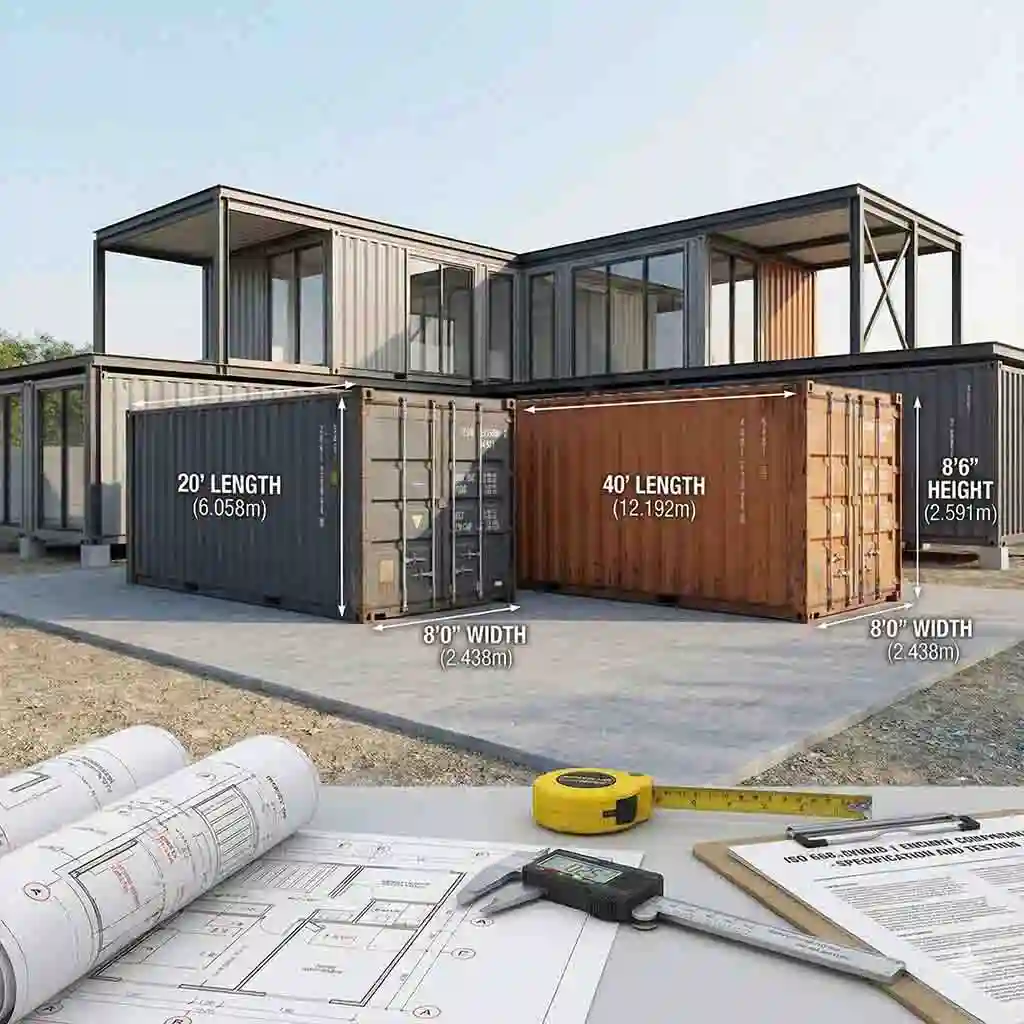
The ISO 668 standard establishes uniform dimensions for Series 1 freight containers, ensuring global compatibility and structural consistency. All Series 1 containers share a uniform width of 8 feet (2.438 meters), while lengths vary to accommodate different applications.
Standard 20-Foot Container Dimensions
The 20-foot container represents the most compact option for container home construction. External dimensions measure 19 feet 10.5 inches in length (6.058m), 8 feet in width (2.438m), and 8 feet 6 inches in height (2.591m) for standard units. High cube variants increase height to 9 feet 6 inches (2.896m), providing crucial additional headroom for residential applications.
Internal dimensions for standard 20-foot containers provide approximately 19 feet 4 inches of usable length (5.898m), 7 feet 8 inches of width (2.352m), and 7 feet 10 inches of height (2.393m). The difference between external and internal measurements accounts for corrugated steel wall thickness and structural framing components. This translates to roughly 160 square feet of floor area per container.
Standard 40-Foot Container Dimensions
Forty-foot containers offer significantly more living space and remain the most popular choice for container home projects. External dimensions measure precisely 40 feet in length (12.192m), maintaining the same 8-foot width (2.438m) and 8-foot 6-inch standard height (2.591m) as their 20-foot counterparts.
Internal clearances for standard 40-foot containers provide 39 feet 5 inches of length (12.031m), 7 feet 8 inches of width (2.352m), and 7 feet 10 inches of height (2.393m). High cube 40-foot containers increase internal height to approximately 8 feet 10 inches (2.698m), offering 320 square feet of floor area with improved ceiling clearance that better accommodates standard residential construction practices.
| Container Type | External Length | External Width | External Height | Internal Length | Internal Width | Internal Height |
|---|---|---|---|---|---|---|
| 20′ Standard | 19’10.5″ (6.058m) | 8’0″ (2.438m) | 8’6″ (2.591m) | 19’4″ (5.898m) | 7’8″ (2.352m) | 7’10” (2.393m) |
| 20′ High Cube | 19’10.5″ (6.058m) | 8’0″ (2.438m) | 9’6″ (2.896m) | 19’4″ (5.898m) | 7’7″ (2.311m) | 8’10” (2.698m) |
| 40′ Standard | 40’0″ (12.192m) | 8’0″ (2.438m) | 8’6″ (2.591m) | 39’5″ (12.031m) | 7’8″ (2.352m) | 7’10” (2.393m) |
| 40′ High Cube | 40’0″ (12.192m) | 8’0″ (2.438m) | 9’6″ (2.896m) | 39’6″ (12.040m) | 7’7″ (2.311m) | 8’10” (2.698m) |
Dimensional Tolerances and Manufacturing Standards
ISO 668 defines strict dimensional tolerances to ensure containers function properly in global transportation systems. The International Code Council recognizes these standards as they relate to building construction using shipping containers. For 20-foot containers, maximum permitted dimensional tolerance is +0/-0.25 inches, while 40-foot containers allow +0/-0.375 inches variation.
These tight tolerances matter significantly for container home construction. When stacking containers vertically or joining them horizontally, even quarter-inch variations can create alignment challenges that complicate structural connections, weatherproofing, and finish work. Understanding these tolerances helps builders plan appropriate connection details and allows Professional Engineers to specify correct fastening systems.
IRC Building Code Requirements for Container Home Dimensions
While ISO 668 establishes container dimensions, the 2021 International Residential Code establishes minimum dimensional requirements for habitable spaces. Successfully integrating shipping containers into code-compliant residential construction requires understanding how these two standards intersect.
Minimum Room Dimensions and Ceiling Heights
The IRC establishes clear dimensional requirements that directly impact container home design. These requirements ensure spaces are safe, functional, and suitable for their intended residential purpose.
📖 Click to Read Full IRC Section R304
IRC Section R304.1 – Minimum area:
Habitable rooms shall have a floor area of not less than 70 square feet (6.5 m2).
Exception: Kitchens.
IRC Section R304.2 – Minimum dimensions:
Habitable rooms shall be not less than 7 feet (2134 mm) in any horizontal dimension.
Exception: Kitchens.
Source: 2021 International Residential Code
Standard 20-foot and 40-foot containers easily meet the 70-square-foot minimum area requirement and the 7-foot minimum horizontal dimension requirement. The internal width of approximately 7 feet 8 inches (2.352m) provides adequate clearance, though builders must account for insulation thickness and interior finish materials that reduce these dimensions.
Ceiling Height Requirements
Ceiling height represents the most critical dimensional challenge in container home construction. The IRC establishes minimum heights that directly conflict with standard container dimensions.
📖 View IRC Section R305 Ceiling Height Requirements
IRC Section R305.1 – Minimum height:
Habitable space, hallways and portions of basements containing these spaces shall have a ceiling height of not less than 7 feet (2134 mm). Bathrooms, toilet rooms and laundry rooms shall have a ceiling height of not less than 6 feet 8 inches (2032 mm).
Exceptions:
1. For rooms with sloped ceilings, the required floor area of the room shall have a ceiling height of not less than 5 feet (1524 mm) and not less than 50 percent of the required floor area shall have a ceiling height of not less than 7 feet (2134 mm).
2. The ceiling height above bathroom and toilet room fixtures shall be such that the fixture is capable of being used for its intended purpose. A shower or tub equipped with a showerhead shall have a ceiling height of not less than 6 feet 8 inches (2032 mm) above an area of not less than 30 inches (762 mm) by 30 inches (762 mm) at the showerhead.
Source: 2021 International Residential Code
Standard 8-foot 6-inch containers provide approximately 7 feet 10 inches of internal height—just barely meeting the 7-foot minimum for habitable spaces after accounting for flooring systems. High cube containers with 8 feet 10 inches of internal height offer significantly better ceiling clearance and represent the preferred choice for most residential applications.
| Space Type | IRC Minimum Height | Standard Container (Internal) | High Cube Container (Internal) | Code Compliance |
|---|---|---|---|---|
| Habitable Rooms | 7’0″ (2134 mm) | ~7’10” (2393 mm) | ~8’10” (2698 mm) | Both compliant* |
| Bathrooms | 6’8″ (2032 mm) | ~7’10” (2393 mm) | ~8’10” (2698 mm) | Both compliant* |
| Shower Area | 6’8″ (2032 mm) | ~7’10” (2393 mm) | ~8’10” (2698 mm) | Both compliant* |
*Assumes minimal floor buildup. Actual compliance depends on flooring system thickness, insulation, and ceiling finish details as verified by your Professional Engineer.
Width Considerations for Interior Layout
The 7-foot 8-inch internal width of shipping containers creates unique planning challenges. After accounting for 2-3 inches of interior insulation on each wall, usable interior width reduces to approximately 7 feet 2 inches to 7 feet 4 inches. This dimension impacts corridor widths, furniture placement, and door swing clearances.
While the IRC does not specify minimum corridor widths for one- and two-family dwellings, practical considerations suggest maintaining at least 36 inches of clear passage width. In container homes, this often necessitates careful furniture planning or strategic container joining to create wider spaces where needed.
Professional Engineer’s Role in Verifying Container Home Dimensions
A licensed Professional Engineer performs critical verification work that ensures your container home dimensions meet both ISO 668 specifications and local building code requirements. This professional review bridges the gap between standardized container manufacturing and jurisdiction-specific construction regulations.
What Your Professional Engineer Reviews
Your PE conducts comprehensive dimensional analysis that goes far beyond simply confirming container measurements. They verify that proposed modifications maintain structural integrity, calculate load paths through modified container frames, and confirm that all habitable spaces meet dimensional requirements after insulation, flooring, and finish systems are installed.
The engineer examines how cutting openings for windows and doors affects the container’s structural properties. Shipping containers derive their strength from the corrugated steel walls and corner posts working as an integrated system. When you remove sections of wall to create openings, the PE calculates required reinforcement and specifies exact dimensions for headers, trimming, and structural framing that compensates for removed material.
Site-Specific Dimensional Adjustments
Professional Engineers adapt standard container home dimensions to your specific building site conditions. They calculate foundation dimensions based on local frost depth requirements, determine appropriate floor elevation to meet flood zone regulations, and specify roof overhang dimensions that provide adequate weather protection for your climate zone.
After purchasing comprehensive plans from PermitContainerhomes.com, you’ll work with a licensed PE who will review the detailed documentation, adapt it for your site conditions, and provide stamped drawings required for permit submission. This collaborative process ensures your container home dimensions work correctly for your specific location and conditions.
Tolerance Stack-Up Analysis
Engineers perform tolerance stack-up analysis to account for cumulative dimensional variations throughout the structure. When stacking two containers vertically, manufacturing tolerances, foundation settlement, and connection compression can accumulate to create misalignment issues. Your PE calculates these potential variations and specifies connection details that accommodate expected dimensional changes.
Multi-Container Configuration Planning
Professional Engineers calculate precise connection dimensions when joining multiple containers. Whether placing containers side-by-side, end-to-end, or in stacked configurations, exact alignment ensures weathertight connections and proper load transfer. The PE specifies bolt patterns, weld locations, and structural steel dimensions for all connection points.
For configurations that remove container walls to create open floor plans, engineers design replacement structural systems that maintain required load capacity. They calculate beam sizes, column spacing, and connection dimensions that replace the removed container structure while maintaining code-compliant ceiling heights and room dimensions.
Step-by-Step Guide to Planning Container Home Dimensions
Successful container home construction begins with methodical dimensional planning that accounts for every layer of your building assembly. This systematic approach prevents costly errors and ensures code compliance from foundation to roofline.
Step 1: Verify Your Container Dimensions
Begin by physically measuring your specific containers before finalizing construction documents. Use a quality tape measure to verify external length, width, and height at multiple points along each container. Check for warping, damage, or modifications that might affect dimensions. Document any variations from ISO 668 standard dimensions and share this information with your design team and Professional Engineer.
Measure internal dimensions carefully, paying particular attention to ceiling height. Examine the condition of flooring, as worn or damaged floors may require removal and replacement, affecting your final interior height calculations. Photograph dimensional irregularities and structural concerns for your PE’s review.
Step 2: Calculate Interior Dimensions After Build-Up
Work backwards from your container’s internal dimensions, subtracting thickness for each building layer. Start with the ceiling, where you’ll typically need 2-4 inches for insulation, vapor barriers, and interior finish materials. Wall assemblies consume 4-6 inches of width (2-3 inches per side) for insulation and finishes. Floor systems range from 2-6 inches depending on insulation requirements and whether you’re installing in-floor heating.
For additional guidance on residential building requirements and energy-efficient construction practices that affect dimensional planning, the U.S. Department of Energy provides resources on meeting energy code standards for container home projects. These standards influence insulation thickness requirements that directly impact your usable interior dimensions.
| Building Layer | Typical Thickness | Purpose | Dimensional Impact |
|---|---|---|---|
| Floor Insulation | 2-4 inches | Thermal barrier, R-13 to R-19 | Reduces ceiling height |
| Subfloor/Finish Floor | 1-2 inches | Level surface, structural support | Reduces ceiling height |
| Wall Insulation (each side) | 2-3 inches | Thermal barrier, R-13 to R-19 | Reduces width by 4-6 inches total |
| Wall Finish (each side) | 0.5-0.75 inches | Interior finish surface | Included in wall assembly |
| Ceiling Insulation | 3-6 inches | Thermal barrier, R-19 to R-30 | Reduces ceiling height |
| Ceiling Finish | 0.5-0.75 inches | Interior finish surface | Reduces ceiling height |
Note: Actual dimensions vary based on climate zone requirements, chosen materials, and local building code provisions. These are general estimates for planning purposes.
Step 3: Plan Window and Door Openings
Determine exact locations and dimensions for all window and door openings before cutting any container steel. The IRC establishes minimum requirements for emergency escape and rescue openings that affect window sizing and placement in sleeping rooms.
📖 View IRC Section R310 Emergency Escape Requirements
IRC Section R310.2.1 – Minimum opening area:
Emergency escape and rescue openings shall have a minimum net clear opening of 5.7 square feet (0.530 m²). The minimum net clear opening height dimension shall be 24 inches (610 mm). The minimum net clear opening width dimension shall be 20 inches (508 mm). The net clear opening dimensions shall be the result of normal operation of the opening.
Exception: Grade floor or below-grade openings shall have a minimum net clear opening of 5 square feet (0.465 m²).
Source: 2021 International Residential Code
Standard container corrugation patterns occur at regular intervals. Planning window and door openings to align with corrugation valleys simplifies cutting and reduces required reinforcement. Your PE will specify header dimensions and reinforcement details based on opening sizes and their location within the container structure.
Step 4: Design Multi-Container Connections
If your project involves multiple containers, create detailed connection drawings showing exact alignment dimensions, bolt hole locations, and structural steel specifications. Allow for weather-stripping and sealant thickness in your dimension calculations—typically 0.25 to 0.5 inches per connection joint.
When removing container walls to create open floor plans between joined containers, dimension your structural replacement beams carefully. The beam must span the full width while maintaining required ceiling height clearances and providing proper bearing at each end. Your PE calculates beam size based on span and load, then you verify adequate headroom remains after installation.
Step 5: Coordinate with Mechanical Systems
HVAC ductwork, plumbing lines, and electrical conduit all consume dimensional space within your container home. Mini-split systems minimize duct dimensions but still require planning for refrigerant line routing. Plumbing vents must extend through the roof, requiring precise vertical clearance calculations. Recessed lighting fixtures need adequate ceiling cavity depth.
Work with your mechanical contractors to establish exact dimensions for equipment, chases, and penetrations before finalizing wall and ceiling assemblies. This coordination prevents situations where mechanical systems conflict with structural elements or reduce ceiling heights below code minimums.
Cost Breakdown & Common Dimension-Related Challenges
Understanding the financial implications of container home dimensions helps builders budget accurately and avoid costly surprises during construction. Dimensional decisions made during planning directly impact material costs, labor expenses, and overall project feasibility.
Container Selection Costs Based on Size
Container dimensions directly correlate with purchase price and transportation costs. Twenty-foot containers typically cost $2,000-$4,000 for used units in good condition, while 40-foot containers range from $3,500-$6,000. High cube variants command premium pricing—typically $500-$1,000 more than standard height containers—but their improved dimensional characteristics often justify the additional investment.
Transportation costs scale with container size and distance. Local delivery of a 20-foot container might cost $200-$500, while 40-foot containers require specialized equipment and typically cost $400-$800 for similar distances. Sites with dimensional access constraints may require crane service, adding $500-$2,000 per container depending on complexity.
| Project Phase | Dimensional Consideration | Typical Cost Range | Notes |
|---|---|---|---|
| Container Purchase | 20′ vs 40′ selection | $2,000-$6,000 per unit | High cube adds $500-$1,000 |
| Delivery/Placement | Access clearances, crane needs | $200-$2,000 per container | Varies by site accessibility |
| Professional Plans | Complete dimensional drawings | Varies by project size | Available at permitcontainerhomes.com/shop/ |
| PE Review & Stamping | Dimensional verification, calculations | $2,000-$5,000 | Required for permit approval |
| Structural Modifications | Window/door openings, reinforcement | $500-$3,000 per opening | Includes labor and materials |
| Insulation System | Thickness affects interior dimensions | $2-$4 per square foot | Spray foam typically $3-$4/sq ft |
| Interior Finish | Drywall, flooring, ceiling materials | $8-$15 per square foot | Reduces final usable dimensions |
Note: Costs vary significantly by location, project complexity, material choices, and local market conditions. These are general estimates for planning purposes. Always obtain multiple quotes from licensed contractors and consult your PE for project-specific requirements.
Common Dimensional Challenges and Solutions
Builders frequently encounter specific dimensional obstacles during container home construction. Understanding these challenges in advance allows for proactive planning that saves time and money.
Challenge 1: Ceiling Height After Insulation. Standard containers provide minimal ceiling height margin after accounting for insulation and finish materials. Solution: Specify high cube containers for all habitable spaces, design thin-profile insulation systems using rigid foam boards, or explore spray foam that maximizes R-value per inch of thickness.
Challenge 2: Door Frame Fitting. Standard interior door frames measure 6 feet 8 inches tall plus jamb and threshold, consuming significant vertical space. Solution: Use pre-hung door units designed for exact ceiling heights, or specify custom door frames that maximize available height while maintaining code-compliant clearances.
Challenge 3: Narrow Width Constraints. The 7-foot 8-inch internal width becomes problematic when divided by interior walls. Solution: Remove one container sidewall when joining containers side-by-side to create wider spaces, or design open floor plans that minimize interior partitions and maximize the sense of spaciousness.
Challenge 4: Multi-Container Alignment. Even small dimensional variations between containers create alignment issues in stacked or joined configurations. Solution: Use adjustable connection systems with slotted bolt holes, install shim plates to accommodate height differences, and specify flexible sealant systems that accommodate minor dimensional variations.
Value Engineering Dimensional Decisions
Strategic dimensional choices during planning optimize your budget without compromising quality or code compliance. Selecting standard container sizes reduces custom modification costs. Planning window and door locations to avoid critical structural areas minimizes reinforcement requirements. Designing with whole-container modules eliminates complex cutting and joining operations.
Working with standard building material dimensions also reduces waste and labor costs. Designing interior wall spacing to align with 4-foot or 8-foot drywall sheets, planning floor joist spacing for standard plywood dimensions, and coordinating window locations with available standard sizes all contribute to project economy.
Expert Tips & Key Takeaways for Container Home Builders
Building a container home requires careful attention to dimensional precision at every stage, from initial container selection through final inspections. These essential insights help DIY builders and professional contractors achieve successful outcomes that meet both ISO 668 specifications and building code requirements.
Essential Points Summary
- Verify Before You Buy: Always measure actual container dimensions before purchase and document any variations from ISO 668 standards. Used containers may have damage or modifications that affect dimensions and structural integrity. Request photos of all sides, measure diagonals to check for square, and inspect for rust or corrosion that might compromise structural sections.
- High Cube Containers Provide Critical Flexibility: The additional 12 inches of height in high cube containers justifies the modest price premium for virtually all residential applications. This extra dimension provides comfortable ceiling heights after insulation and finishes, accommodates mechanical systems without sacrificing headroom, and creates living spaces that feel open rather than cramped.
- Account for Every Layer in Your Calculations: Professional builders work backwards from finished interior dimensions, carefully subtracting thickness for flooring (2-6 inches), wall insulation and finish (4-6 inches total width reduction), and ceiling assembly (3-6 inches). Missing even one layer in calculations can result in spaces that violate IRC minimum dimensions after construction.
- Professional Engineer Review Is Non-Negotiable: Your PE verifies that all dimensional modifications maintain structural integrity, calculates required reinforcement for openings based on exact sizes and locations, confirms code compliance for finished interior dimensions, and provides the stamped drawings required for permit approval. PE costs of $2,000-$5,000 represent essential investment in project success, not optional expense.
- Dimensional Precision Protects Your Investment: Container homes succeed when builders respect both ISO 668 manufacturing standards and IRC building code requirements. With comprehensive planning documentation from PermitContainerhomes.com, Professional Engineer support, and meticulous attention to dimensional details, you can confidently build a container home that meets all code requirements and provides comfortable, functional living space.
The intersection of ISO 668 container standards and IRC building codes creates specific dimensional constraints that require careful planning and professional engineering support. Understanding these requirements from project inception through final inspection ensures your container home meets all regulatory requirements while providing the functional, comfortable living spaces you envision.
Ready to Start Your Container Home Project?
Explore our collection of comprehensive container home plans designed to align with 2021 IRC and IBC building code standards. Each plan includes complete architectural drawings with precise ISO 668 container dimensions, structural details with exact measurements, electrical layouts, plumbing systems, and beautiful 3D visualizations—everything your Professional Engineer needs for efficient review and dimensional verification.
Browse Complete Plan Collection →Need Plan Modification? If you find a plan you love but need to adjust it for your local climate or personal needs—such as modifying container dimensions, relocating windows or doors, or adapting for site-specific requirements—our team can help. We offer a professional plan modification service after purchase. Simply contact us with your modification needs, and we’ll provide a personalized quote.
⚖️ Professional Engineering & Plan Documentation Disclaimer
Important: Our plans are permit-ready but require review and stamping by a local licensed Professional Engineer (PE) in your jurisdiction. Final approval is subject to local building codes and regulations. We recommend consulting your local building department to verify all requirements.
Refund Policy: Due to the digital nature of our plans, all sales are final. Please review our Refund Policy for details.