Shipping Container Sizes for Homes: The Ultimate 20ft vs 40ft Guide
Navigating permits, engineering, and codes for different container footprints
Selecting the correct shipping container sizes for homes is the single most important decision you will make during the planning phase of your project. While many future builders focus solely on the visual difference between a compact 20-foot studio and a spacious 40-foot dwelling, the dimensions you choose will dictate your entire permit strategy, foundation engineering requirements, and compliance with the International Residential Code (IRC).
When evaluating standard shipping container sizes for homes, you aren’t just comparing square footage; you are comparing two completely different regulatory pathways. A 20-foot unit might qualify as an Accessory Dwelling Unit (ADU) with simplified setbacks, while a 40-foot unit often requires full primary dwelling permits. Furthermore, “going small” does not always mean avoiding red tape—habitable space codes apply regardless of the footprint.
In this ultimate guide, we will break down the technical specifications, cost implications, and code challenges associated with the most common shipping container sizes for homes. We will help you align your plot’s zoning constraints with the right ISO dimensions to ensure a smooth build.
Understanding Standard Shipping Container Sizes for Homes
To plan a compliant build, you must first understand the strict ISO definitions that govern shipping container sizes for homes. These steel modules are built for international freight, not human habitation, which means their dimensions are fixed and unyielding. The two primary options available to residential builders are the 20-foot and 40-foot units.
20-Foot Containers: The Compact Option
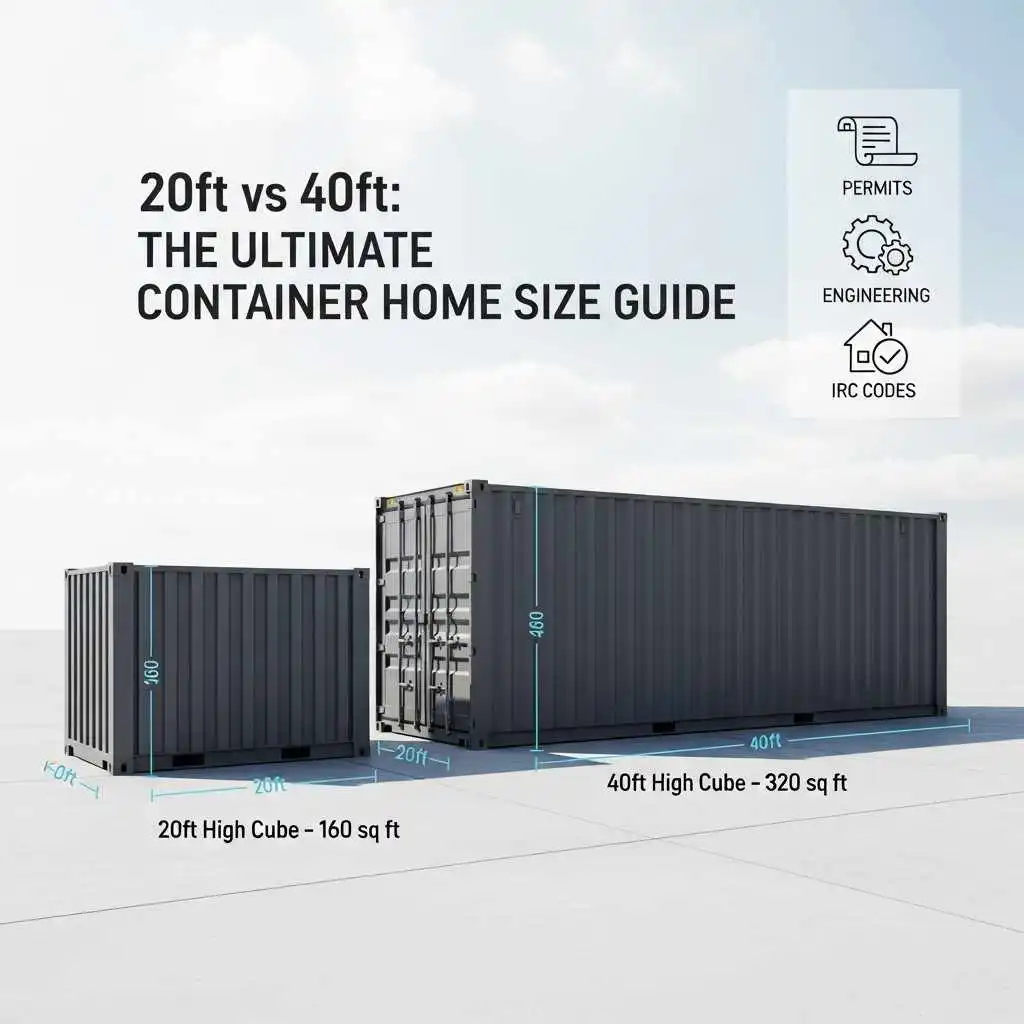
Among the available shipping container sizes for homes, the 20-foot High Cube is the most versatile for small urban lots. It offers approximately 160 square feet of floor area. While small, it is perfect for guest houses or backyard offices. However, the limited length makes it challenging to partition separate rooms while maintaining the minimum dimensions required by the International Code Council (ICC).
40-Foot Containers: The Primary Dwelling Standard
The 40-foot High Cube is the gold standard when discussing shipping container sizes for homes intended for full-time living. With 320 square feet of space, it allows for a linear floor plan with distinct zones for sleeping, living, and hygiene. This size is significantly easier to permit as a standalone residence because it meets the minimum “dwelling unit” definitions found in the IRC without requiring complex variances.
📖 View IRC Definition of Dwelling Unit
IRC Section R202 – Definitions:
DWELLING UNIT. A single unit providing complete independent living facilities for one or more persons, including permanent provisions for living, sleeping, eating, cooking and sanitation.
Source: 2021 International Residential Code
Permit Implications of Different Shipping Container Sizes for Homes
Your choice between these shipping container sizes for homes often determines which permit application you will file. Many builders mistakenly believe that smaller containers are exempt from permits. This is a myth. While tool sheds under 200 square feet are often exempt, any structure used for habitation—regardless of size—requires a permit.
The 20ft Permit Pathway (ADU vs. Shed)
When utilizing smaller shipping container sizes for homes like the 20-footer, you are often filing for an Accessory Dwelling Unit (ADU) permit. This can be advantageous because many jurisdictions have relaxed setbacks for ADUs compared to primary dwellings. However, you must prove to the building department that the structure meets all safety codes, just like a larger house.
The IRC Section R105.2 clarifies that exemptions strictly apply to “accessory structures” like tool sheds, not homes. If you plumb it, you permit it.
📖 View IRC Section R105.2 Exempt Work
IRC Section R105.2 – Work exempt from permit:
Permits shall not be required for the following… 1. Other than storm shelters, one-story detached accessory structures, provided that the floor area does not exceed 200 square feet (18.58 m2).
Source: 2021 International Residential Code
The 40ft Permit Pathway (Primary Residence)
Larger shipping container sizes for homes like the 40-foot unit almost always fall under primary dwelling codes. This means they must meet standard setbacks (often 20 feet from the rear property line) and minimum square footage requirements for local zoning. While the permit process is more rigorous, a 40-foot unit is less likely to be scrutinized as a “temporary structure” compared to its smaller counterpart.
| Feature | 20ft Container Home | 40ft Container Home |
|---|---|---|
| Typical Use | ADU / Home Office | Primary Residence |
| Permit Difficulty | Moderate (Zoning ease) | Standard (Full review) |
| Exemption Status | None (if habitable) | None |
IRC Habitable Room Codes & Dimensions
When evaluating different shipping container sizes for homes, you are strictly bound by the “7-foot rule.” A standard ISO container interior is roughly 7’8″ wide. After framing and insulating to meet energy codes, you often lose 4-5 inches per wall, leaving a net width of just under 7 feet. This creates a critical compliance issue regardless of the container length you choose.
The 70-Square-Foot Rule Impact
The IRC mandates that every dwelling unit must have at least one habitable room not less than 120 square feet. Additionally, other habitable rooms (like bedrooms) must be at least 70 square feet. In the context of shipping container sizes for homes, a 20-foot unit (160 sq ft total) leaves almost no margin for error. Meeting these distinct zoning requirements while fitting a bathroom and kitchenette into a 20-foot footprint often forces an open studio layout.
Conversely, larger shipping container sizes for homes, such as the 40-foot unit, allow you to easily frame a compliant 100+ square foot bedroom and a 150+ square foot living area. This additional length provides the geometric flexibility needed to satisfy code officials without requiring complex variances.
📖 View IRC Section R304.1 Minimum Area
IRC Section R304.1 – Minimum area:
Habitable rooms shall have a floor area of not less than 70 square feet (6.5 m2). Exception: Kitchens.
IRC Section R304.2 – Minimum dimensions:
Habitable rooms shall be not less than 7 feet (2134 mm) in any horizontal dimension. Exception: Kitchens.
Source: 2021 International Residential Code
Engineering Differences: 20ft vs 40ft
The structural modifications required for different shipping container sizes for homes vary significantly in complexity and cost. While both 20ft and 40ft units transfer loads through their corner castings, removing sidewalls for windows or doors compromises their integrity differently. A 40-foot container has a much longer span, making it more susceptible to sagging if large sections of the corrugated steel wall are removed without proper reinforcement.
For additional guidance on maintaining thermal envelope integrity while reinforcing these structures, the U.S. Department of Energy provides resources on energy-efficient home design, which is critical when adding steel lintels that can act as thermal bridges.
The PE Review Process by Size
After purchasing comprehensive plans from PermitContainerhomes.com, you will work with a licensed Professional Engineer (PE). Generally, smaller shipping container sizes for homes are faster to engineer. A 20ft unit with standard window cuts typically requires less complex calculation than a 40ft unit featuring large sliding glass doors or joined modules.
| Cost Factor | 20ft Container Build | 40ft Container Build |
|---|---|---|
| Plan Complexity | Lower Tier | Mid/High Tier |
| PE Review Fee | $2,000 – $3,500 | $3,000 – $5,000 |
| Foundation | ~4 Piers (Min) | ~6-8 Piers |
| Steel Headers | Minimal | Moderate/Heavy |
Note: PE costs vary by jurisdiction and project complexity. Foundation costs depend heavily on soil conditions and frost depth requirements.
Ceiling Height: The High Cube Requirement
When comparing shipping container sizes for homes, height is as important as length. Standard containers (8’6″ tall) rarely meet code after conversion. Once you frame the floor for plumbing and the ceiling for insulation, you often lose 10-12 inches of height. The IRC requires a minimum of 7 feet for habitable spaces. This makes “High Cube” models (9’6″ tall) practically mandatory for residential use.
📖 View IRC Section R305.1 Ceiling Height
IRC Section R305.1 – Minimum height:
Habitable space, hallways and portions of basements containing these spaces shall have a ceiling height of not less than 7 feet (2134 mm). Bathrooms, toilet rooms and laundry rooms shall have a ceiling height of not less than 6 feet 8 inches (2032 mm).
Source: 2021 International Residential Code
Cost Breakdown & Logistics: The Hidden Factors
While the purchase price of a used 40-foot unit is often only 30-40% higher than a 20-foot unit, the logistical costs associated with different shipping container sizes for homes can scale disproportionately. The primary challenge is not just the cost of the steel box, but the complexity of maneuvering it onto your foundation.
Delivery & Site Access Challenges
A 20-foot container can often be delivered by a standard tilt-bed tow truck or a smaller flatbed that requires minimal turning radius. This makes smaller shipping container sizes for homes accessible for winding mountain roads or tight urban driveways. Conversely, a 40-foot container requires a semi-truck and a 40-foot trailer, often needing up to 100 feet of straight-line clearance to unload. If your site has a sharp switchback or narrow gate, you may be forced to hire a crane to lift the unit from the road, which can instantly add $3,000+ to your budget.
Foundation Anchorage Requirements
Regardless of the shipping container sizes for homes you choose, your structure must be securely anchored to the foundation to resist wind and seismic loads. A 40-foot container presents a massive surface area to the wind (over 340 square feet on the long side). In high-wind zones, the uplift forces can be significant. The IRC requires specific anchorage for cold-formed steel framing, and while containers are unique, the principle of securing them to the concrete remains the same.
Your Professional Engineer will specify the connection detail—often a steel plate embedded in the concrete pier welded to the container’s corner casting. This ensures the home doesn’t slide or tip during a storm.
📖 View IRC Section R403.1.6 Foundation Anchorage
IRC Section R403.1.6 – Foundation anchorage:
Wood sill plates and wood walls supported directly on continuous foundations shall be anchored to the foundation in accordance with this section. … Cold-formed steel framing shall be anchored directly to the foundation… anchored to the foundation with minimum 1/2-inch-diameter (12.7 mm) anchor bolts spaced not greater than 6 feet (1829 mm) on center…
Source: 2021 International Residential Code
Expert Tips & Key Takeaways
Choosing between standard shipping container sizes for homes is more than just a preference for space; it is a strategic decision that impacts your permit pathway, budget, and construction timeline. Here are the essential points to guide your final decision.
Essential Points Summary
- 20ft Units are for Constraints: These smaller shipping container sizes for homes are ideal for ADUs and urban infill but are harder to permit as primary dwellings due to habitable room area codes (IRC R304).
- 40ft Units are for Living: The 40-foot unit is the standard for primary residences. It is easier to frame compliant bedrooms and living areas but requires significantly more maneuvering room for delivery.
- High Cube is Mandatory: regardless of the shipping container sizes for homes you research, always choose 9’6″ High Cube containers to ensure you meet the 7-foot ceiling height requirement (IRC R305).
- Permits are Required for Both: Do not fall for the “under 200 sq ft” exemption myth if you are building a dwelling with plumbing and sleeping quarters.
- Engineering Scales with Complexity: 20ft units generally require simpler engineering, while 40ft units (especially those with large cutouts) require more robust steel reinforcement.
With comprehensive planning documentation, Professional Engineer support, and a clear understanding of your site’s limitations, you can successfully navigate the complexities of container construction. Whether you choose the compact efficiency of a 20-footer or the spacious potential of a 40-footer, the key is to start with a plan that respects both the building code and your budget.
Ready to Start Your Container Home Project?
Explore our collection of comprehensive container home plans designed to align with 2021 IRC and IBC building code standards. Each plan includes complete architectural drawings, structural details, electrical layouts, plumbing systems, and beautiful 3D visualizations—everything your Professional Engineer needs for efficient review.
Browse Complete Plan Collection →Need Plan Modification? If you find a plan you love but need to adjust it for your local climate or personal needs—such as moving a window or adding a door—our team can help. We offer a professional plan modification service after purchase. Simply contact us with your modification needs, and we’ll provide a personalized quote.
⚖️ Professional Engineering & Plan Documentation Disclaimer
Important: Our plans are permit-ready but require review and stamping by a local licensed Professional Engineer (PE) in your jurisdiction. Final approval is subject to local building codes and regulations. We recommend consulting your local building department to verify all requirements.
Refund Policy: Due to the digital nature of our plans, all sales are final. Please review our Refund Policy for details.