
Container Home Building Codes & Permits: The Complete Checklist
Master IRC/IBC Requirements and Navigate Your Permit Application with Confidence
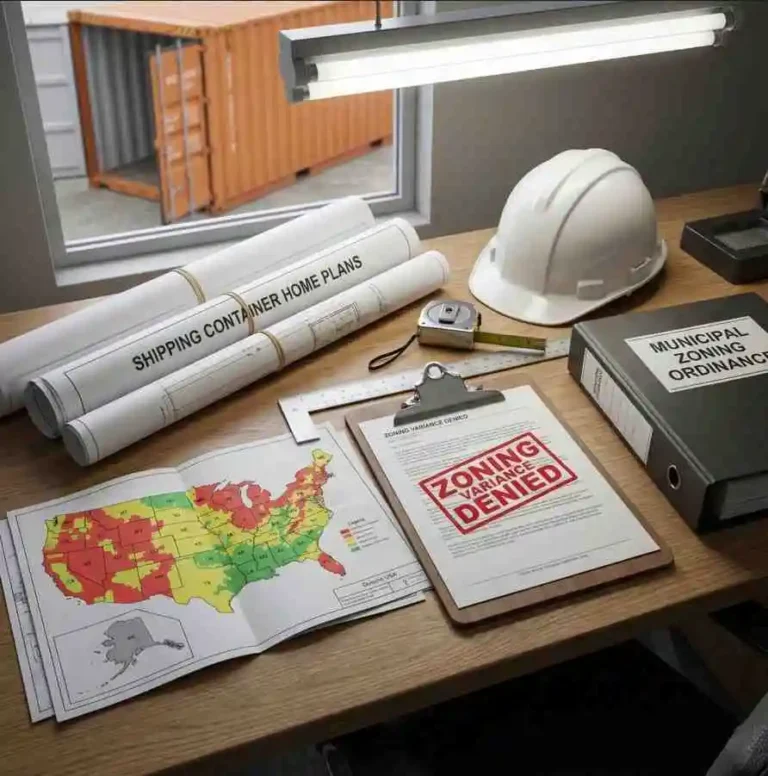
Understanding container home building codes and permits is essential before breaking ground on your shipping container dream home. The path from concept to certificate of occupancy requires navigating International Residential Code (IRC) and International Building Code (IBC) requirements that govern everything from structural integrity to electrical systems.
Most prospective container home builders underestimate the complexity of building code compliance. Unlike conventional stick-frame construction, shipping container homes present unique challenges that building departments scrutinize carefully—from load-bearing modifications to thermal envelope performance.
This comprehensive guide provides a complete checklist of container home building codes and permits requirements, breaking down each compliance step so you can approach your project with clarity. You’ll discover exactly which codes apply to your build, what documentation your building department requires, and how professional engineering review ensures your plans meet all regulatory standards.
Understanding Container Home Building Codes: The Foundation
Container home building codes and permits requirements exist to protect occupant safety and ensure structural integrity. The International Residential Code (IRC) governs one- and two-family dwellings including townhouses, while the International Building Code (IBC) applies to commercial and larger residential structures.
Why Standard Building Codes Apply to Container Homes
Building officials treat container homes identically to conventional construction—your structure must meet all applicable codes regardless of the building materials used. The International Code Council publishes the IRC, which establishes minimum requirements for residential structures including foundations, structural systems, fire safety, energy efficiency, and mechanical systems.
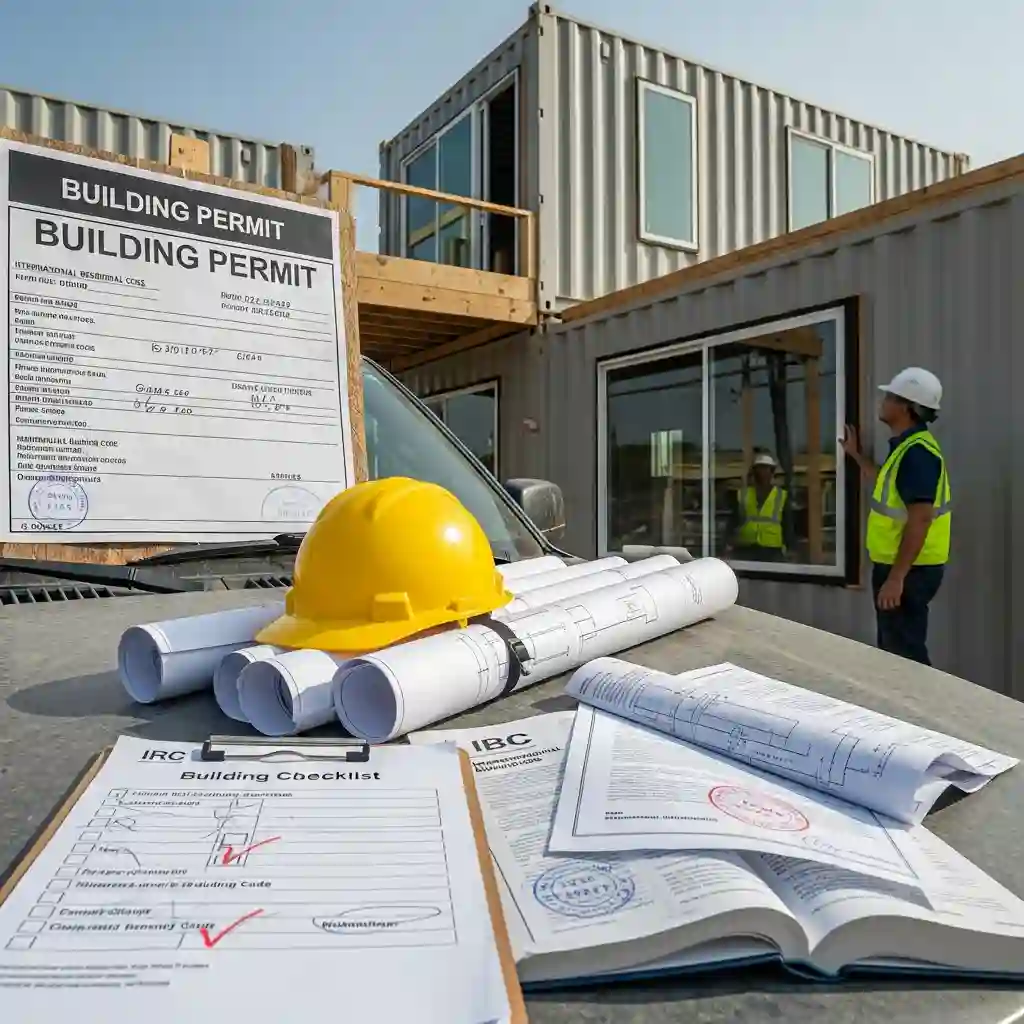
According to IRC Section R105.1, any owner who intends to construct, enlarge, alter, or change the occupancy of a building must first make application to the building official and obtain the required permit. This fundamental requirement applies without exception to shipping container homes.
📖 View Full IRC Section R105.1 Text
IRC Section R105.1 – Required:
Any owner or owner’s authorized agent who intends to construct, enlarge, alter, repair, move, demolish or change the occupancy of a building or structure, or to erect, install, enlarge, alter, repair, remove, convert or replace any electrical, gas, mechanical or plumbing system, the installation of which is regulated by this code, or to cause any such work to be performed, shall first make application to the building official and obtain the required permit.
Source: 2021 International Residential Code
The Three Code Categories That Govern Your Build
Container home building codes and permits fall into three primary regulatory categories. Building codes address structural integrity, fire resistance, and means of egress. Mechanical and plumbing codes govern HVAC systems, water supply, and drainage. Electrical codes ensure safe power distribution and lighting throughout your container home.
| Code Category | Primary IRC/IBC Reference | Container Home Application |
|---|---|---|
| Structural & Building Envelope | IRC Chapter 3, IBC Chapter 16 | Foundation design, container modifications, load calculations, wind/seismic resistance |
| Fire & Life Safety | IRC Chapter 3, IBC Chapters 7-10 | Fire-resistant assemblies, egress requirements, smoke detection |
| Mechanical, Plumbing & Electrical | IRC Chapters 11-15, 34-42 | HVAC sizing, insulation R-values, electrical service capacity, plumbing fixture requirements |
IRC and IBC Code Requirements for Container Structures
The International Residential Code establishes comprehensive requirements that directly impact container home design and construction. Section R301.2 specifies design criteria including wind loads, seismic considerations, snow loads, and climate zones that determine insulation and energy efficiency standards.
Foundational Requirements for Container Homes
IRC Section R403 mandates that foundations be designed and constructed to support all imposed loads. For container homes, this includes the dead load of the containers themselves plus live loads from occupancy, furniture, and environmental factors. The foundation system must prevent settlement, lateral movement, and frost heave in accordance with local soil conditions and frost depth requirements.
Building officials evaluate container home foundations using the same criteria applied to conventional construction. The International Code Council requires that all foundation designs account for soil bearing capacity, which typically ranges from 1,500 to 4,000 pounds per square foot (PSF) depending on soil type.
📖 View IRC Section R301.2 Design Criteria
IRC Section R301.2 – Design Criteria:
Buildings shall be constructed to safely support all loads, including dead loads, live loads, roof loads, flood loads, snow loads, wind loads and seismic loads as prescribed by this code. The construction of buildings shall result in a system that provides a complete load path that transfers all loads from their point of origin through the load-resisting elements to the foundation.
Source: 2021 International Residential Code
Structural Modification Requirements
When you cut openings in container walls for windows and doors, you compromise the container’s original structural integrity. IRC Chapter 6 requires engineered headers and proper load redistribution at all openings. A Professional Engineer must calculate the required header sizes and specify reinforcement methods that restore structural capacity.
The corrugated steel walls of shipping containers provide significant lateral strength through their geometry. However, removing sections for living space requires careful engineering analysis. Your PE will specify steel reinforcement—typically welded steel plates or structural tubing—around all openings to maintain the load path required by IRC R301.2.
| Container Modification Type | IRC Requirement | Typical Engineering Solution |
|---|---|---|
| Window/Door Openings | IRC R301.2 (Load Path) | Welded steel headers, doubled corner posts, reinforcement plates |
| Container Joining | IRC R602.3 (Connection) | Structural steel connections with engineer-specified fasteners |
| Roof Modifications | IRC R802 (Roof Framing) | Engineered roof framing system designed for local snow/wind loads |
| Floor System | IRC R502 (Floor Framing) | Insulated floor assembly meeting deflection limits (L/360) |
Energy Code Compliance
IRC Chapter 11 prescribes energy efficiency requirements that significantly impact container home design. Your thermal envelope—walls, roof, and floor—must achieve minimum R-values specified in IRC Table N1102.1.2 based on your climate zone. Steel’s high thermal conductivity creates thermal bridging challenges that require continuous insulation strategies.
The Professional Engineer’s Critical Role in Code Compliance
Professional Engineer (PE) review and stamping represents the most critical step in achieving container home building codes and permits approval. Building departments require PE-stamped structural drawings because container modifications fall outside the prescriptive provisions of IRC Chapter 6, necessitating engineered design in accordance with IRC Section R301.1.3.
Why Building Departments Require PE-Stamped Plans
IRC Section R301.1.3 states that alternative methods and materials may be used when approved by the building official. Since shipping container construction doesn’t follow conventional wood-frame prescriptive methods, it qualifies as an alternative construction method requiring engineering analysis. Your building official will not issue permits without verification from a licensed Professional Engineer that your design meets all applicable IRC/IBC requirements.
📖 View IRC Section R301.1.3 – Alternative Provisions
IRC Section R301.1.3 – Alternative Provisions:
As an alternative to the requirements in Section R301.1.1 the following standards are permitted subject to the limitations of this code and the approval of the building official:
Where there is insufficient evidence of compliance with the provisions of this code, or evidence that a material or method does not conform to the requirements of this code, or in order to substantiate claims for alternative materials or methods, the building official shall have the authority to require tests as evidence of compliance to be made at no expense to the jurisdiction.
Source: 2021 International Residential Code
The PE’s structural calculations address foundation design, load-bearing capacity after wall modifications, connection details between containers, and lateral force resistance. These calculations prove to the building department that your container home will safely support all imposed loads including occupancy, environmental loads, and the building’s own weight.
What Your PE Reviews and Stamps
Professional Engineers evaluate multiple aspects of container home design to ensure comprehensive code compliance. Structural integrity analysis verifies that modified containers maintain adequate load-bearing capacity. Foundation design calculations ensure proper soil bearing pressure and frost protection. Connection details specify welding requirements and fastener schedules for container joining. Load path verification confirms that forces transfer from roof through walls to foundation without failure.
| PE Review Component | IRC/IBC Reference | Deliverable Document |
|---|---|---|
| Structural Calculations | IBC Chapter 16, IRC R301 | Sealed calculation package showing all load analysis |
| Foundation Design | IRC Chapter 4, IBC Chapter 18 | Foundation plans with reinforcement details |
| Wind/Seismic Analysis | IRC R301.2, ASCE 7 | Lateral force calculations and anchorage specifications |
| Connection Details | IRC R602.3, AWS D1.1 | Welding specifications and structural connection drawings |
| Opening Reinforcement | IRC R301.2 | Header sizing and reinforcement plate specifications |
PE Costs and Timeline Expectations
Professional Engineer review typically costs between $2,000 and $5,000 for a residential container home project. The fee varies based on project complexity, number of containers, foundation type, and local seismic or wind requirements. PEs licensed in high-wind coastal areas or seismically active zones often charge higher fees due to additional analysis requirements.
The review process takes 2-4 weeks on average once you provide complete preliminary plans. Your PE needs comprehensive architectural drawings showing all container modifications, site-specific soil reports, local code amendments, and climate data for your building location. Starting with well-prepared plans from our IRC/IBC-aligned collection significantly streamlines this process and reduces PE revision cycles.
Finding the Right PE for Your Container Project
Not all Professional Engineers have container home experience. Look for structural engineers licensed in your state who specialize in alternative construction methods or steel structures. The National Society of Professional Engineers maintains a directory of licensed PEs searchable by specialty and location.
Request references from previous container home projects and ask about their familiarity with local building department requirements. An experienced PE knows which officials scrutinize container projects more carefully and can proactively address common objections in the structural documentation.
The Permit Application Process: Step-by-Step
Navigating container home building codes and permits requires methodical preparation and documentation. The permit application process follows a predictable sequence, though timeline and specific requirements vary by jurisdiction. Understanding each step helps you avoid common delays and rejections.
Step 1: Pre-Application Consultation
Schedule a pre-application meeting with your local building department before investing in detailed plans. Bring preliminary sketches showing container configuration, approximate dimensions, and property location. This consultation reveals jurisdiction-specific requirements, local code amendments, and any container home policies your building department has established.
Ask specific questions during this meeting about PE stamping requirements, soil testing procedures, utility connection approvals, and typical plan review timelines. Some jurisdictions have adopted additional requirements beyond base IRC provisions—understanding these upfront prevents costly plan revisions later.
- Does the jurisdiction require IBC instead of IRC due to square footage or zoning?
- What soil testing documentation is required for foundation design?
- Are there local amendments to standard IRC energy code requirements?
- What is the typical plan review timeline and fee structure?
- Does the jurisdiction require fire sprinklers (some do for all new construction)?
Step 2: Document Preparation
Complete permit applications require extensive documentation beyond architectural plans. Site plans show property boundaries, setbacks, easements, existing structures, and proposed container home placement. The site plan must include driveway access, utility connection points, grading and drainage patterns, and septic system location if applicable.
Your architectural plan set should include floor plans with dimensions and room labels, foundation plans showing footings and anchorage, electrical plans with service capacity and panel location, plumbing plans with fixture locations and drain routing, and mechanical plans showing HVAC equipment and ductwork. Review our cost calculator guide to budget for these professional plan development costs.
| Required Document | Key Information Required | Who Prepares |
|---|---|---|
| Architectural Plans | Floor plans, elevations, sections, door/window schedules | Architect or designer (start with our plans) |
| PE-Stamped Structural | Calculations, foundation design, connection details | Licensed Professional Engineer in your state |
| Site Plan | Property boundaries, setbacks, utilities, grading | Surveyor or civil engineer |
| Soil Report | Bearing capacity, frost depth, drainage characteristics | Geotechnical engineer |
| Energy Calculations | R-values, U-factors, air leakage, window performance | Energy consultant or PE |
| Utility Applications | Water service, sewer connection, electrical service | You (owner) to utility companies |
Step 3: Plan Review and Response to Comments
Building departments conduct comprehensive plan reviews that typically take 2-6 weeks depending on workload and project complexity. The plan examiner reviews your submittal against IRC Chapter 3 for building planning, Chapter 4 for foundations, Chapter 11 for energy efficiency, and all applicable mechanical, plumbing, and electrical chapters.
Expect corrections and requests for additional information—this occurs on virtually all container home applications. Common plan review comments include requests for additional structural details at container connections, clarification of insulation installation methods, revised energy calculations showing compliance, and specifications for welding procedures and inspector qualifications.
📋 View Common Plan Review Comment Examples
Typical Building Department Plan Review Comments:
- Structural: “Provide PE-stamped calculations showing header capacity at 8-foot door opening on south wall. Verify loads per IRC Table R502.3.1(1).”
- Energy: “Energy calculations do not account for thermal bridging through steel container walls. Provide revised calculations showing continuous insulation strategy and total U-factor.”
- Foundation: “Soil report indicates 2,500 PSF bearing capacity. Revise foundation to distribute container point loads across adequate footing area.”
- Fire Safety: “Specify fire-resistance rating of container wall assembly. Provide test data or engineering judgment per IRC R302.1.”
- Mechanical: “HVAC Manual J load calculation required. Container construction thermal mass differs from conventional construction—verify sizing accounts for steel envelope.”
Address plan review comments promptly and completely. Incomplete responses extend the review cycle and delay permit issuance. Have your PE available to revise structural documentation as needed—minor calculation updates are common during this phase.
Step 4: Permit Issuance and Fees
Once the building department approves your plans, you’ll pay permit fees calculated based on project valuation. Most jurisdictions use the ICC valuation tables that assign construction costs per square foot for different building types. Permit fees typically range from $1,500 to $5,000 for a single-family container home depending on size and jurisdiction.
You’ll receive approved plan sets stamped with the building department’s approval. Keep one set on site at all times during construction—inspectors will reference these approved plans during all inspections. Additional fees may apply for utility connections, impact fees, or special district assessments depending on your location.
Special Permits and Additional Approvals
Building permits aren’t the only approvals you may need. Septic system permits from county health departments apply if you’re not connecting to municipal sewer. Well permits govern new water well drilling. Electrical utility service applications must be approved before utility companies install transformers and meters. Access permits may be required if your driveway crosses drainage easements or impacts right-of-way.
Understanding zoning requirements before permit application prevents serious complications. Read our comprehensive guide on shipping container zoning laws to verify that container homes are permitted use in your zone. Some jurisdictions classify containers as manufactured housing requiring different approvals than site-built homes.
Inspections and Common Code Compliance Challenges
Container home building codes and permits compliance doesn’t end at permit issuance—the inspection process verifies that construction matches approved plans. IRC Section R109 requires inspections at specific construction stages to ensure code conformance before proceeding to subsequent work phases.
The Container Home Inspection Sequence
Building inspectors follow a standard progression that begins with foundation inspection before concrete placement. The inspector verifies that footing excavations reach required depth, reinforcing steel placement matches structural plans, and anchor bolt locations align with container corner positions. You cannot pour concrete until the foundation inspection passes.
Frame inspection occurs after containers are placed and structural modifications are complete but before insulation installation. The inspector examines welded connections between containers, reinforcement around window and door openings, roof framing attachments, and verification that all structural elements match PE-stamped drawings. This inspection is critical—any deviations from approved structural plans must be addressed immediately.
📖 View IRC Section R109.1.1 – Foundation Inspection
IRC Section R109.1.1 – Foundation Inspection:
Inspections associated with footings and foundations shall verify compliance with the code as to R-value, location, thickness, and depth of insulation; concrete mix design; grade beam and footing depth, size and location; compliance with flood plain requirements; and required placement of reinforcement and anchor bolts.
Source: 2021 International Residential Code
Specialized Inspections for Container Construction
Container homes often require special inspections beyond standard residential construction. AWS Certified Welding Inspectors verify that structural welds meet specifications in accordance with AWS D1.1 Structural Welding Code. Your jurisdiction may require these inspections for all load-bearing container connections, adding $500-$1,500 to inspection costs.
Insulation inspections verify proper installation of thermal barriers and vapor retarders. Since container homes use continuous insulation to address thermal bridging, inspectors pay special attention to insulation continuity, proper sealing at penetrations, and achievement of required R-values from IRC Table N1102.1.2. Photograph insulation installation before covering for documentation if inspectors cannot schedule promptly.
| Inspection Stage | IRC Reference | What Inspectors Examine |
|---|---|---|
| Foundation | IRC R109.1.1 | Footing depth, reinforcement, anchor bolt placement, bearing capacity verification |
| Frame/Structural | IRC R109.1.2 | Container connections, opening reinforcement, load-bearing modifications, PE compliance |
| Welding (Special) | AWS D1.1 | Weld quality, penetration, heat-affected zones, connection integrity |
| Plumbing Rough-In | IRC R109.1.3 | Drain slope, vent sizing, water supply routing, fixture placement |
| Mechanical Rough-In | IRC R109.1.4 | Ductwork sizing, equipment placement, combustion air, venting |
| Electrical Rough-In | IRC R109.1.5 | Wire sizing, circuit protection, grounding, service capacity |
| Energy/Insulation | IRC R109.1.6 | R-value achievement, air sealing, thermal bridging mitigation |
| Final | IRC R109.1.7 | Overall code compliance, occupancy safety, all systems operational |
Common Inspection Failures and How to Avoid Them
Container home inspections fail most frequently due to inadequate structural reinforcement documentation. Inspectors require visible evidence that welded connections match PE specifications—this means leaving structural elements exposed until after frame inspection. Covering welds before inspection results in automatic failure and costly demolition to verify compliance.
Energy code failures occur when insulation installation doesn’t achieve continuous thermal protection. Gaps at container junctions, uninsulated thermal bridges through steel framing, and inadequate air sealing cause inspection rejections. The inspector may require blower door testing per IRC Section N1102.4.1.2 to verify that air leakage doesn’t exceed 3-5 air changes per hour depending on climate zone.
- Structural modifications not matching approved plans: Any field changes require PE approval and amended permit before inspection
- Missing weld documentation: Keep welding procedure specifications and welder certifications on site for inspector review
- Inadequate container anchorage: Foundation-to-container connections must resist uplift from wind loads per IRC Table R301.2(2)
- Electrical grounding issues: Container steel structure requires careful grounding per NEC Article 250
Working Effectively with Building Inspectors
Building inspectors protect public safety—approach inspections as collaborative verification rather than adversarial examination. Schedule inspections 24-48 hours in advance as most jurisdictions require. Have approved plans on site with relevant pages marked for quick reference. Clean the work area before inspection so inspectors can easily examine structural elements and connections.
If an inspection fails, request specific corrections in writing. IRC Section R104.1 requires building officials to specify the code sections violated and the work necessary for compliance. Address failures completely before requesting re-inspection—repeated failures damage your relationship with the building department and may trigger increased scrutiny.
Expert Tips for Navigating Building Codes Successfully
Successfully navigating container home building codes and permits requires strategic planning that begins before you purchase containers. These expert strategies help you avoid common pitfalls and streamline the approval process based on lessons learned from hundreds of container home projects.
Start with Code-Informed Plans
The most significant mistake container home builders make is designing first and considering codes later. This backwards approach leads to expensive redesigns when building departments identify code violations. Starting with professionally developed plans aligned with IRC/IBC requirements provides the foundation for efficient permit approval.
Our comprehensive container home plans are specifically designed to align with 2021 IRC/IBC code provisions, incorporating proper load paths, energy-efficient assemblies, and structural details that PEs can readily review and stamp. This approach reduces PE revision cycles and demonstrates building department competence from your first submittal.
Understand Your Climate Zone Requirements
IRC Table N1102.1.2 prescribes different insulation R-values and building envelope requirements based on climate zones ranging from Zone 1 (hot) to Zone 8 (subarctic). Your climate zone determines minimum ceiling insulation, wall insulation, floor insulation, and window U-factors. Container homes in Zone 5 and higher face particularly challenging thermal performance requirements due to steel’s conductivity.
Climate zone also affects foundation frost depth requirements per IRC Table R403.1.1, which ranges from 0 inches in southern climates to 72 inches in northern regions. Verify your exact climate zone using the DOE climate zone map before finalizing foundation design.
| Climate Zone | Example Locations | Minimum Wall R-Value | Minimum Ceiling R-Value | Key Container Challenge |
|---|---|---|---|---|
| Zone 1-2 | South Florida, Hawaii | R-13 | R-30 | Moisture control, cooling efficiency |
| Zone 3-4 | Most of South, coastal California | R-20 or R-13+R-5 | R-38 or R-30+R-5 | Balanced heating/cooling, thermal bridging |
| Zone 5-6 | Northern states, mountain regions | R-20+R-5 | R-49 | Continuous insulation, frost protection |
| Zone 7-8 | Alaska, far northern regions | R-21+R-5 | R-49 | Extreme thermal bridging, ice damming prevention |
Document Everything
Maintain comprehensive project documentation from pre-application through final inspection. Create a project binder containing all permit applications, approved plans, PE calculations, soil reports, inspection records, and correspondence with the building department. This documentation proves invaluable when inspectors have questions or when you sell the property years later.
Photograph each construction phase with date stamps enabled. Document foundation excavation depth, reinforcing steel placement, container placement and leveling, all structural welds, insulation installation before covering, and rough-in plumbing and electrical. These photos provide evidence of compliance and help resolve any inspection disputes.
Budget for Code Compliance Costs
Container home building codes and permits compliance involves significant professional fees beyond basic construction costs. Budget $2,000-$5,000 for PE review and stamping, $1,500-$5,000 for building permits and plan review fees, $800-$2,000 for geotechnical soil testing, $500-$1,500 for special welding inspections, and $300-$800 for energy code compliance documentation.
Our detailed cost calculator helps you budget accurately for all permit-related expenses. Understanding total compliance costs upfront prevents budget surprises that delay or derail projects.
Consider Modular Construction Strategies
Some builders successfully navigate building codes by completing container modifications and much interior work off-site at facilities with controlled environments. This modular approach lets certified welders complete structural work under supervision before containers arrive at your property. However, verify that your jurisdiction accepts off-site construction—some require all structural work occur on the permitted site.
Modular strategies particularly help in remote areas where finding qualified welders and inspectors proves difficult. Completing welding at a certified fabrication facility generates documentation that satisfies building departments even when local welding inspectors are unavailable.
Build Relationships with Your Building Department
Building officials and inspectors respond positively to builders who demonstrate professionalism and code knowledge. Attend pre-application meetings prepared with questions, submit complete and organized permit applications, maintain clean job sites, and address inspection comments thoroughly. These practices build credibility that smooths the entire permit and inspection process.
If your jurisdiction has limited container home experience, offer to educate building officials about your project. Provide references to successful container home projects in similar jurisdictions, share industry best practices from organizations like the Shipping Container Home Builders Association, and demonstrate how your PE-stamped plans ensure safety equivalent to conventional construction.
📋 Complete Container Home Building Codes & Permits Checklist
Use this comprehensive checklist to track your progress from initial planning through final certificate of occupancy. Each phase builds on previous work—complete items sequentially for best results.
Phase 1: Pre-Planning & Research (Weeks 1-2)
- ☐ Verify property zoning allows container homes (see our zoning laws guide)
- ☐ Review state-specific container home regulations if applicable
- ☐ Determine which code applies: IRC for 1-2 family dwellings, IBC for larger structures
- ☐ Identify your climate zone using DOE climate zone map
- ☐ Research local building department container home experience and policies
- ☐ Schedule pre-application consultation with building department
- ☐ Budget for all code compliance costs using our cost calculator
Phase 2: Professional Team Assembly (Weeks 2-4)
- ☐ Acquire code-aligned preliminary plans from professional plan collection
- ☐ Find PE licensed in your state with steel/alternative construction experience
- ☐ Engage surveyor for site plan and boundary verification
- ☐ Hire geotechnical engineer for soil testing and bearing capacity report
- ☐ Identify certified welders with AWS certification if needed
- ☐ Contact utility companies about service requirements and applications
Phase 3: Design Development & Engineering (Weeks 4-10)
- ☐ Complete architectural plans: floor plans, elevations, sections, details
- ☐ Provide PE with site-specific data: soil report, wind speed, seismic category, snow loads
- ☐ Obtain PE-stamped structural calculations and drawings
- ☐ Verify foundation design meets IRC Chapter 4 requirements
- ☐ Confirm all container modifications include proper reinforcement details
- ☐ Develop energy compliance documentation per IRC Chapter 11
- ☐ Create mechanical plans showing HVAC sizing per Manual J calculations
- ☐ Prepare electrical plans with service capacity and panel schedules
- ☐ Detail plumbing plans with fixture locations and drain routing
Phase 4: Permit Application Submittal (Weeks 10-12)
- ☐ Assemble complete permit application package per building department requirements
- ☐ Include PE-stamped structural drawings and calculations
- ☐ Attach soil report from geotechnical engineer
- ☐ Submit site plan showing setbacks, easements, utilities
- ☐ Provide energy compliance documentation
- ☐ Include complete architectural plan set (minimum 3 copies typically required)
- ☐ Submit all required supplemental forms and fee calculations
- ☐ Obtain dated receipt proving application submission
Phase 5: Plan Review & Corrections (Weeks 12-18)
- ☐ Monitor plan review status with building department
- ☐ Respond promptly to requests for additional information
- ☐ Have PE address structural calculation questions
- ☐ Provide clarifications on energy code compliance if requested
- ☐ Submit revised drawings addressing all plan review comments
- ☐ Obtain final plan approval and stamped permit drawings
- ☐ Pay all permit fees and receive permit placard
- ☐ Post permit placard visibly at job site per IRC requirements
Phase 6: Construction & Inspections (Months 4-10)
- ☐ Schedule foundation inspection before concrete placement
- ☐ Pass foundation inspection (verify footing depth, reinforcement, anchor bolts)
- ☐ Complete foundation and allow proper curing time
- ☐ Place containers and complete structural modifications
- ☐ Schedule frame/structural inspection before covering work
- ☐ Pass frame inspection (verify welds, reinforcement, PE compliance)
- ☐ Complete plumbing rough-in and schedule inspection
- ☐ Complete mechanical rough-in and schedule inspection
- ☐ Complete electrical rough-in and schedule inspection
- ☐ Install insulation and schedule energy/insulation inspection
- ☐ Complete all interior finishes and exterior work
- ☐ Schedule final inspection
- ☐ Pass final inspection (overall code compliance verification)
- ☐ Obtain Certificate of Occupancy
Phase 7: Post-Occupancy (Ongoing)
- ☐ Maintain project documentation file with all permits and inspections
- ☐ Keep as-built drawings showing actual construction details
- ☐ Retain PE calculations and structural documentation
- ☐ Document all warranty information from contractors and suppliers
- ☐ File Certificate of Occupancy with property records
Want this checklist as a printable PDF? Contact our team at PermitContainerHomes.com to receive the complete downloadable version plus bonus code compliance resources.
Frequently Asked Questions About Container Home Building Codes & Permits
Do shipping container homes require the same permits as traditional houses?
Yes, container homes require identical building permits as conventional stick-frame construction. IRC Section R105.1 mandates permits for any new dwelling construction regardless of building materials. Building departments evaluate container homes against the same structural, electrical, plumbing, mechanical, and energy code requirements that apply to traditional homes.
Can I avoid permits if my container home is on wheels or considered temporary?
No, this represents a dangerous misconception. If your structure serves as a dwelling—regardless of wheels or intended duration—it requires permits and code compliance. Some jurisdictions allow small accessory structures under specific square footage without permits, but these exemptions rarely apply to habitable living spaces. Unpermitted construction jeopardizes insurance coverage, mortgage eligibility, and property resale value.
How much do Professional Engineer services cost for container home plans?
Professional Engineer review and stamping typically costs $2,000-$5,000 for residential container homes. Fees vary based on project complexity, number of containers, foundation requirements, and local environmental loads (wind, seismic, snow). High-wind coastal areas and seismically active zones require more extensive analysis, increasing PE costs. Budget toward the higher end for multi-container designs or unique architectural features.
What happens if I modify my container home differently than approved plans?
Any construction deviation from approved plans requires amended permits and potentially revised PE approval before proceeding. Building inspectors compare actual construction to approved drawings—deviations result in inspection failures. Significant structural changes require new engineering analysis and plan review. Minor field modifications may be acceptable with building official approval, but always verify before deviating from permitted plans.
Are container homes subject to different codes than conventional construction?
No, container homes follow the same IRC and IBC provisions as traditional construction. The difference lies in application—since containers don’t fit IRC prescriptive framing provisions, they require engineered design per IRC Section R301.1.3. All other requirements for foundations, energy efficiency, fire safety, egress, plumbing, electrical, and mechanical systems apply identically to container and conventional homes.
How long does the complete permit process take from application to approval?
Expect 6-12 weeks from complete application submittal to permit issuance for straightforward single-family container homes. Complex multi-container projects or jurisdictions with limited container experience may extend to 12-16 weeks. The timeline includes initial plan review (2-4 weeks), response to corrections (1-2 weeks), and re-review (2-3 weeks). Starting with comprehensive, code-aligned plans minimizes this timeline by reducing revision cycles.
Do I need special inspections beyond standard building inspections?
Many jurisdictions require AWS Certified Welding Inspector verification of structural welds in container homes. This special inspection ensures that welds meet AWS D1.1 Structural Welding Code specifications. Budget $500-$1,500 for welding inspections depending on project scope. Some building departments also require third-party special inspections for foundations in challenging soil conditions or high-seismic areas.
Building Your Container Home the Right Way
Navigating container home building codes and permits successfully requires understanding IRC/IBC requirements, engaging qualified professionals, and approaching the process methodically. While the regulatory path seems complex initially, breaking it into phases makes compliance achievable for any committed builder.
The investment in proper engineering, complete permit applications, and thorough inspections protects your family’s safety and your property’s value. Container homes built to code perform reliably for decades, qualify for conventional financing and insurance, and command strong resale value. Shortcuts that avoid permits create liability risks, financing obstacles, and potential legal consequences that far outweigh compliance costs.
Starting with professionally developed, code-aligned plans establishes the foundation for permit success. Our comprehensive container home plan collection provides IRC/IBC-informed designs that give PEs excellent starting points for structural review and demonstrate building department competence from first submittal.
Ready to Start Your Code-Compliant Container Home Project?
Explore our professionally designed container home plans aligned with current IRC/IBC standards. Each plan includes detailed architectural drawings, structural considerations for PE review, and comprehensive specifications that streamline your permit application.
All plans serve as excellent foundations for Professional Engineer review and are designed to align with 2021 IRC/IBC standards. PE review, stamping, and jurisdiction-specific modifications remain your responsibility. Building codes vary by location—always verify requirements with your local building department.