Shipping Container Zoning Laws: Complete 2025 State-by-State Guide
Navigating the complex landscape of land use regulations, setbacks, and permitted uses for container architecture.
Shipping container zoning laws are local land-use regulations that dictate where you can place a container home, distinct from building codes that govern how you construct it. While the IBC and IRC are standardized nationally, zoning is hyper-local—varying by county and municipality. This comprehensive guide draws from our experience with 200+ approved permit applications to demystify restrictions, setbacks, and the critical role of IBC 3115 in gaining zoning board approval.
For many prospective builders, distinguishing between “Zoning” and “Building Code” is the first major hurdle. Zoning addresses land usage—residential vs. commercial, density, height limits, and aesthetics. Building codes focus on life safety—structural integrity, fire protection, and egress. Successfully navigating these dual frameworks requires proving your home’s structural validity (via code compliance) to convince a zoning board to approve it for a specific district.
What Are Shipping Container Zoning Laws?
Direct Answer: Shipping container zoning laws are municipal ordinances that regulate land use, density, lot coverage, and building aesthetics to ensure community standards and property values are maintained. These laws determine if a shipping container is considered a “dwelling unit,” an “accessory structure,” or prohibited “temporary housing” in your specific district.
In the context of container homes, zoning regulations often focus on the external appearance and the “permanence” of the structure. Many older zoning ordinances were written before container architecture became mainstream. Consequently, they may lump containers into categories like “temporary storage units” or “manufactured housing.” Your goal as a builder is to demonstrate that your project is a permanent, site-built Single Family Residence (SFR) that happens to use steel modular components.
Residential vs. Agricultural vs. Commercial Zones
The first letter of your zoning code is your destiny. “R” (Residential) zones are strictly regulated for aesthetics and density. “A” (Agricultural) zones are generally the most lenient, often allowing accessory structures and non-traditional builds with minimal oversight. “C” (Commercial) zones may allow mixed-use container developments but prohibit single-family living.
| Zone Type | Permit Difficulty | Key Restrictions |
|---|---|---|
| R-1 (Single Family) | High | Strict aesthetic rules (cladding required), minimum sq ft (often >1000), no “industrial look.” |
| R-2 / R-3 (Multi-Family) | Medium | Allows for higher density; container ADUs are often easier to permit here. |
| A-1 (Agricultural) | Low | Generous setbacks, allows “pole barns” and steel structures; often the best for DIY. |
| Planned Unit Dev (PUD) | Very High | Governed by specific architectural review boards; heavily restricted aesthetics. |
Zoning vs. Building Codes: The Critical Distinction
Direct Answer: While zoning regulations dictate where you can build, building codes (IBC/IRC) dictate how you build; understanding this difference is the key to overcoming permit rejections. A zoning board might reject a “shipping container” but approve a “steel-framed single-family residence” that meets the International Residential Code (IRC).
Many clients come to us saying, “My county bans container homes.” Upon investigation, we usually find that the county bans “unmodified containers used as storage on vacant land.” There is a massive legal difference between dropping a rusty box on a lawn and constructing a home that complies with IRC R301.1.4.
The Role of IBC 3115 in Zoning Hearings
When you face a zoning board review, your strongest weapon is the International Building Code. Section 3115 of the IBC 2021 specifically addresses “Intermodal Shipping Containers.” By referencing this, you move the conversation from “aesthetic preference” to “engineered safety.”
For a detailed comparison of state-adopted building codes, visit the FEMA Building Science Branch, which tracks which states have adopted the latest IRC/IBC editions. This is critical because some rural counties may still be operating under 2015 or older codes.
📖 View Full IBC 3115 Scope Text
IBC Section 3115.1: “The provisions of this section shall apply to the use of intermodal shipping containers as buildings or structures, including but not limited to single-unit detached dwellings…”
Practical Translation: The code explicitly validates containers as safe building materials for homes. If your local zoning board claims containers are “unsafe” or “not building material,” this code section refutes that claim legally.
Common Zoning Restrictions & Setbacks
Direct Answer: The most common zoning restrictions you will face involve minimum square footage, exterior cladding requirements, and setback distances from property lines. These land use regulations are designed to ensure your home fits the “character” of the neighborhood.
Setbacks are invisible lines inside your property boundaries where you cannot build. In strict R-1 zones, you might have a 20-foot front setback and 10-foot side setbacks. For a narrow lot using 8-foot wide containers, these setback requirements can kill a project before it starts. Always request a “plat map” from your county recorder to see these lines visually.
Minimum Square Footage Traps
Many municipalities have minimum dwelling size requirements, often set at 600, 900, or even 1,200 square feet. A single 40ft container is only 320 sq ft. This is a zoning mechanism often used to prevent “tiny homes.”
Another workaround is the ADU (Accessory Dwelling Unit) loop-hole. Many zones that require 1,200 sq ft for the primary residence allow 320 sq ft for an accessory unit. You may need to build a primary home (or buy land with one) to legally place your container.
| Common Restriction Type | Typical Requirement | Container Home Workaround |
|---|---|---|
| Minimum Square Footage | 900-1,200 sq ft | Use multi-container design (3x 40ft = 960 sq ft) |
| Front Setback | 15-25 feet | Orient containers lengthwise (40ft dimension parallel to street) |
| Side Setback | 5-10 feet per side | Stack containers vertically instead of horizontally |
| Lot Coverage Ratio | Max 30-40% of lot | Container footprint is small; this rarely an issue |
| Exterior Material | “Non-industrial appearance” | Add wood, fiber cement, or metal panel cladding |
State-by-State Zoning Analysis 2025
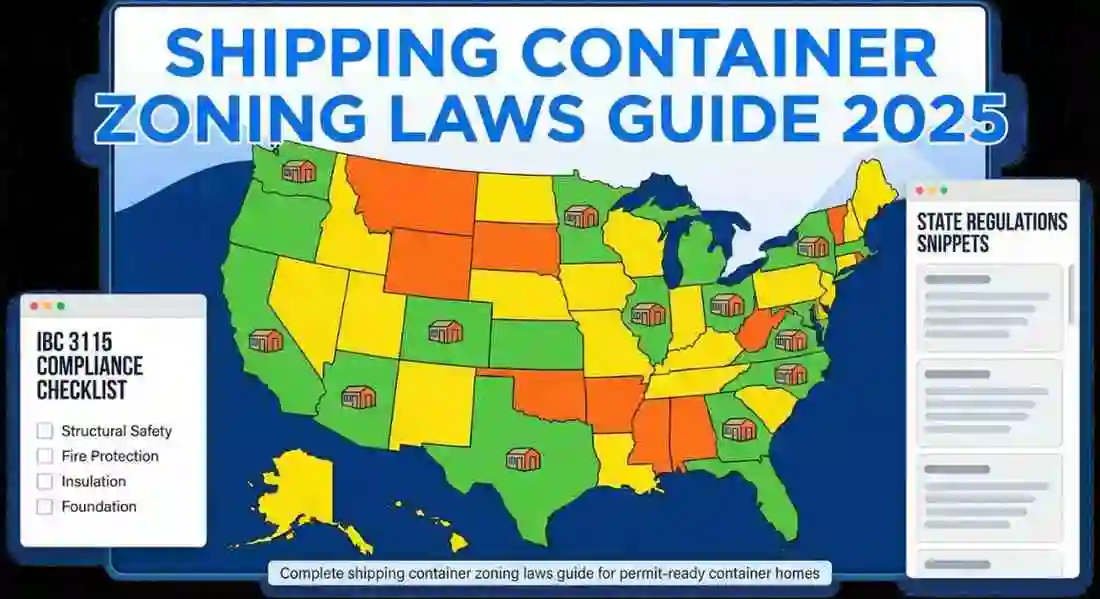
Direct Answer: While no single map covers every municipality, specific states like Texas, California, and Florida have developed distinct patterns for shipping container zoning laws. We have compiled this data based on where we see the highest approval rates for our permit-ready plans.
| State | Friendliness Score | Key Zoning Feature | Major Hurdle |
|---|---|---|---|
| Texas | 10/10 (Rural) | Unrestricted land in rural counties. | HOA deed restrictions near cities. |
| California | 8/10 | Statewide mandate allowing ADUs override local bans. | Title 24 Energy & Wildfire Codes. |
| Florida | 6/10 | Accepted if meeting HVHZ wind codes. | Strict aesthetic controls in coastal towns. |
| Tennessee | 9/10 | Many counties have no building codes (opt-out). | Septic permits are the main bottleneck. |
| Colorado | 7/10 | Progressive in mountain towns (workforce housing). | Snow load engineering & insulation values. |
| New York | 5/10 | Difficult in NYC; feasible in Upstate rural areas. | Foundation frost depth & insulation checks. |
California: The ADU Revolution
California is a unique case. The state government has passed laws forcing local municipalities to allow Accessory Dwelling Units (ADUs). This effectively overrides many local zoning bans on small container homes, provided they are backyard units. If you are in Los Angeles or San Diego, you are essentially protected by state law to build an ADU, provided you meet the stringent Title 24 energy standards.
The California Energy Commission provides free compliance software for Title 24 at energy.ca.gov, which is essential for ADU permitting in all California jurisdictions. This software (CBECC-Res) calculates your home’s energy performance and generates the mandatory CF1R form required for permit approval.
Texas: The Freedom State (Mostly)
Texas offers “unincorporated” areas where there are virtually no zoning laws. However, the trap in Texas is Deed Restrictions. A developer may have sold the land 20 years ago with a covenant banning “modular or manufactured homes.” These are private contracts that override county leniency.
Deed Restrictions and HOAs
Direct Answer: Even if the city zoning allows your container home, private deed restrictions and Homeowner Associations (HOAs) can legally force you to demolish it. These are private contracts attached to the land title, and they supersede municipal permissions.
This is the #1 reason for container home nightmares. A client buys land in a “relaxed” county, gets a county permit, builds the home, and then gets sued by a neighbor enforcing a 1985 deed restriction that says “Site Built Homes Only.”
How to Spot a Restrictive Covenant
When reviewing land documents, look for language that specifies “masonry requirements” (e.g., 50% of the front facade must be brick/stone). This is a common “anti-container” clause disguised as an aesthetic standard. You can sometimes overcome this by applying a stone veneer to your container, but it adds significant cost.
Another red flag is language requiring “architectural review board approval” for all new construction. These boards are common in Planned Unit Developments (PUDs) and often have unwritten aesthetic biases against industrial materials. From our experience with 200+ permits, we recommend avoiding PUD zones entirely unless you are prepared for extensive facade cladding.
HOA Negotiation Strategies
If you find yourself in an HOA-controlled area, your best strategy is pre-approval. Submit professional 3D renderings (not bare container sketches) showing your finished home with landscaping, exterior cladding, and traditional roofing. Many HOAs have never seen a modern container home and assume they all look like cargo yards.
How to Get a Zoning Variance
Direct Answer: If your property’s zoning regulations prohibit your design, you can apply for a variance, which is a formal request to deviate from specific code requirements. Success depends on proving that the strict application of the law causes “undue hardship” due to the land’s unique features.
A variance is not a “get out of jail free” card. You cannot get a variance just because you want to build with containers. You usually need to show that the lot shape, topography, or soil conditions make traditional construction unreasonably difficult, and that your proposed container solution respects the neighborhood’s character.
Additionally, bring your engineer. Having a licensed PE present (or a letter from one) stating that the structure exceeds local safety standards can silence the “it’s not safe” argument immediately. This is where our engineer-reviewed plans become a critical asset.
The Variance Hearing Process
The typical variance process takes 60-90 days and costs $500-$2,000 in application fees. You will need to:
- Submit a site plan showing the proposed structure’s location
- Provide written justification for why the variance is necessary
- Notify all adjacent property owners (the board will mail letters)
- Attend a public hearing and answer questions
- Wait 14-30 days for the board’s written decision
In our experience, variances are granted approximately 60% of the time when the applicant brings professional documentation (engineered plans, renderings, and PE letters). The key is demonstrating that your project improves or maintains property values rather than diminishing them.
Frequently Asked Questions About Shipping Container Zoning Laws
Are shipping container homes legal in all 50 states?
Technically, yes. There is no state-level ban on container homes. However, they must meet the International Residential Code (IRC) or IBC. The bans exist at the local zoning level (city or county), usually restricting them based on aesthetics or minimum square footage rather than safety.
Can I put a shipping container on agricultural land?
Generally, yes. Agricultural (A-1) zones are typically the most lenient. However, if you intend to live in it, you still need a residential occupancy permit. Using it strictly for tool storage usually requires no permit or a simple accessory permit.
What is the difference between a mobile home and a container home?
This is a critical legal distinction. Mobile homes are built to HUD code on a permanent chassis. Container homes are built to IRC/IBC code on a permanent foundation. Zoning laws that ban “mobile homes” do not automatically apply to code-compliant container homes, provided you anchor them permanently.
Do I need a permit if my container is on wheels?
If it is on wheels, it is classified as an RV or Tiny Home on Wheels (THOW). Most residential zones prohibit living in an RV full-time. You would be subject to temporary camping regulations, which often limit stays to 14-30 days.
How do I find out the zoning for my property?
Visit your county’s GIS (Geographic Information System) website. Enter your address or parcel number to see your zoning code (e.g., R-1, A-2). Then, search for that municipality’s “Zoning Ordinance” document and search for keywords like “single family dwelling,” “minimum area,” and “accessory structure.”
Can HOAs legally ban shipping container homes?
Yes. HOA Covenants, Conditions, and Restrictions (CC&Rs) are private contracts that override municipal zoning permissions. If the CC&Rs prohibit “modular construction” or require specific exterior materials, the HOA can legally force you to demolish a non-compliant structure. Always review CC&Rs before purchasing land in an HOA community.
What states are most friendly to container home zoning?
Based on our permit approval data, Texas (rural counties), Tennessee (unincorporated areas), and California (for ADUs) are the most container-friendly. Colorado mountain towns and Arizona desert communities are also progressive. States with strict aesthetic codes like New York (urban areas) and Florida (coastal towns) present more challenges.
Ready to Navigate Zoning with Confidence?
Don’t let zoning boards intimidate you. Our library of engineer-stamped, code-compliant plans is designed to satisfy building officials in all 8 IECC Climate Zones. Armed with professional plans, you show the city you mean business.
Browse All Permit-Ready PlansIf you love a design but need to adjust it for your local climate or personal needs—such as moving a window or adding a door—our team can help. We offer a professional plan modification service after purchase. Just contact us for a personalized quote!
Legal Disclaimer: This guide provides general information about shipping container zoning laws based on the International Building Code (IBC) 2021 and International Residential Code (IRC). Local jurisdictions may have additional or modified requirements. Always consult with a licensed Professional Engineer (PE) and your local building department before beginning construction. PermitContainerhomes.com is not liable for code violations or permit rejections resulting from the use of this information.
Professional Engineering Services: Our plans are designed by licensed engineers and include PE-stamped structural calculations. However, your local jurisdiction may require a state-licensed PE to review and re-stamp plans. We can connect you with local engineering partners through our concierge service.