The Ultimate Guide to 3 Bedroom Container Home Plans
An Engineer’s Deep Dive into Multi-Container Design, Permitting, and Family-Friendly Layouts
Opting for 3 bedroom container home plans signifies a major step up from a simple cabin or studio. This is the moment your project transitions from a “tiny home” concept to a full-fledged, permanent family residence. It’s an exciting, ambitious, and entirely achievable goal.
As a structural engineer, I’ve seen the incredible potential of these builds. I’ve also seen the critical pitfalls that can derail a project. A successful 3-bedroom container home is not just about placing three boxes on your land; it’s a sophisticated exercise in multi-container assembly, structural reinforcement, and intelligent, code-compliant design.
This guide is for the serious builder. We’re moving past the hype and into the engineering. We will cover how to structurally and legally combine multiple containers to create spacious, light-filled living areas, how to manage the complex permitting requirements, and how to create a home that is safe, comfortable, and built to last. Let’s walk through this together.
Why a 3-Bedroom Build? The Engineering & Lifestyle Case
A 3-bedroom home is the new standard for modern living, offering flexibility that a smaller build cannot. This design isn’t just for a growing family; it provides essential space for a home office, a guest room, a home gym, or a rental unit (ADU) where zoning allows.
From an engineering perspective, a multi-container home is a modular masterpiece. By combining 40-foot High-Cube (HC) containers, we can achieve 960 sq. ft. (3 containers) or 1,280 sq. ft. (4 containers) of gross space before adding any non-container additions. This scale allows us to design proper great rooms, private bedroom wings, and dedicated utility spaces.
The Core of the Build: Multi-Container Engineering
This is the single most important part of your project. You cannot create spacious 3 bedroom container home plans without cutting and joining containers. Doing this safely and legally requires a deep understanding of structural engineering.
1. The Building Blocks: Why 40ft High Cubes are Standard
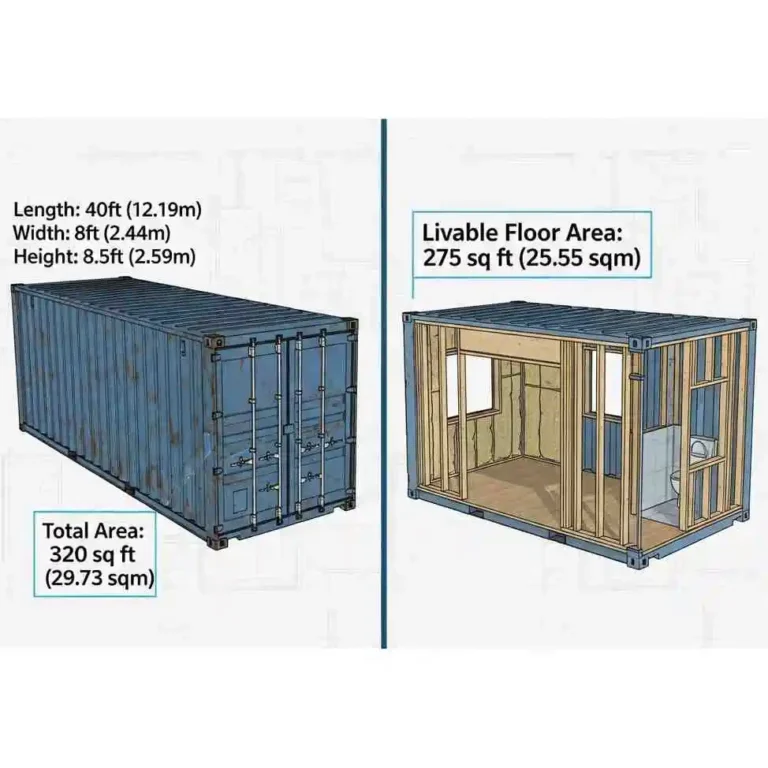
For a family home, the standard 20-foot or 40-foot container is often insufficient. The game-changer is the 40-foot High-Cube (HC) container. Its 9′ 6″ exterior height provides a finished interior ceiling height of ~8′ 6″ after insulation, comfortably clearing the 7-foot minimum ceiling height required by the International Residential Code (IRC) Section R305.
| Container Type | Exterior Dimensions (LxWxH) | Interior Height (Approx.) | Square Footage | Primary Use Case |
|---|---|---|---|---|
| 20′ Standard | 20′ x 8′ x 8′ 6″ | 7′ 10″ | 160 sq. ft. | Offices, ADUs, Add-on Rooms |
| 40′ Standard | 40′ x 8′ x 8′ 6″ | 7′ 10″ | 320 sq. ft. | Single-Story Homes (Low Ceilings) |
| 40′ High Cube (HC) | 40′ x 8′ x 9′ 6″ | 8′ 10″ | 320 sq. ft. | Recommended for all habitable spaces |
2. The “Great Room” Challenge: Structurally Removing Walls
A container’s strength is not in its roof or floor; it is in the two long corrugated walls and the corner posts. These C-channel walls act as a “stressed-skin” system, providing immense shear strength. The moment you cut a window, door, or—critically—an entire wall, you have compromised this system.
To create the open-plan living area essential to modern 3 bedroom container home plans, we must remove these walls and replace the structural capacity. This is non-negotiable and is detailed in every one of our plan sets.
- Headers: For doors and windows, we weld in C-channel or tubular steel (HSS) headers to transfer the load to the sides.
- Moment Frames: To remove an entire 40-foot wall, we weld in a complete steel “moment frame” (HSS columns and a heavy I-beam header). This frame restores the load-bearing capacity of the corner posts and prevents the container from “racking” or twisting.
- Floor & Roof Beams: When “mating” two containers, steel I-beams or channels are often bolted or welded between them to create a seamless, structurally-sound floor and roof line.
This level of steelwork is governed by the International Building Code (IBC) Chapter 22 (Steel) and is why our professional, permit-ready plans are so essential. You can learn more about these standards directly from the International Code Council (ICC).
Archetypes: 3 Common 3 Bedroom Container Home Plans
While customization is endless, most 3 bedroom container home plans fall into one of three design archetypes. The configuration you choose will be dictated by your lot size, budget, and aesthetic.
Archetype 1: The “Duplex” (Side-by-Side)
This is the most straightforward multi-container build. It typically involves two 40-foot High-Cube containers placed side-by-side. The two interior walls are completely removed and reinforced, creating a single, spacious 640 sq. ft. “great room.” The bedrooms and bathrooms are then framed out at either end.
A more common 3-bedroom variant uses three 40ft HC containers in parallel, yielding 960 sq. ft. The central container becomes a massive open-plan living and kitchen area, while the two outer containers house a master suite on one side and two bedrooms with a “Jack-and-Jill” bath on the other.
Archetype 2: The “Courtyard” (L-Shape or U-Shape)
This popular design uses three or four containers to create a private, sheltered outdoor living space. By arranging the containers in an L or U shape, you create a home that is intimately connected with the outdoors. This design is fantastic for passive solar and natural ventilation.
The engineering challenge here is “stitching” the corners where containers meet at a 90-degree angle. This requires careful cutting, welding, and weatherproofing to create a seamless interior flow.
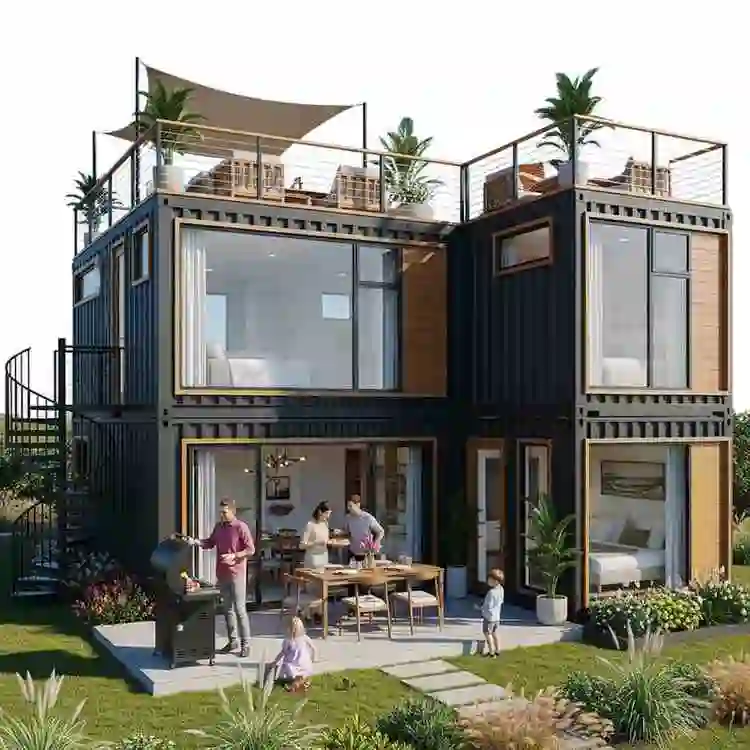
Archetype 3: The “Stack” (Two-Story)
This is the most iconic, but also most structurally complex, 3-bedroom design. Stacking containers leverages their incredible compressive strength—the corner posts can support thousands of pounds. This design is ideal for urban lots with a small footprint.
The primary challenges are the foundation, which must handle massive point loads, and the creation of interior stairwells, which requires cutting a large, reinforced opening in the floor/ceiling of the containers. We strongly recommend our comprehensive Container Home Building Guide before attempting a multi-story build.
The Permit Path: Navigating IRC & IBC for Multi-Container Builds
Here at PermitContainerhomes.com, this is our specialty. A 3-bedroom home is a “permanent dwelling” and will be scrutinized far more heavily than a simple shed. You must be prepared to speak the language of the building department.
Is Your Home IRC or IBC?
99% of single-family 3 bedroom container home plans will fall under the International Residential Code (IRC). This is your rulebook for everything from ceiling heights to staircase dimensions.
However, your project could trigger the International Building Code (IBC) if it is:
- Over 3 stories tall.
- Used for commercial purposes (like an office).
- Considered a multi-family dwelling (e.g., a duplex rental).
Key Code Sections Your Inspector Will Check
When you submit our plans, your inspector will be looking for compliance on a few key points. Here’s where our engineer-designed plans shine.
📖 Click to View Key IRC 2021 Code Requirements
R305.1 Minimum Height: Habitable space… shall have a ceiling height of not less than 7 feet (2134 mm). (This is why we mandate 40ft High-Cube containers.)
R310.1 Emergency Escape (Egress): Habitable attics, basements and every sleeping room shall have not less than one operable emergency escape and rescue opening.
R310.2.1 Minimum Opening Area: …shall have a net clear opening of not less than 5.7 square feet (0.53 m2).
R311.2 Egress Door: At least one egress door… shall be side-hinged… and shall provide a minimum clear width of 32 inches (813 mm)… and a minimum clear height of 78 inches (1981 mm).
Foundation Engineering for 3-Bedroom Homes
You cannot use simple deck blocks. A multi-container 3-bedroom home is a heavy, permanent structure that requires a foundation compliant with IRC Chapter R403. The foundation’s job is to transfer all the loads (live, dead, and environmental) safely into the ground.
Our Foundation Options Guide provides a full overview, but for 3 bedroom container home plans, we typically recommend one of these systems:
- Monolithic Slab-on-Grade: A single, poured concrete slab that acts as both the floor and the foundation. This is excellent for thermal mass and provides a perfectly level base for all your containers.
- Pier and Beam System: This is a very common choice. Concrete piers are poured deep into the ground (below the frost line) at all corner points and along the length of the containers. Steel I-beams then span these piers to create a “ladder” for the home to rest on.
- Full Basement / Crawlspace: The most expensive, but most flexible, option. Poured concrete walls create a full basement or crawlspace, allowing for easy routing of utilities (plumbing, HVAC) and offering additional storage or living space.
📖 Click for Foundational Code (IRC R403.1.1)
R403.1.1 Minimum size. Minimum size of concrete… footings shall be as set forth in Table R403.1… The footing width, W, shall be based on the load-bearing value of the soil in accordance with Table R401.4.1. Footing projections, P, shall be not less than 2 inches (51 mm) and shall be not more than the footing thickness, T.
(This text confirms that your foundation design MUST be based on your specific soil’s load-bearing capacity, which is why a local soil test is often required.)
Solving for Volume: MEP, HVAC & Insulation Strategy
Your 3 bedroom container home plans will likely encompass 960 to 1,280 square feet. This is a significant volume to heat, cool, and service. A single mini-split and a tankless water heater won’t be enough.
Insulation: The “Metal Tent” Problem
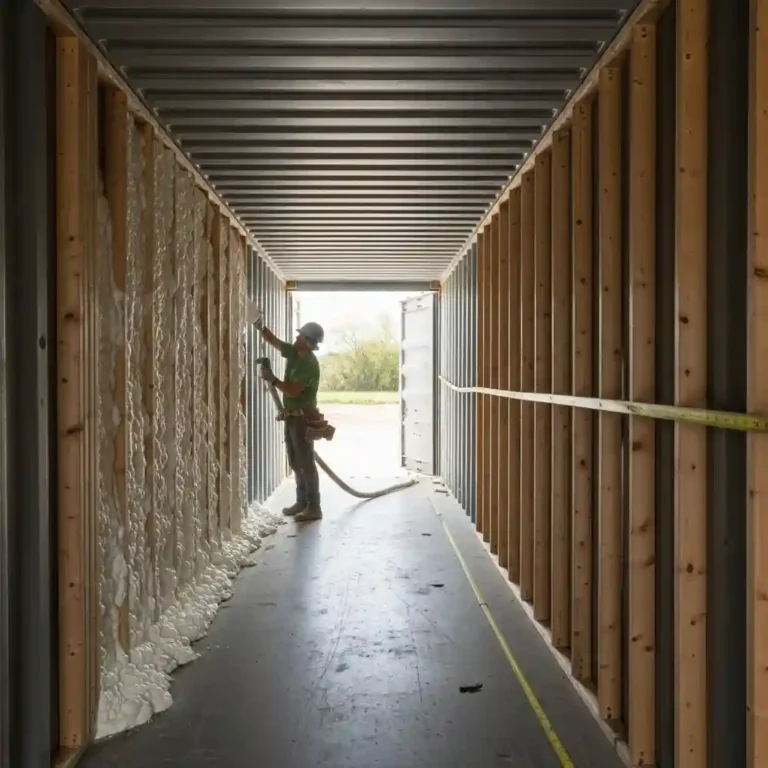
A steel box is a “metal tent”—it conducts heat and cold with extreme efficiency. Your #1 priority is creating a complete thermal break. The undisputed best choice is closed-cell spray foam insulation. We detail this in our Container Home Insulation Guide.
For a 3-bedroom home, you must meet the R-value requirements for your specific climate zone, as defined by the U.S. Department of Energy. Spray foam is the only way to achieve high R-values (R-21 to R-49) in the limited space of a container wall.
HVAC Strategy: Go Central or Go Zoned
With a larger home, you have two primary options:
- Multi-Zone Mini-Split: A single outdoor condenser can power 3-4 indoor “heads,” allowing you to create different temperature zones for the living area, master suite, and kids’ rooms.
- Central HVAC (Forced Air): A traditional furnace and A/C unit. This is more complex in a container home, as you must frame a “chase” or run ductwork through a crawlspace or attic (if you add a pitched roof). However, it provides the most even and powerful climate control.
Realistic Budgeting for a 3-Bedroom Container Home
This is the final, and most critical, hurdle. It is a persistent myth that container homes are “cheap.” A multi-container home is NOT a low-cost alternative to stick-built; it is a high-performance, high-durability alternative.
Use our Free Cost Estimator for a personalized budget. Below is a general breakdown of where your money will go.
| Cost Category | Estimated Cost Range (DIY-Heavy) | Estimated Cost Range (Pro/Turnkey) | Engineer’s Notes |
|---|---|---|---|
| Plans & Engineering | $2,000 – $5,000 | $2,000 – $5,000 | Includes our plans + a local PE stamp. Non-negotiable. |
| Containers (3x 40′ HC) | $12,000 – $21,000 | $12,000 – $21,000 | Cost for “one-trip” containers, delivered. |
| Foundation (Slab or Pier) | $10,000 – $25,000 | $20,000 – $40,000 | Highly variable based on soil and frost line. |
| Structural Reinforcement | $8,000 – $15,000 | $15,000 – $25,000 | Cost of steel beams, HSS, and welding labor. |
| Insulation (Closed-Cell) | $10,000 – $15,000 | $12,000 – $18,000 | Do not skip this. This is a professional job. |
| MEP (Plumbing, Electric) | $15,000 – $25,000 | $25,000 – $45,000 | Must be done by licensed professionals. |
| Interior Finishing | $20,000 – $40,000 | $50,000 – $100,000+ | Drywall, flooring, kitchen, baths. (IKEA vs. Custom) |
| Total Estimated Cost | $77,000 – $141,000 | $146,000 – $294,000+ | Excludes land, permits, and utility hook-up fees. |
Ready to Build Your 3-Bedroom Home?
Your journey to a durable, spacious, and code-compliant container home starts with a professional plan. Our 3 bedroom container home plans are designed by engineers to get you permitted faster.
Browse All 3-Bedroom PlansIf you love a design but need to adjust it for your local climate or personal needs—such as moving a window or adding a door—our team can help. We offer a professional plan modification service after purchase. Just contact us for a personalized quote!
Disclaimer: All information provided in this article is for educational and informational purposes only. The International Residential Code (IRC) and International Building Code (IBC) are complex documents and are updated regularly. Always consult with a qualified local architect, structural engineer, and your local building department to ensure your project complies with all current codes and regulations in your jurisdiction. Do not begin any construction without approved permits.