40 Foot High Cube vs Standard: Square Footage & Headroom Guide
Why the vertical dimension is the most critical factor in your container home build
When planning a container home, most builders obsess over the length and width, immediately calculating the 40 foot container square footage to see if their floor plan fits. However, focusing solely on the floor area is a common rookie mistake that can lead to significant permitting hurdles down the road. While the footprint of a standard and High Cube container is identical, the vertical volume—specifically the headroom—determines whether your home will easily meet building codes or struggle to pass inspection.
The difference between a comfortable, code-compliant home and a claustrophobic metal box often comes down to a single foot of vertical steel. Understanding the interplay between usable interior space, insulation thickness, and International Residential Code (IRC) ceiling height requirements is essential before you purchase your first box.
In this guide, we will analyze the true usable space of 40-foot containers, compare the critical dimensions of Standard vs. High Cube units, and explain why paying a premium for extra height is often the smartest investment you can make.
The Tale of the Tape: Dimensions Analyzed
To understand the 40 foot container square footage potential, we must first look at the raw exterior and interior dimensions. A standard ISO shipping container and a High Cube container share the exact same length and width, meaning their footprint on your land is identical.
Standard 40-Foot Container Dimensions
A standard container is the “economy” option in the shipping world, but it poses challenges for residential conversion. The exterior height is 8′ 6″, but the interior height is significantly less due to the corrugation and floor structure.
40-Foot High Cube (HC) Dimensions
The High Cube is the industry standard for container homes. The exterior height is 9′ 6″, providing that crucial extra foot of interior volume. This additional space allows for the installation of plumbing chases, ductwork, and thick ceiling insulation without compressing the living space below comfortable levels.
The International Code Council publishes the dimensions and standards that building codes rely upon. Understanding these raw numbers is the first step in checking feasibility.
| Dimension | Standard 40′ Container | High Cube 40′ Container |
|---|---|---|
| Exterior Length | 40′ 0″ | 40′ 0″ |
| Exterior Width | 8′ 0″ | 8′ 0″ |
| Exterior Height | 8′ 6″ | 9′ 6″ |
| Interior Height (Approx) | 7′ 10″ | 8′ 10″ |
| Gross Square Footage | ~320 sq. ft. | ~320 sq. ft. |
The Code Reality: Why Headroom Matters
While the raw 40 foot container square footage (320 sq. ft.) looks promising, the usable square footage is dictated by code-compliant ceiling heights. The International Residential Code (IRC) sets strict minimums for habitable spaces.
IRC Section R305: Ceiling Height
To permit a space as a “habitable room” (living room, bedroom, kitchen), it must meet specific vertical requirements. If your finished ceiling drops below this threshold due to insulation and framing, that square footage cannot legally be counted as habitable space.
According to the 2021 IRC, habitable rooms generally require a minimum ceiling height of 7 feet.
📖 Click to Read Full IRC Section R305.1
IRC Section R305.1 – Minimum Height:
Habitable space, hallways and portions of basements containing these spaces shall have a ceiling height of not less than 7 feet (2134 mm). Bathrooms, toilet rooms and laundry rooms shall have a ceiling height of not less than 6 feet 8 inches (2032 mm).
Source: 2021 International Residential Code
IBC Considerations for Commercial Uses
If you are building a commercial structure (like a rental office or pop-up shop) using the International Building Code (IBC), the requirements are even stricter. Occupiable spaces often require 7′ 6″ ceilings, making standard containers almost impossible to use without heavy modification.
📖 Click to Read Full IBC Section 1208.2
IBC Section 1208.2 – Minimum Ceiling Heights:
Occupiable spaces, habitable spaces and corridors shall have a ceiling height of not less than 7 feet 6 inches (2286 mm) above the finished floor. Bathrooms, toilet rooms, kitchens, storage rooms and laundry rooms shall have a ceiling height of not less than 7 feet (2134 mm) above the finished floor.
Source: 2021 International Building Code
The Insulation Factor & PE Review
When calculating your actual 40 foot container square footage, you must account for the “wall thickness penalty.” Unlike traditional stick framing where insulation sits inside the wall cavity, container insulation typically builds inward from the corrugated steel skin.
How Insulation Eats Square Footage
To meet energy codes in most climate zones, you will likely use closed-cell spray foam. A typical R-value requirement might demand 2 to 3 inches of foam on walls and ceiling. When you add framing (studs) and drywall, you lose approximately 4-6 inches of width from each wall.
This reduction doesn’t just affect floor area; it affects volume. In a standard container, adding 3 inches of ceiling insulation and 2 inches of flooring material reduces your 7′ 10″ interior height to roughly 7′ 5″—leaving very little room for error, lighting fixtures, or ceiling fans.
The Professional Engineer’s Role
Your Professional Engineer (PE) will perform calculations to ensure your container modification retains its structural integrity. They will assess the loads imposed by insulation, interior framing, and snow loads on the roof. A PE will often recommend High Cube containers because the extra depth in the floor and ceiling joists allows for sturdier reinforcement without violating minimum ceiling height codes.
After purchasing comprehensive plans from PermitContainerhomes.com, you’ll work with a licensed PE who will review the detailed documentation, adapt it for your site conditions, and provide stamped drawings required for permit submission. Their review ensures that your insulation strategy meets energy codes while maintaining structural safety.
Calculating Usable Square Footage
For additional guidance on residential building requirements and efficient design, the U.S. Department of Energy provides resources on meeting energy code standards for compact home projects. Efficient planning is key when every inch counts.
Gross vs. Net Square Footage
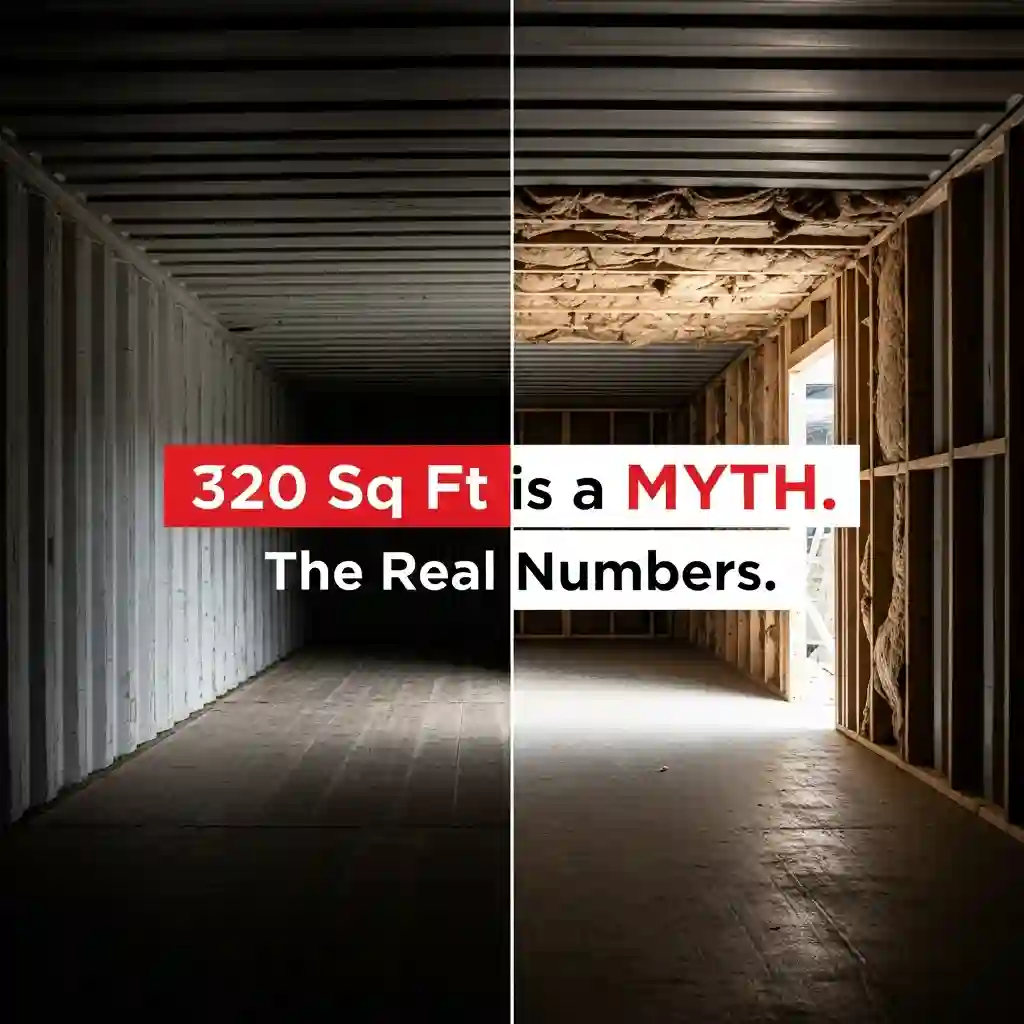
The gross 40 foot container square footage is simply the exterior dimensions: 40′ x 8′ = 320 sq. ft. However, permit applications and real estate listings care about habitable or net square footage.
Let’s calculate the loss for a typical build-out:
- Original Interior Width: ~7′ 8″
- Wall Build-out (Framing + Insulation + Drywall): ~4.5″ per side (9″ total loss)
- Net Interior Width: ~6′ 11″
- Net Interior Length: ~39′ 3″ (assuming insulation on ends)
Net Usable Area: ~272 sq. ft.
You lose nearly 50 square feet to insulation and framing! This makes the remaining space precious, and vertical volume becomes the primary way to make the home feel larger.
| Feature | Impact on Dimensions | Resulting Constraint |
|---|---|---|
| Closed Cell Foam (3″) | Reduces Height & Width | Standard container ceilings drop below 7′ 6″ |
| Framing (2×4 vs 2×2) | Reduces Width | Narrower hallways (critical for ADA) |
| Ductwork | Reduces Headroom | Must use High Cube or mini-splits |
| Flooring | Reduces Height | Adds 1″-2″ to floor buildup |
Note: These calculations are estimates. Actual insulation thickness depends on your Climate Zone requirements found in IRC Chapter 11.
Minimum Room Areas
The IRC also dictates minimum floor areas for rooms. While a container is small, you cannot simply slice it into tiny compartments. You must meet the 70 square foot minimum for habitable rooms.
📖 Click to Read Full IRC Section R304.1
IRC Section R304.1 – Minimum Area:
Habitable rooms shall have a floor area of not less than 70 square feet (6.5 m²). Exception: Kitchens.
IRC Section R304.2 – Minimum Dimensions:
Habitable rooms shall be not less than 7 feet (2134 mm) in any horizontal dimension. Exception: Kitchens.
Source: 2021 International Residential Code
Cost vs. Value: Is High Cube Worth It?
The primary hesitation builders have with High Cube containers is the upfront cost. On the used market, a High Cube unit may cost $300 to $1,000 more than a standard unit. When calculating the total project budget, it is vital to weigh this cost against the long-term value and construction ease.
The Hidden Costs of Standard Containers
Trying to save money on the initial container purchase often leads to higher costs during the build:
- Complex Framing: You may need to use steel stud framing or custom thin-wall solutions to save inches, which are often more expensive than standard 2×4 lumber.
- Insulation Upgrades: To achieve high R-values in thin walls, you may need expensive vacuum insulated panels or premium spray foam kits rather than standard batt insulation.
- Resale Value: Homes with 7-foot ceilings feel cramped and are harder to sell than those with airy 8-foot ceilings permitted by High Cube dimensions.
The High Cube Advantage
The 40 foot container square footage in a High Cube feels significantly larger because of the volume. This extra foot allows for:
- Raised Floors: Space to run plumbing drains under the subfloor rather than penetrating the steel floor (which can compromise structural integrity).
- Recessed Lighting: Ability to install can lights without breaking the thermal envelope.
- Standard Windows: Room for standard headers above windows and doors without pushing the ceiling down.
Expert Tips & Key Takeaways
Building a container home requires careful navigation of dimensions, building codes, and engineering realities. Here are the essential points to remember as you select your container type.
Essential Points Summary
- High Cube is King: For residential conversions, the 9′ 6″ exterior height of a High Cube is vastly superior to the 8′ 6″ standard height.
- Net vs. Gross: Always calculate your net interior square footage (~270 sq. ft.) rather than the gross exterior (~320 sq. ft.) to plan realistic room layouts.
- Watch the 7-Foot Rule: IRC R305 requires a minimum 7-foot ceiling. Standard containers make this very difficult to achieve once insulated.
- PE Review is Mandatory: Modifying containers affects their structural integrity. Plan for $2,000-$5,000 for PE review and stamps.
- Plan for Systems: High Cube containers allow you to run HVAC and plumbing in the ceiling/floor voids without intruding on living space.
With comprehensive planning documentation, Professional Engineer support, and the right choice of container, you’re well-positioned to successfully navigate the permitting process. Don’t let the lure of a cheaper standard container compromise the livability and legality of your future home.
Ready to Start Your Container Home Project?
Explore our collection of comprehensive container home plans designed to align with 2021 IRC and IBC building code standards. Each plan includes complete architectural drawings, structural details, electrical layouts, plumbing systems, and beautiful 3D visualizations—everything your Professional Engineer needs for efficient review.
Browse Complete Plan Collection →Need Plan Modification? If you find a plan you love but need to adjust it for your local climate or personal needs—such as moving a window or adding a door—our team can help. We offer a professional plan modification service after purchase. Simply contact us with your modification needs, and we’ll provide a personalized quote.
⚖️ Professional Engineering & Plan Documentation Disclaimer
Important: Our plans are permit-ready but require review and stamping by a local licensed Professional Engineer (PE) in your jurisdiction. Final approval is subject to local building codes and regulations. We recommend consulting your local building department to verify all requirements.
Refund Policy: Due to the digital nature of our plans, all sales are final. Please review our Refund Policy for details.